Support

Deir el-Bahari

About

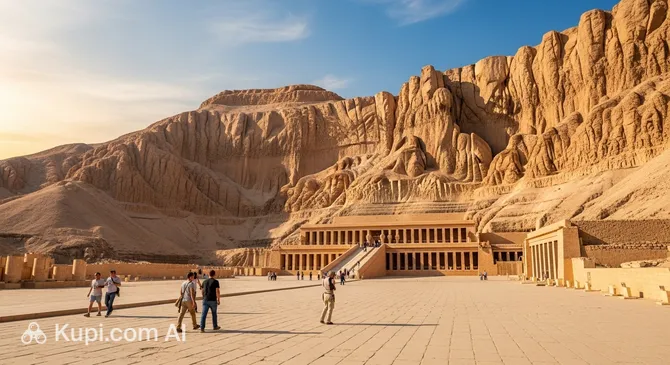
Imagine monumental temples that seem to grow directly out of the golden cliffs of the Theban Highlands. This is Deir el-Bahari—one of the world's most recognizable and majestic archaeological ensembles, located on the west bank of the Nile, opposite the city of Luxor. This complex in Egypt brings together mortuary temples from different eras, showcasing the incredible skill of ancient architects.
Deir el-Bahari
Deir el-Bahari. Иллюстрация. Источник: Kupi.com AI

The main treasure of this site is the Mortuary Temple of Hatshepsut. It is an engineering masterpiece of the 18th Dynasty, consisting of three grand terraces connected by massive ramps. Unlike traditional Egyptian temples, it looks surprisingly modern thanks to its clean lines and open colonnades, perfectly integrated into a natural limestone amphitheater.

In addition to Hatshepsut's temple, the complex includes the ruins of the earlier sanctuary of Pharaoh Mentuhotep II and the temple of Thutmose III. For every traveler, visiting this location is a true immersion into the era of Ancient Egypt's prosperity, where faith in the gods and the power of rulers were embodied in stone.

Contacts

To confirm the latest information before your trip to Deir el-Bahari, you can use the contact details provided below:

How to contactContact
AddressPJP5+W35 Egyptian Environmental Affairs Agency، Al Qarnah, Al Qarna, Luxor Governorate 1340420, Египет
Phone+20 11 47985137

What to Do

Your introduction to the complex begins with an ascent up the wide inclined ramps. As you climb from one terrace to another, you will appreciate the scale of the ancient builders' vision. Be sure to linger by the colonnades to examine the unique reliefs: they detail the legendary expedition to the Land of Punt, from which the Egyptians brought back exotic trees, gold, and incense. These images have retained amazing clarity over thousands of years.

Inside the complex, it is worth looking into the sanctuaries dedicated to the goddess Hathor and the god Anubis. Here, you can see statues of Hatshepsut herself depicted as a pharaoh and enjoy the view of the Nile Valley from the upper levels. Deir el-Bahari is a perfect place for photography; the "mountain amphitheater" effect creates a stunning backdrop that cannot be found anywhere else in the world.

For a deeper dive into history, it is recommended to use an audio guide or the services of a licensed tour guide. They will help decipher the symbolism of the hypostyle halls and talk about the nuances of the architectural innovations of Senenmut, the queen's chief architect, who managed to create harmony between man-made stone and wild nature.

Getting There

The Deir el-Bahari archaeological complex is located on the West Bank of the Nile, approximately 5–7 kilometers from the city center. To get here from the East Bank, where most hotels and the railway station are located, it is most convenient to take a taxi. The trip across the bridge takes about 15–20 minutes. Many travelers also prefer to cross the river by local ferry and then hire a driver on the West Bank.

If you prefer an organized trip, a group bus tour is the best option. Such tours usually include visits to several key sites of the Theban Necropolis at once. More active tourists can rent a bicycle at the West Bank pier, but keep in mind that the road goes uphill and the climate in this part of the country is very hot.

Ближайший город: Luxor

History & Facts

The history of Deir el-Bahari began back in the 11th Dynasty, when Pharaoh Mentuhotep II chose this secluded spot for his mortuary temple. He was the first to combine the cult of the ruler and the worship of gods in one building, creating an unusual structure with pyramidal elements. However, the true flourishing of this place is linked to the name of the great Queen Hatshepsut, who ruled during the 18th Dynasty.

Her temple, named "Djeser-Djeseru" ("Holy of Holies"), was built over 15 years under the direction of the prominent architect Senenmut. This architectural wonder was intended to emphasize the legitimacy of the female pharaoh's power and her divine origin. Later, next to Hatshepsut's sanctuary, her successor, Thutmose III, also built his temple.

Scientific study of the complex began in the 19th century under the guidance of famous Egyptologists such as Auguste Mariette and Édouard Naville. Since 1961, a Polish-Egyptian archaeological mission has been actively working here, carrying out colossal restoration and reconstruction work on the terraces and reliefs, returning the temple to its former glory.

Time Needed

To leisurely explore the main terraces, study the exquisite reliefs, and take high-quality photographs against the backdrop of the cliffs, allow at least 2–3 hours for your visit to Deir el-Bahari. This is enough time for a stroll through the complex and a brief introduction to its history.

If you plan to study each sanctuary in detail with a professional guide or an audio guide, the visit may take up to 4 hours. Keep in mind that the complex is outdoors, so it's best to plan your visit for the morning hours when the sun is not yet at its peak.

Working Hours

The Deir el-Bahari complex is open to visitors daily. Official working hours are from 06:00 AM to 05:00 PM. The early opening allows tourists to see the temples in the soft morning light and avoid the peak midday heat.

As the schedule may change depending on the season or restoration work, it is recommended to check the current schedule on the official website of the Egyptian Ministry of Tourism and Antiquities or with your tour operator before your trip.

06:00–17:00

Nearby

The West Bank of the Nile is a true treasure trove of ancient history. A visit to Deir el-Bahari is naturally combined with viewing other grand monuments located just a few minutes' drive away.

NameDistance
Mortuary Temple of Hatshepsut0.2 km
Valley of the Kings0.7 km
Tombs of the Nobles0.7 km
Valley of the Kings0.7 km
Ramesseum1.1 km
Deir el-Medina1.2 km
Luxor Hot Air Balloon Ride1.3 km

Reached the end of the page?

That means the route is fully explored