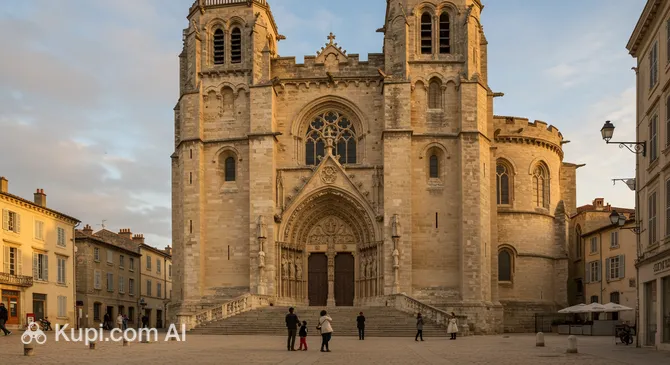
St. Peter's Cathedral in Montpellier (Cathédrale Saint-Pierre de Montpellier), also known as Montpellier Cathedral, has a rich and multi-layered history dating back to the Early Middle Ages. Its story begins not in the 14th century, as it might seem at first glance, but much earlier. A religious structure already existed on this site in the 6th century. Later, in 1364, Pope Urban V founded a church here that became part of the monastery of Saint Germain and Saint Benedict. This monastery played an important role in the spiritual life of the region, and it wasn't until 1536 that the church was granted cathedral status, marking a new stage in its history.
Over the centuries, the cathedral has been rebuilt and renovated several times, which is reflected in its architectural appearance. One of the significant transformations took place in the 18th century under the guidance of architect Jean-Antoine Giral. During this period, not only were the facade and interiors updated, but a new organ was also installed, which continues to delight parishioners and visitors with its sound today. These changes gave the cathedral a more majestic and contemporary look for that era, while preserving its Gothic foundation.
The 19th century also left its mark on the architecture of Montpellier Cathedral. The bell tower was rebuilt and the choirs were updated, adding a sense of monumentality to the building. Special attention was paid to the interior decoration: magnificent stained-glass windows depicting biblical scenes were added, filling the cathedral space with colored light. A notable detail is the sculptures depicting representatives of various classes and professions of the time, making the cathedral not only a religious site but also a historical monument reflecting the social structure of society.
Thus, Montpellier Cathedral is not just a place of worship, but a living witness to the centuries-old history of Montpellier and all of France. Every reconstruction and renovation has added new features while preserving the spirit of past eras. The architectural elements of the cathedral—from the massive portal supports resembling castle towers to the delicate stained glass—tell visitors about the changing styles, tastes, and historical events, making it one of the city's most interesting landmarks.