Support

Couriot - Musée de la Mine

About

Imagine a place where time stood still the moment the last shift of miners left the face. The Curiot Mine Museum is not just an exhibition, but a grand industrial complex in the city of Saint-Étienne, recognized as an important historical monument. Located on the site of a former coal mine, this museum covers an impressive 115 hectares, serving as a reminder of the times when France was a powerful industrial nation.
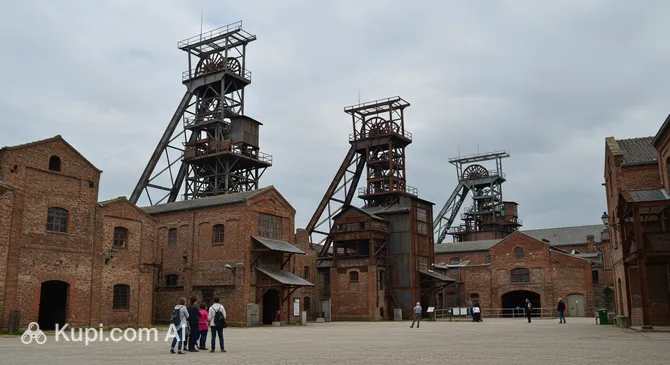
Couriot Mine Museum
Couriot Mine Museum. Иллюстрация. Источник: Kupi.com AI

The museum's trademark features are two giant conical slag heaps, which locals affectionately call "the city's two breasts." These man-made mountains, over 150 meters high, serve as silent witnesses to six centuries of coal mining in the region. Today, the area has been transformed into the modern Parc-Musée de la Mine, where the rugged aesthetics of industrial architecture harmoniously blend with public spaces for walking.

Visitors can expect a unique immersive experience: from descending into authentic underground galleries to inspecting grand surface structures such as the compressor station and workshops. This place tells the story not only of coal but of the people — their daily lives, labor, and courage — making Couriot a must-visit for anyone wanting to see the "inner workings" of Europe's industrial history.

Contacts

To find the latest information on special events or to book group tours, you can use the museum's official contact channels.

How to contactContact
Address3 Boul. Maréchal Franchet d'Esperey, 42000 Saint-Étienne, France
Phone+33 4 77 43 83 23
Websitewww.musee-mine.saint-etienne.fr

What to Do

The main highlight that draws tourists here is the chance to experience a descent into the underground gallery. You will travel into the depths of the earth on a special mine transport vehicle, where the atmosphere of the working zones has been recreated. The organizers have added special effects: vibrations and the sounds of operating machinery allow you to feel the harshness of mining labor firsthand. It is a brief but deeply emotional journey into the "heart" of the mine.

On the surface, it's worth spending time inspecting the preserved machinery. Visit the compressor room and the electric locomotive workshop, where giant units look as though they were only just switched off. The scale of the conveyors and loading platforms is impressive even for those not interested in engineering. After the technical halls, stop by the modern exhibition spaces, where multimedia installations tell "The Great History of Couriot."

End your visit with a walk through the park itself. Climb to the base of the slag heaps to appreciate their scale and enjoy a panoramic view of Saint-Étienne. Interesting fact: on the first Sunday of every month, admission to the museum is free, making it an excellent spot for an educational family outing without extra cost.

Getting There

The museum is located at 3 Boulevard Maréchal Franchet d'Esperey. If you are arriving by car from the city center, follow the signs for Parc de Montaud. At the first roundabout, head towards the shopping center, then turn towards the Jacquard district and follow the Musée de la Mine signs. For GPS navigation, use the coordinates: 45.4386876 N and 4.3768425 E.

Saint-Étienne's public transport also makes it easy to reach the site. You can take a tram or bus to stops near the central district, followed by a short walk or a quick taxi ride. For travelers coming from other regions, taking a train to Saint-Étienne-Châteaucreux station is a convenient option, from where the museum is just a few minutes away.

If you are planning a trip from Lyon, the drive via the A72 motorway takes about an hour. The museum is located on the outskirts, but it is impossible to miss thanks to the two enormous slag heaps that tower over the city skyline and serve as an excellent landmark for tourists.

Ближайший город: Saint-Étienne

History & Facts

The history of coal mining in this region dates back to the 13th century, but the real industrial boom began in the 1820s with the arrival of steam engines. The mine we see today owes its existence to the engineer Henry Couriot. It was he who, at the beginning of the 20th century, proposed an ambitious project to develop deep coal seams. Work was interrupted by World War I but was completed in 1919, and the mine was named in honor of its creator.

During the interwar period, the facility became one of the most modern in Europe. By 1936, it was producing up to 900,000 tons of coal per year, accounting for a quarter of the entire Loire basin's output. It was during this time that the famous slag heaps (terril) were formed, growing over decades to 150 meters in height. At its peak, more than 1,500 miners worked here, for whom an entire residential quarter — the Chavasse workers' citadel — was built.

The era of "black gold" began to decline after the industry was nationalized in 1946 due to competition from oil. Extraction at Couriot ceased in 1965, and the mine was finally closed in 1973. To preserve the memory of generations of workers, a museum was opened here in 1991, which received the status of a historical monument in 2011, transforming into a unique open-air park-museum.

Time Needed

To fully immerse yourself in the atmosphere of the mining past and see all the exhibitions, it is recommended to set aside 2 to 3 hours for your visit. This is enough time to walk through the underground route and explore the surface pavilions without rushing.

The time is usually distributed as follows: about 45 minutes for the tour of the restored galleries, and another hour for exploring the exhibitions "The Miner's Figure" and "Six Centuries of Mining." If you decide to stroll through the surrounding park and climb to the foot of the slag heaps for the panoramic views, allow an additional half hour. Keep in mind that groups for the underground gallery depart on a schedule, so a short wait might extend your visit.

Working Hours

The museum welcomes visitors on a steady schedule throughout the week, except for Mondays. Doors are open from Tuesday to Sunday, 10:00 AM to 6:00 PM. The museum is closed on Mondays for technical work and maintenance of the exhibits.

Please take note of the public holidays when the museum is closed: January 1, May 1, July 14, August 15, November 1, and December 25. At other times, it's best to plan your visit for the morning hours to catch one of the first underground tours before the main groups arrive.

DayWorking hours
ПонедельникЗакрыто
Вторник10:00 – 18:00
Среда10:00 – 18:00
Четверг10:00 – 18:00
Пятница10:00 – 18:00
Суббота10:00 – 18:00
Воскресенье10:00 – 18:00

Nearby

The museum's location on the edge of the city allows you to combine an exploration of industrial history with walks through the interesting sites of Saint-Étienne itself. Exploring the surrounding streets and squares will help you better feel the atmosphere of this French city.

NameDistance
Lipopette Bar1 km
Hop Square1.1 km
Museum of Art and Industry1.1 km
The Blue Grotto1.4 km
La Fabuleuse Cantine1.5 km
La Java Bleue Restaurant1.6 km
Yellow Jump Trampoline Park2.1 km

Reached the end of the page?

That means the route is fully explored