Support

La Maison des Têtes

About

If you find yourself in the historic center of a city like Valence, one of the region's most original buildings will inevitably catch your eye. The House of Heads (Maison des Têtes) is a magnificent 16th-century private mansion that stands as living proof of the transition from strict Flamboyant Gothic to the lavish Renaissance. It is not just a building, but a true architectural masterpiece located near Place des Clercs.
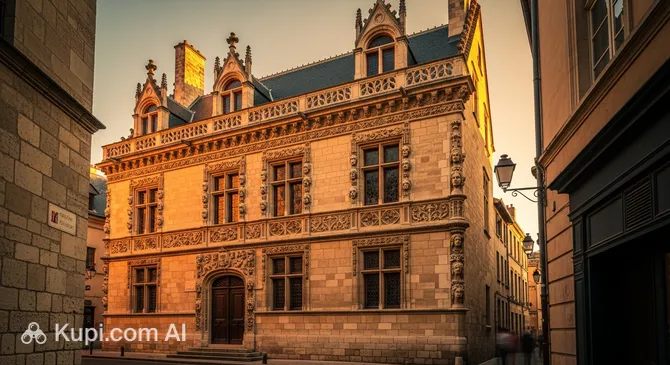
House of Heads
House of Heads. Иллюстрация. Источник: Kupi.com AI

The monument earned its intriguing name thanks to the numerous sculpted faces and busts that literally cover its facade and inner courtyard. These stone carvings are more than just decorations—they are allegorical figures. Each group of heads symbolizes important aspects of human existence at the time: Fortune, Time, Justice, and Medicine.

Today, this landmark located in France welcomes more than 25,000 visitors every year. It is rightfully considered the "signature" of the city, attracting photographers and history buffs with its detailed reliefs and magical atmosphere of the past.

Contacts

For the latest information on special exhibitions or changes to the opening hours, you can use the administration's contact details.

How to contactContact
Address57 Grande Rue, 26000 Valence, Франция
Phone+33 4 75 79 20 86
Websitewww.valenceromansagglo.fr

What to Do

The first thing to do is carefully study the main three-level facade. Here, you can spend hours admiring the ornate lines of Flamboyant Gothic, whimsical floral ornaments, and, of course, the famous heads that gave the house its name. Every detail of the cornice or window opening hides fantastic figures and the fine craftsmanship of medieval masters.

Be sure to step inside to see the inner corridor decorated with busts of Roman emperors. This passage creates a striking visual effect and transports visitors into the atmosphere of the Renaissance. The inner courtyard is also full of surprises: the sculptural decor continues here, revealing new facets of the stone carvers' skill.

Today, the building houses the Architecture and Heritage Interpretation Center (Pays d’Art et d’Histoire). Here, you can learn about the restoration of the rooms on the first and second floors, as well as book a professional tour. This is a great opportunity to find out exactly how this monument was restored to its original splendor.

Getting There

This architectural treasure is located at 57 Grande Rue, in the heart of the historic quarter. If you are already walking through the old town, look for the spire of the Cathedral of Saint Apollinaris—the building is located in its immediate vicinity and near the main pedestrian squares.

For those arriving in Valence by train, the walk from the central railway station to the site will take about 10–15 minutes. The entire old center is mostly pedestrian-friendly, so the best way to get there is a leisurely stroll through the colorful streets.

If you prefer a taxi, a car can drop you off as close as possible to the pedestrian zone, from where you will only have to walk a few dozen meters. For navigation users, use the coordinates: 44.9319654, 4.8906883.

Ближайший город: Valence

History & Facts

The history of this unusual building began between 1528 and 1532. It was commissioned by Antoine de Dorne, an influential man of his time—a professor at the local university and city consul. He brought the inspiration for his mansion's appearance from Italy, seeking to recreate the aesthetics of exquisite Italian palazzos in Provence.

Over the centuries, the house has changed owners many times. After the founder's death, it passed to his son, and later became part of the dowry of Antoine's daughter, who married a member of the de Marquet family. This lineage owned the mansion until the turbulent events of the French Revolution, when in 1794, the building was declared a national asset and sold.

In the 19th and 20th centuries, the facade underwent only minor changes—for example, a large arch was added to the first floor. Despite the changing eras, the building has retained its unique decor. In 1944, it received official status as a historic monument, and in the 1980s, it passed into municipal ownership, allowing its doors to open to all lovers of art and architecture.

Time Needed

For a detailed look at the facade, a study of the symbolism of each sculpted head, and a peek into the inner courtyard, 1–2 hours is sufficient for most travelers. This is enough time for a leisurely inspection and some memorable photos.

If you decide to book a guided tour or want to carefully explore the exhibition of the architecture and heritage center located inside, it's worth setting aside about 2–3 hours for your visit. This will allow for a deeper dive into the historical context and the secrets of the mansion's restoration.

Working Hours

When planning your visit, please note that the site is usually closed to visitors on Mondays. On weekdays (Tuesday–Friday), the mansion's doors are open from 1:00 PM to 6:00 PM.

On weekends, the schedule expands slightly: from 10:00 AM to 1:00 PM and, after a break, from 2:00 PM to 6:00 PM. Nevertheless, it is recommended to check the official website before your trip, as opening hours may change depending on the season or special cultural events.

DayWorking hours
понедельникЗакрыто
вторник13:00–18:00
среда13:00–18:00
четверг13:00–18:00
пятница13:00–18:00
суббота10:00–13:00, 14:00–18:00
воскресенье10:00–13:00, 14:00–18:00

Nearby

A walk around this architectural gem can turn into a full-fledged journey through time, as the city's historic center is literally saturated with monuments from different eras.

You can stop by neighboring squares, see ancient cathedrals, or simply enjoy the atmosphere of old French streets, each of which holds its own secrets.

NameDistance
Museum of Valence, Art and Archaeology0.1 km
Chez Grand-mère0.1 km
Café de la Bastille0.2 km
Victor Hugo Shopping Center0.3 km
Monumental Fountain0.3 km
Jouvet Park0.4 km
Escape Game Valence0.5 km

Reached the end of the page?

That means the route is fully explored