Support

Narikala Fortress

About

Narikala Fortress is one of the most iconic and ancient landmarks in Tbilisi, which locals affectionately call the "soul and heart of the city." This majestic fortress complex stands proudly on the rocky right bank of the Mtkvari River, offering breathtaking views of the Old Town. As an integral part of Georgia's history, Narikala attracts travelers with its antiquity and picturesque ruins that blend harmoniously into the modern city skyline.
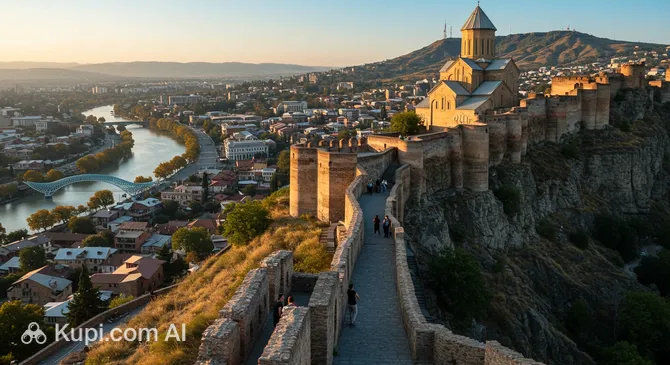
Narikala Fortress. Illustration.
Source: Kupi.com AI

Traveler photos:

At its core, Narikala is an impressive historical fortification. The complex consists of massive stone walls and towers that have survived from various historical eras, bearing witness to the rich past of this land. A walk through the fortress grounds allows you to touch the centuries, feel the spirit of the time, and imagine the events that unfolded by these ancient walls.

St. Nicholas Church holds a special place within the fortress. This church was rebuilt in the 1990s on the site of an even older temple and is active today. Inside, it is decorated with impressive frescoes depicting not only traditional biblical scenes but also important moments from Georgian history. Visiting Narikala is not just about seeing ancient ruins; it's a true immersion into the history and culture of Tbilisi.

Contacts

Since Narikala Fortress is primarily an open-air historical monument, it does not have a single information center with a phone number or email for visitors. For basic information on operating hours (if applicable, for example, for the cable car or the entrance to St. Nicholas Church on the grounds) and access methods, it is best to check Tbilisi tourism portals or inquire directly on-site.

There are several ways to reach Narikala Fortress: the most popular is by cable car, which departs from Rike Park and offers magnificent views of the city. You can also walk up one of the scenic trails leading from the Old Town, or take a taxi to the nearest possible point at the foot of the hill.

How to contactContact
AddressMRQ5+4R3, Tbilisi, Georgia

What to Do

A visit to Narikala Fortress is an opportunity not only to touch ancient history but also to enjoy truly breathtaking views. You can walk along its ancient walls, imagining the events of past centuries. From numerous observation decks, magnificent panoramas of Tbilisi unfold: the Old Town with its colorful roofs, the famous sulfur baths, Metekhi Church, and the modern districts of the capital stretching along the Mtkvari River are all clearly visible. This is the perfect place to take impressive photos as a souvenir of your trip.

While on the fortress grounds, be sure to visit St. Nicholas Church. This church, restored on its historical foundation, is interesting for its unique frescoes depicting not only biblical scenes but also significant moments from the history of Georgia. For those interested in history and architecture, Narikala is a valuable example of fortification art from different eras. Every stone here seems to tell its own story, allowing for a deeper understanding of the city's past.

The fortress takes on a special charm as evening falls. When the lights come on, the ancient walls and towers are enveloped in a magical atmosphere, creating the perfect setting for romantic walks. From the heights of Narikala Fortress, you get an unforgettable view of night Tbilisi, shimmering with thousands of lights. It’s a wonderful way to end a day filled with exploration and new experiences.

Getting There

Located in the heart of Old Tbilisi on the slopes of Mount Mtatsminda, Narikala Fortress can be reached in several ways, each interesting in its own right. One of the most popular and scenic options is the cable car. The departure station is located in Rike Park, and the ride itself is a bit of an adventure, offering magnificent views of the city and the Mtkvari River. The cable car will take you almost directly to the walls of the ancient citadel.

For those who enjoy walking, there are several routes. You can start your ascent from Freedom Square or from the famous Abanotubani sulfur baths district. The path will lead you through the narrow, winding streets of the Old Town, each steeped in history. By walking up, you can better feel the atmosphere of this ancient area and enjoy the colorful views. The route through the historic Abano district is especially recommended for those who want to combine a visit to the fortress with a tour of the sulfur baths.

If you prefer to take a taxi, you can get to the nearest possible point at the base of the hill where the fortress stands. However, keep in mind that vehicle access directly to Narikala Fortress is limited, so the final stretch will likely need to be covered on foot. This is to preserve the historical character and for the convenience of pedestrians. Public transport, such as buses, will take you to areas adjacent to the Old Town, from where you can continue on foot or by cable car.

Nearest city: Tbilisi

History & Facts

The history of Narikala Fortress is rooted in antiquity, although the exact date of its founding remains a mystery to historians. It is generally believed that the first fortifications on this strategically important hill existed as early as the 4th century AD. In those times, the citadel was known by the name Shuris-tsikhe, which can be translated as "Rival Fortress" or "Invidious Fortress." This original name already hinted at its significance and impregnability, making it a key element in the defense of ancient Tbilisi.

Over the centuries, Narikala has been rebuilt and expanded many times, reflecting the turbulent history of Georgia. During the 7th and 8th centuries, under Arab rule, the fortress was significantly enlarged and strengthened. Later, in the 11th and 12th centuries, during the reign of Georgian kings like David the Builder, the citadel underwent another large-scale reconstruction. It was from the 14th century that it became known by its current name, Naryn-Kala, which means "Little Fortress" in Turkic languages. This name was likely given by the Mongols and became firmly established in history.

Narikala Fortress acquired its near-modern appearance in the 16th and 17th centuries, when its walls and towers were once again expanded and reinforced. However, in 1827, tragedy struck: a powerful explosion of a gunpowder magazine, triggered by a lightning strike according to one version, along with a subsequent earthquake, caused colossal destruction. Since then, Narikala has never been fully restored to its former glory.

Despite all the trials it has faced, the ancient walls and towers of Narikala Fortress that survive today continue to stand proudly over Tbilisi. They serve as silent witnesses to the city's centuries-old history and are one of the most recognizable symbols of the capital of Georgia, drawing travelers with their antiquity and unbreakable link to the past.

Time Needed

To fully enjoy the views and explore Narikala Fortress, most visitors are recommended to set aside 1.5 to 2.5 hours. This time is generally sufficient for a leisurely walk along the main sections of the fortress walls, examining the ancient ruins, visiting St. Nicholas Church on the grounds, and, of course, taking stunning panoramic photos of Tbilisi from above.

The actual time you spend at Narikala may depend on your pace and interests. If you plan to explore every corner in detail, perhaps stop at information boards, or simply meditate while admiring the views, it is better to aim for the upper end of the suggested time. If your goal is a general tour and a few memorable shots, a shorter stay may suffice. Don't forget to also account for the time it takes to ascend to the fortress, whether on foot or by cable car, to plan your visit as comfortably as possible.

Working Hours

Narikala Fortress is an attraction that delights with its accessibility. According to available information, it is open to visitors 24/7, allowing you to plan your visit at any convenient time, whether it's at dawn to watch the sunrise over Tbilisi or for an evening stroll under the starlit sky. Moreover, entrance to the fortress grounds is free, making it even more attractive to tourists.

Thanks to the 24-hour access and the lack of an entrance fee, no advance ticket booking or registration is required to visit Narikala Fortress. You can simply come and enjoy this historical site. The fortress is open year-round, allowing travelers to explore its ancient walls in any season.

8:00 – 20:00

Nearby

The surroundings of Narikala Fortress are just as rich in interesting places as the ancient citadel itself. Exploring nearby attractions will allow you to dive deeper into the atmosphere of Tbilisi and get a fuller picture of its multifaceted culture and history. A walk through this area can turn into a fascinating journey, where every corner holds its own secrets and legends.

By setting aside a little time to see what lies near Narikala Fortress, you can enrich your experience and discover new sides of this amazing city. From scenic parks to authentic venues, there is something of interest for every traveler. Below is a list of some notable places located in the immediate vicinity of the fortress.

NameDistance
Usakhelouri Restaurant0.1 km
Khinkali Pub0.2 km
See3600.3 km
Bridge of Peace0.6 km
Freedom Square0.9 km
The Clock Tower0.9 km
Galleria Tbilisi1.1 km

Have you reached the end of the page?

So the route has been studied inside and out