Support

Naturkundemuseum Bamberg

About

A journey into the world of science and history in Germany is incomplete without a visit to one of the most remarkable places in Bamberg — the Natural History Museum. Housed in the majestic building of a former Jesuit college, it represents a rare symbiosis of a classic 18th-century "cabinet of curiosities" and an ultra-modern scientific and educational center.
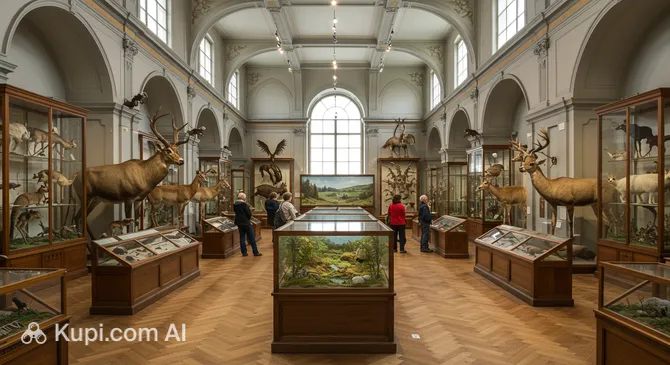
Bamberg Natural History Museum
Bamberg Natural History Museum. Иллюстрация. Источник: Kupi.com AI

The main pride and hallmark of the museum is the legendary Bird Hall (Vogelsaal). This unique early 19th-century Neoclassical interior houses thousands of exhibits across two tiers, ranging from tiny eggs and nests to exotic skeletons. Stepping inside, visitors feel as if they have leaped through time into the era of great natural science discoveries.

The museum's total collection is impressive in scale, numbering over 200,000 items. Here, you can see not only a rich entomological collection and rare minerals but also curious historical artifacts, such as the famous "Lying Stones" of Dr. Beringer. This site is rightfully considered one of the most significant and atmospheric natural history collections in the country.

Contacts

To find out current information about special exhibitions or to book a group tour, you can contact the museum administration directly. The staff are always ready to help visitors plan their visit and answer questions about current displays. Below are the main contact details for the institution.

How to contactContact
AddressFleischstraße 2, 96047 Bamberg, Германия
Phone+49 951 8631249
Websitewww.naturkundemuseum-bamberg.de

What to Do

Your first stop should be the Bird Hall—a true visual masterpiece. Here, you can spend hours examining more than 1,500 taxidermy specimens, including rare exotic species brought from distant lands centuries ago. This space is perfect for thoughtful observation and atmospheric photography surrounded by antique wooden display cases.

Fans of mysteries and scientific curiosities should definitely seek out Beringer's "Lying Stones". This exhibit tells the fascinating story of one of the most famous hoaxes in the world of paleontology. In other halls, you will find modern dioramas dedicated to the geology and wildlife of Upper Franconia, where interactive models and audio guides make the learning process lively and engaging.

The museum offers excellent conditions for a family outing: children will be delighted by the functional models and the chance to see local mammals up close. Before starting your tour, we recommend watching the introductory film, which provides a background on the building's history and the collection's most valuable treasures.

Getting There

The Natural History Museum is conveniently located in the heart of the historical center at Fleischstraße 2. The former Jesuit college building is within walking distance of the city's key tourist spots, making it easy to include in a walking tour of Old Bamberg.

If you are arriving by train, you can take a bus from the central station (Bamberg Hauptbahnhof) or lines 1–5. The "Zentrum" or "Theater" stops are the most convenient, leaving just a 5–10 minute walk to the museum entrance. Holders of the Bamberg City Ticket should remember that it grants free travel on public transport and museum admission.

For those traveling by car, it is recommended to leave your vehicle in one of the city center car parks, such as the Fish Market (Fischmarkt) or the multi-story Parkhaus Kongresszentrum. From there, you can enjoy a leisurely 10-minute walk to the museum while taking in the city's architecture. The city is also very bike-friendly, thanks to its extensive network of cycle paths.

Ближайший город: Bamberg

History & Facts

The history of this "temple of science" began in 1791 thanks to the initiative of Prince-Bishop Franz Ludwig von Erthal. He envisioned the collection as a teaching base for future natural science professors. A magnificent two-story hall in the Neoclassical style was designed specifically for this purpose within the former Jesuit school building, and its authentic appearance continues to capture the imagination today.

The secularization of 1803 contributed significantly to the development of the collections. It was then that the museum was enriched with valuable geological finds and taxidermy specimens from the closed Banz Abbey. Over time, the modest "nature cabinet" evolved into a massive collection that today numbers around 200,000 exhibits.

The museum's crown jewel—the Bird Hall (Vogelsaal)—reached its finished form in the early 19th century. At the time, it was considered a gold standard for the scientific presentation of biodiversity. Remarkably, the interior and the arrangement of the exhibits have been preserved almost in their original state, allowing us to see nature through the eyes of researchers from two centuries ago.

Today, the museum is under the scientific patronage of the Bavarian State Collection of Natural History (SNSB). Under the direction of Dr. Oliver Wings, the institution continues its tradition of enlightenment, successfully combining the preservation of fragile historical artifacts with modern research methods.

Time Needed

To explore all the halls without missing any details, most visitors need between 1.5 and 2.5 hours. This is plenty of time to leisurely examine both the historical "museum within a museum" and the modern interactive zones.

Typically, about 45 minutes is spent admiring the magnificent Bird Hall, where you'll want to inspect every display case. The remaining time should be devoted to the modern exhibitions on the nature of Upper Franconia, as well as watching the short introductory film that provides context for the collection.

Working Hours

The museum warmly opens its doors to visitors from Tuesday to Sunday, 10:00 AM to 4:00 PM. Please note that the institution is closed on Mondays.

As the operating schedule may change on public holidays or during special events, we recommend checking the museum's official website before your visit for the most up-to-date information.

DayWorking hours
понедельникЗакрыто
вторник10:00–16:00
среда10:00–16:00
четверг10:00–16:00
пятница10:00–16:00
суббота10:00–16:00
воскресенье10:00–16:00

Nearby

Strolling through the museum's surroundings is an excellent way to feel the atmosphere of the ancient city, as most iconic landmarks are just a few hundred meters away. Its proximity to UNESCO World Heritage sites makes this area ideal for a deep dive into Bavarian culture and history.

After immersing yourself in the world of natural history, you can head to the famous Old Town Hall on the water or visit one of the historic breweries for which this region is so famous. Below are the nearest points of interest:

NameDistance
St. Martin's Catholic Church0.1 km
Neptune Fountain (Gabelmoo)0.2 km
Fässla Stub'n0.2 km
Bamberg Old Town0.3 km
Old Town Hall0.3 km
Zum Sternla Brewery0.4 km
Bamberg Old Town0.4 km

Reached the end of the page?

That means the route is fully explored