Support

Gwalior Fort

About

Gwalior Fort is one of the most majestic and largest fortresses in all of India, located in the city of Gwalior. This historical giant rises proudly atop a 90-meter cliff of sandstone and basalt, creating an impressive silhouette against the city skyline. The fortress is so large that it can be considered a real city within a city, full of ancient secrets and architectural treasures.
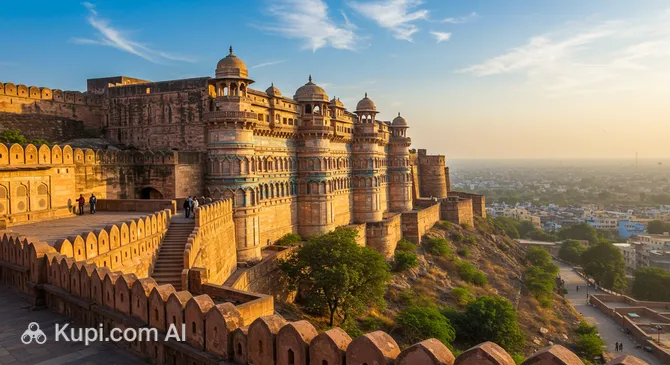
Gwalior Fort. Illustration.
Source: Kupi.com AI

Traveller photos:

The power of the structure is staggering: the cliff on which the fortress stands stretches 2-3 kilometers in length, and its width reaches 1,200 meters in some places. This entire vast complex, with a total area of about 3 km², is surrounded by powerful walls with massive circular bastions that served as reliable protection for centuries.

Behind the fortress walls lies a whole world of history. A unique architectural ensemble has been preserved here, including six palaces, six temples, a mosque, and eight ancient water reservoirs. Of particular value are the rare monuments of 11th-century Indian architecture, which make visiting the fortress an unforgettable journey into the past. This is a place where every stone breathes history, and the views from the walls are breathtaking.

Contacts

To get the most up-to-date information on opening hours, ticket prices, and available tours, it is recommended to contact the fortress administration or tourist services. Below are the key contact details that may be useful when planning your visit.

How to contactContact
AddressGwalior, Madhya Pradesh 474008, India
Websitegwaliordivisionmp.nic.in

What to Do

Visiting Gwalior Fort is an immersion into the rich history and culture hidden behind its massive walls. Once inside, you can explore many unique structures. Be sure to pay attention to the magnificent Man Singh Palace, built in the 16th century, which captivates with its Rajput architecture. No less interesting are the ancient temples: Sas-Bahu, dedicated to Vishnu and Shiva, and the majestic Teli-ka-Mandir, dating back to the 11th and 9th centuries respectively. Each of these buildings is a true masterpiece reflecting the greatness and skill of ancient architects.

Beyond exploring palaces and temples, you can study the ingenious engineering of the past at the fortress. Note the complex water supply system, consisting of numerous wells and cisterns carved directly into the rock to collect rainwater. Eight such reservoirs have been preserved, which in their time provided water for a garrison of up to 15,000 people year-round. This is a unique opportunity to see how survival needs were managed in a medieval fortress.

For the most curious travelers, the fortress has another surprise in store — underground chambers. These cool rooms and corridors were used by residents to escape the scorching Indian heat. The entire hill on which the fort stands is literally riddled with secret passages. There are even legends that one such tunnel connected the palace in Gwalior with distant Agra. Exploring these mysterious corners will add a touch of mystery and adventure to your visit.

Getting There

Getting to Gwalior Fort is quite simple, as the city of Gwalior itself has excellent transport links with other major centers in India. The city is an important railway hub, so traveling by train is one of the most convenient ways to arrive. For international travelers, Delhi is often the starting point. From the capital, you can reach Gwalior by train, which takes about 3-4 hours, or take a domestic flight to Gwalior's local airport.

Once in the city, you can easily reach the foot of the hill where the fortress stands. Local buses run regularly from the center of Gwalior to the site, and you can also always use a taxi or auto-rickshaw. The ride doesn't take much time and allows you to soak in the atmosphere of an Indian city.

To ascend directly to the fortress entrance, you can choose one of two ways. The most scenic option is the cable car, which offers breathtaking views of the city and its surroundings. For those who prefer physical activity, a pedestrian road leads to the top of the hill. However, it is worth noting that the climb is quite steep and may require effort, especially in hot weather.

Nearest city: Gwalior

History & Facts

The history of Gwalior Fort is shrouded in lore and legends. According to one, the fortress was founded in the 6th century by a local ruler named Suraj Sen. He suffered from leprosy, and the hermit sage Gwalipa cured him by giving him water from a sacred pond. In gratitude, the ruler built a powerful fortification on this site and named it after his savior — Gwalior. Notably, that very sacred pond has been preserved on the fortress grounds to this day.

Beyond its legendary origins, the construction of the fortress also had pragmatic reasons. Its strategic location allowed for the control of important trade routes. The fort gained particular significance in the 15th century for the Rajput princes of the Tomar dynasty, who sought protection from the troops of Tamerlane and his followers. Throughout its long history, the fort changed hands many times, witnessing numerous battles and shifts in ruling dynasties.

The modern appearance of the palace-fortress complex took shape mainly during the heyday of the Rajput kingdom in the late 15th and early 16th centuries, although the earliest buildings date back to the 10th century and the first mentions of the fort to the 6th century. This majestic complex, which became a striking example of Rajput architecture, served as a prototype for the later palaces of the Mughal emperors. The grandeur and beauty of Gwalior Fort were so great that Babur, the famous founder of the Mughal Empire, called it "the pearl among the fortresses of India".

Time Needed

When planning a visit to Gwalior Fort, you should prepare for a thorough and long walk. Given the vast territory of the complex, which covers about 3 km², and the abundance of historical sites, it is recommended to set aside at least 3-4 hours for a full tour. This time is enough to explore the main attractions, including palaces and temples, without rushing, as well as to enjoy the impressive panoramic views from the fortress walls.

If you have a deep interest in history and architecture, or simply enjoy leisurely exploring ancient ruins, you could easily spend a whole day at the fort. This approach will allow you to study all the monuments in detail, including the palaces of Man Singh and Gujari, the Sas-Bahu and Teli-ka-Mandir temples, and to peek into less obvious corners, such as ancient water reservoirs and Jain sculptures carved into the rocks. In the evening, a popular light and sound show is held here, which is a perfect end to a busy day.

Working Hours

Gwalior Fort is open to visitors year-round, allowing you to plan your visit at any convenient time. The main opening hours of the complex are from 7:00 AM to 5:30 PM. This time is quite sufficient to see the main attractions. The most comfortable period for a visit is between October and March, when the weather in the region is most favorable and not as hot.

To avoid queues, especially during the peak tourist season, it is recommended to purchase tickets in advance. This can be done online through the official portals for selling tickets to Indian monuments. Although the fortress is usually open daily, rules can change. Therefore, before your trip, it is worth checking the current opening hours and potential closing days on the official website or at a local tourist information center to ensure your visit goes smoothly.

Open 24/7

Nearby

Visiting Gwalior Fort is undoubtedly the main event for any traveler in this region. However, to get a complete picture of the rich heritage of Gwalior, it's worth dedicating some time to its surroundings. In the immediate vicinity of the fort, there are many other historical and cultural sites, each revealing the multifaceted history of this corner of India in its own way.

A walk through these sites will not only complement your impressions of the majestic fort but also allow you to dive deeper into the city's atmosphere, see unique architectural monuments, and learn more about the dynasties that left their mark here. Below is a list of interesting places located within walking distance of the fortress.

NameDistance
Gujari Mahal0.3 km
Shri Koteshwar Mahadev Temple0.6 km
Sasbahu Temples0.9 km
Tomb of Tansen1 km
Tomb of Muhammad Ghaus1 km
Kunal Aquarium1.2 km
Urvai Gate, Gwalior Fort1.2 km

Reached the bottom of the page?

Looks like you know this route inside out