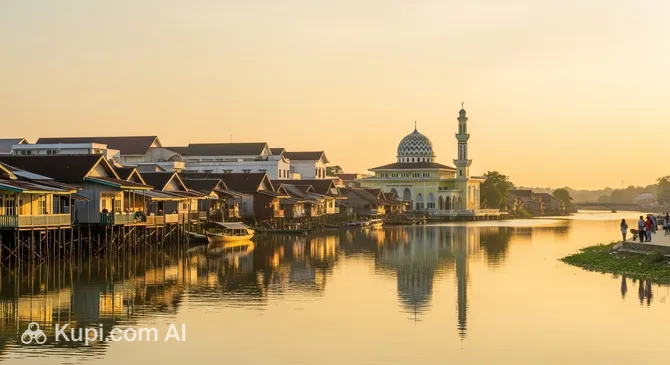
Public transport in Muara Teweh is informal and decentralized, reflecting the town's size and its location in the heart of Borneo. Tourists accustomed to structured city networks with metros, trams, or scheduled large buses will not find them here. Instead, the local transportation system relies heavily on small, flexible vehicles and riverboats that adapt to the needs of the community and the geography of the Barito River.
The most ubiquitous form of transport for getting around the town center is the Ojek, or motorcycle taxi. These can be found at designated corners or shelters known as pangkalan throughout the city. Ojeks are the quickest way to navigate the streets and reach specific destinations like hotels, markets, or government offices. While public minivans (known locally as angkot or mikrolet) do exist, they typically operate on fixed routes connecting the city center to outlying districts and neighboring villages, making them less practical for short, intra-city tourist trips.
Given the town's riverine setting, water transport is an essential part of the public network. Small wooden motorboats, locally called Kelotok, and faster speedboats act as water taxis. They are crucial for crossing the majestic Barito River to reach the Jingah district or for visiting floating settlements that are inaccessible by road. These boats usually congregate at the main piers near the waterfront markets and depart once they have enough passengers or can be chartered for a private crossing.
The payment system in Muara Teweh is almost exclusively cash-based. There are no travel cards, electronic passes, or tap-to-pay terminals for transport. When using an ojek or a boat, you must pay the driver directly in Indonesian Rupiah (IDR). It is highly recommended to carry small denominations (such as 5,000, 10,000, and 20,000 notes), as drivers often do not have change for large bills. For traditional ojeks without a fixed meter, the fare should be negotiated and agreed upon before you hop on to avoid misunderstandings upon arrival.
Ride-hailing applications like Gojek or Grab may have a presence in the town, offering a more standardized pricing model for motorcycle taxis and occasionally cars. However, availability can be sporadic compared to major metropolitan areas, and finding a driver late at night can be difficult. If you choose to use these apps, the price is fixed within the application, but many drivers still prefer cash payments over digital wallets.
For tourists wishing to explore at their own pace, renting a car with a driver is the most comfortable alternative, especially for visiting attractions outside the city limits like the waterfalls or nature reserves. Self-drive car rentals are rare and generally not recommended due to road conditions. While walking is a pleasant option for exploring the immediate waterfront area and central markets, the heat and humidity often make motorized transport a better choice for longer distances.
A unique feature of the local transport "system" is the scenic nature of the river crossings. Taking a kelotok is not just a means of getting from point A to point B; it is an atmospheric experience that offers views of the lanting (floating houses) and the bustling river life. These boats typically operate from early morning until sunset. If you need to cross after dark, be prepared to pay a higher charter rate, as regular services wind down with the daylight.