Support

Tower of David

About

The Tower of David is an ancient citadel rising majestically near the Jaffa Gate of the Old City of Jerusalem, in Israel. Despite its famous name, this powerful fortification has no direct historical connection to King David, as one might assume. The tower was erected in the 2nd century BCE to protect the city and strengthen its strategically important points, and since then, it has been a silent witness to many historical eras.
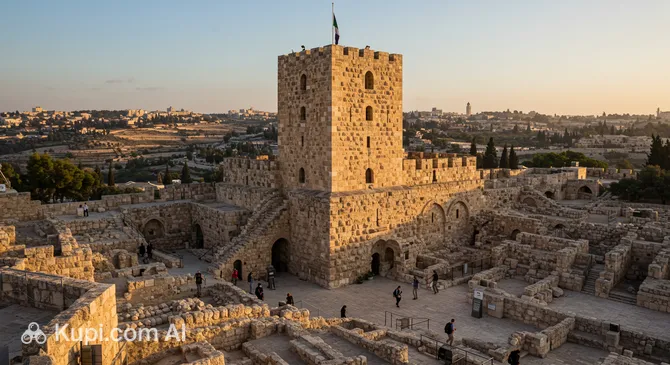
Tower of David. Illustration.
Source: Kupi.com AI

Traveler photos:

Today, the Tower of David is an impressive complex of structures where every stone holds echoes of the past. Within its walls, architectural styles from various periods—from the Second Temple era to Ottoman rule—are intertwined. One of the most notable parts of the citadel is the "Phasael" tower, built by Herod the Great and preserved to this day. A walk through the courtyard and towers allows you to literally touch history.

The architectural beauty and historical significance of the Tower of David attract not only pilgrims but everyone interested in archaeology, art, and ancient history. The massive walls that have stood the test of time, the skillful masonry, and the preserved decorative elements leave an indelible impression. Currently, the citadel houses the Museum of the History of Jerusalem, whose exhibitions fascinatingly recount the city's centuries-old history, making a visit to the Tower of David even more educational and memorable.

Contacts

To find up-to-date information regarding opening hours, ticket prices, and available tours at the Tower of David, it is recommended to visit the museum's official website or contact the Jerusalem tourist information centers. You can also find useful information on-site, right at the entrance to the citadel.

How to contactContact
AddressJerusalem 1001363
Phone number+972 2-626-5333
Websitewww.tod.org.il

What to Do

By visiting the Tower of David, you can delve deep into the centuries, exploring ancient archaeological excavations that reveal layers of Jerusalem's history. Here, you can observe archaeologists at work and study artifacts from various eras. Additionally, the citadel functions as a museum, featuring fascinating exhibits that tell the rich history of the city and the fortress itself.

Be sure to climb to the observation decks of the Tower of David, which offer breathtaking panoramic views of the Old City of Jerusalem—it's the perfect spot for memorable photos. Various exhibitions are also regularly held within the tower's walls. Interestingly, in the 1920s, it was here that art exhibitions took place, marking the beginning of an entire era in Israeli art known as the "Tower of David Period."

For a deeper understanding of the citadel's historical significance and architectural features, visitors can join guided tours conducted on the grounds. These tours will help you better appreciate the grandeur and multifaceted nature of the Tower of David, making your visit even more rewarding and informative.

Getting There

Getting to the Tower of David, located by the Jaffa Gate of the Old City of Jerusalem, is quite simple thanks to its central location. If you are staying at a hotel near the Old City or in the center of Jerusalem, a pleasant walk can be a great way to reach the citadel while soaking up the atmosphere of the ancient city along the way.

For those who prefer public transport, numerous bus routes from various districts of Jerusalem run to the Old City, and specifically to the Jaffa Gate. Check the route numbers that stop nearby depending on your location. You can also use the Jerusalem Light Rail (tram); the nearest stop is "City Hall," from where it is a 10-15 minute walk to the Jaffa Gate and the Tower of David.

Of course, taking a taxi is always an option. This can be especially convenient if you are traveling with luggage or prefer a more comfortable way to get around. Most taxi drivers in Jerusalem are well-acquainted with the location of the Tower of David, as it is one of the city's key attractions. Simply mention Jaffa Gate or "Migdal David" (in Hebrew), and you will be taken to the right place.

Nearest city: Jerusalem

History & Facts

Although the Tower of David as we see it today is the result of centuries of reconstruction, its history dates back to the 2nd century BCE, when the first fortifications were erected to protect the Old City of Jerusalem. However, the citadel acquired its truly monumental appearance during the reign of Herod the Great. He added three massive towers to the existing fortifications to strengthen the vulnerable northwestern part of the Western Hill. Herod named the tallest one, reaching 145 feet, "Phasael" in memory of his brother. The other two towers were named "Mariamne," after his second wife, and "Hippicus," after one of his friends. Notably, of these three grand structures, only the "Phasael" tower survives today, continuing to impress with its grandeur.

Following the dramatic events of 70 CE and the destruction of Jerusalem by the Romans, the Tower of David did not lose its significance, serving as barracks for Roman legionnaires. Over time and with changing eras, the purpose of the citadel evolved. In the 4th century, when the Roman Empire officially adopted Christianity, a community of monks found shelter within its walls. A new stage in the fortress's history began after the Arab conquest of Jerusalem in 638. The new Muslim rulers appreciated the strategic importance of the structure and undertook efforts to repair and strengthen it.

The resilience of the Tower of David has been tested multiple times throughout history. For instance, during the First Crusade in 1099, the fortress withstood the onslaught of the Crusaders and surrendered only after its defenders were guaranteed safe passage. Later, in the 14th century, the citadel underwent significant reconstruction. In 1310-1311, on the orders of the Mamluk Sultan al-Malik al-Mu'azzam Sharaf, extensive works were carried out, which largely formed the appearance of the tower familiar to modern visitors. These reconstructions and additions from different eras have turned the Tower of David into a true architectural and historical palimpsest, where every stone tells its own unique story.

Time Needed

When planning a visit to the Tower of David in Jerusalem, it is worth allocating at least 2-3 hours for exploration. This time is usually enough to take a leisurely stroll along the ancient citadel walls, enjoy the panoramic views of the Old City from the observation decks, and, of course, explore the main exhibition of the Museum of the History of Jerusalem located within the complex. The museum's displays span millennia of the city's history, and studying them carefully can take up a significant portion of your visit.

If you have a deep interest in archaeology and history, or plan to visit temporary exhibitions and special events periodically held at the Tower of David (such as the famous night light and sound show), your stay might extend to half a day. It's also worth considering that during peak tourist seasons or major events, additional time may be needed for waiting at the entrance or viewing popular exhibits. In any case, the Tower of David is a place that deserves thoughtful and unhurried exploration.

Working Hours

To get the most up-to-date information on the opening hours of the Tower of David in Jerusalem, it is recommended to visit the museum's official website or contact them directly. Opening hours may vary depending on the season, holidays, or special events such as night light and sound shows.

Generally, major tourist sites like the Tower of David are open to visitors year-round but may have reduced hours on certain days or follow winter/summer schedules. We strongly advise checking in advance if pre-booking tickets is required, especially if you plan to attend popular events or are traveling during the peak tourist season. This will help avoid potential queues and guarantee your visit.

DayOpening hours
Monday9:00 – 17:00
Tuesday9:00 – 20:00
Wednesday9:00 – 17:00
Thursday9:00 – 17:00
Friday9:00 – 15:00
Saturday9:00 – 15:00
Sunday12:00 – 17:00

Nearby

A visit to the Tower of David is undoubtedly a highlight of any trip to Jerusalem. However, to make your experience even richer and more complete, it's worth paying attention to the attractions located in the immediate vicinity. Exploring the surrounding area will allow you to dive deeper into the multi-layered history and culture of this unique city, complementing your impressions of the citadel itself with new discoveries and perspectives.

The Old City of Jerusalem is a veritable open-air museum where literally every stone breathes history. Near the Tower of David are many iconic sites, each deserving of attention. Walking through the narrow streets leading from one holy site to another will allow you to feel the unique atmosphere of this ancient center of three world religions.

NameDistance
Church of the Holy Sepulchre0.3 km
Zion Gate0.4 km
Mamilla Avenue0.5 km
Tacos Luis0.6 km
Western Wall0.6 km
Hamiffal0.7 km
Al-Aqsa Mosque0.7 km

Have you reached the end of the page?

So the route has been studied inside and out