Support

Church of the Holy Sepulchre

About

The Church of the Holy Sepulchre is one of the greatest and most revered shrines in the Christian world, located in the heart of the Old City of Jerusalem. According to centuries-old tradition, this is the site where Jesus Christ was crucified, buried, and then resurrected. It is not just a church, but a vast architectural complex that attracts millions of pilgrims and tourists from all over the world every year, seeking to touch history.
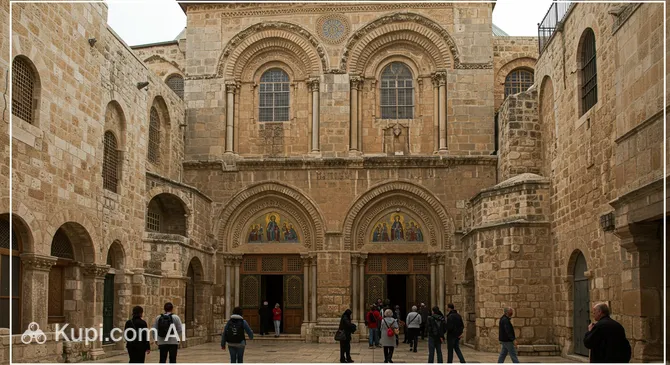
Church of the Holy Sepulchre. Illustration.
Source: Kupi.com AI

Traveler photos:

Several key sites for Christianity are united under the church's vaults. The main ones are Golgotha, where, according to tradition, the cross on which the Savior was crucified stood; the Stone of Anointing, where his body was placed to prepare for burial; and, of course, the Aedicule—a small chapel built directly over the cave of the Holy Sepulchre. Each part of the complex has its own unique atmosphere and history, allowing visitors to walk through the final stations of the Cross.

Today, the Church of the Holy Sepulchre is not only a center of pilgrimage but also a unique example of the coexistence of different cultures. Ownership and service rights are divided among six Christian denominations: Greek Orthodox, Catholic, Armenian, Coptic, Syrian, and Ethiopian. This fact gives the shrine a special, incomparable character and makes a visit here an even more memorable event for travelers exploring Israel.

Contacts

Since the Church of the Holy Sepulchre is jointly managed by six different Christian denominations, it does not have a single contact center or official website for general tourist inquiries. Each denomination has its own representative offices. For the most up-to-date information on opening hours, visiting rules, and service schedules, it is recommended to contact the Christian Information Center in Jerusalem or check the city's official tourism portals upon arrival.

How to contactContact
AddressJerusalem

What to Do

A visit to the Church of the Holy Sepulchre is a profound and multifaceted experience. Many pilgrims begin their journey by walking the Via Dolorosa—the Way of the Cross that, according to tradition, Christ walked on the way to his execution, ending at the church entrance. Immediately upon entering, visitors are greeted by the Stone of Anointing, where it is believed the body of Jesus was prepared for burial. From here, you can climb to Golgotha, where the altar is located at the site of the crucifixion, and touch the holy relic. The heart of the church is the Aedicule—the chapel housing the Holy Sepulchre, which believers strive to enter to pay homage to the most important site in Christianity.

In addition to exploring the shrines, visitors can witness the unique spiritual life of the church. Services of six different Christian denominations are held here regularly, allowing you to experience the richness of liturgical traditions. This atmosphere is especially palpable during major religious holidays. The most famous event is the annual ceremony of the Holy Fire, which takes place on the eve of Orthodox Easter and gathers thousands of believers from around the world who wish to witness this miracle. Even on an ordinary day, a visit to the church leaves an unforgettable impression, letting you feel the centuries-old history and spiritual power of this place.

Getting There

The Church of the Holy Sepulchre is located in the heart of the Old City of Jerusalem, in the Christian Quarter. You can reach the Old City walls in several ways: by public transport, taxi, or even on foot if you are staying nearby. Entry to the area is through one of the eight gates, but for visiting the church, it is most convenient to use the Jaffa Gate or New Gate, which offer the shortest path to the shrine.

Once inside the walls, your path to the church will lead through narrow, cobblestone streets, each steeped in centuries of history—this in itself is an unforgettable part of the journey. Don't be afraid of getting lost in the labyrinth of alleys, as numerous signs in English, Hebrew, and Arabic will help you find your way. Additionally, the shrine's location near the famous Via Dolorosa serves as an extra landmark for pilgrims and tourists.

Nearest city: Jerusalem

History & Facts

The history of the Church of the Holy Sepulchre is a centuries-old chronicle closely intertwined with key events of the Christian world. Its origins date back to the 4th century when the Roman Emperor Constantine the Great, who converted to Christianity, and his mother, Saint Helena, decided to immortalize the holy sites in Jerusalem. According to tradition, this was the site of Golgotha, where Christ was crucified, and the cave where his body was buried. In 326, large-scale excavations began, during which these holy sites were discovered, and by 335, the first temple complex was solemnly consecrated.

Throughout its long history, the church has survived several cycles of destruction and rebirth. In 614, it was severely damaged by the Persian invasion but was restored by the Byzantine Emperor Heraclius. One of the most devastating destructions occurred in the early 11th century by order of Caliph al-Hakim, after which the shrine was rebuilt. Later, the Crusaders made a significant contribution to the church's appearance, uniting scattered buildings into a single monumental complex in the 12th century.

The modern appearance of the Church of the Holy Sepulchre is the result of numerous restorations carried out in different eras. Its architecture harmoniously and complexly intertwines Byzantine, Romanesque, Gothic, and later styles. This architectural kaleidoscope is a living testament to the turbulent history of not only the church itself but also all of Israel. Every era has left its mark on the stones of the shrine, turning it into a unique monument where you can literally touch different layers of history.

Time Needed

For a full visit to the Church of the Holy Sepulchre, it is recommended to set aside 1.5 to 3 hours. This time is usually sufficient to see all the main holy sites without rushing: climb up to Golgotha, touch the Stone of Anointing, and visit the Aedicule—the chapel built over the burial place of Christ. Such a time allowance will allow you to not only catch a glimpse of the key points but also calmly experience the unique atmosphere of this sacred place in Jerusalem.

When planning your visit, keep in mind that the duration of your stay can vary greatly due to several factors. The main one is long queues, especially for the Aedicule, where waiting can take a significant amount of time. To avoid the largest crowds, it is best to come early in the morning on a weekday. Also, allow extra time if you wish to attend one of the services or simply spend a few minutes in silence and reflection, away from the tourist bustle.

Working Hours

The Church of the Holy Sepulchre is open to visitors daily throughout the year, though opening hours vary by season. In summer, from April to September, the shrine's doors are open to all from 05:00 to 21:00. In winter, from October to March, the church operates on a shortened schedule—from 05:00 to 20:00. It is important to remember that the schedule may change, especially during major church holidays and special services.

Entrance to the Church of the Holy Sepulchre is free, and individual visits generally do not require prior booking or tickets. You can come at any convenient time within the opening hours. However, if your trip to Jerusalem coincides with important religious dates, it is recommended to check for potential changes in the schedule and access rules in advance, as the number of visitors increases significantly and access may be temporarily restricted.

Nearby

Visiting the Church of the Holy Sepulchre is just the beginning of your acquaintance with the incredibly rich history and culture of the Old City of Jerusalem. The shrine is located in the very center of a maze of narrow streets, where new treasures are revealed around every corner. A walk through the surrounding area will allow you to immerse yourself deeper in the centuries-old atmosphere of this unique place and see other iconic landmarks located just a few steps away.

Exploring the neighboring quarters will enrich your impressions and help you form a more complete picture of the city's spiritual and cultural diversity. From ancient walls and gates to other equally significant holy sites—everything is located within walking distance, inviting you to take a leisurely and educational stroll.

NameDistance
Tower of David0.3 km
Western Wall0.5 km
Zion Gate0.6 km
Mamilla Avenue0.6 km
Al-Aqsa Mosque0.6 km
Dome of the Rock0.6 km
Tacos Luis0.7 km

Have you reached the end of the page?

So the route has been studied inside and out