Support

Yad Vashem

About

Yad Vashem is the official national memorial to the victims of the Holocaust (Shoah) and Heroism, located in Jerusalem. Established by a decision of Israel's parliament in 1953, it serves to perpetuate the memory of the six million Jews who were victims of Nazism between 1933 and 1945. The complex also honors the heroism of the Righteous Among the Nations—non-Jews who risked their own lives to save Jews during World War II.

Located on the western slope of the Mount of Remembrance (Har HaZikaron), the memorial is an extensive complex covering about 18 hectares. It includes the Holocaust History Museum, numerous memorial sites such as the Children's Memorial and the Hall of Remembrance, archives, research centers, a synagogue, sculptures, and gardens. Each element of the complex plays a vital role in preserving historical evidence and personal stories.
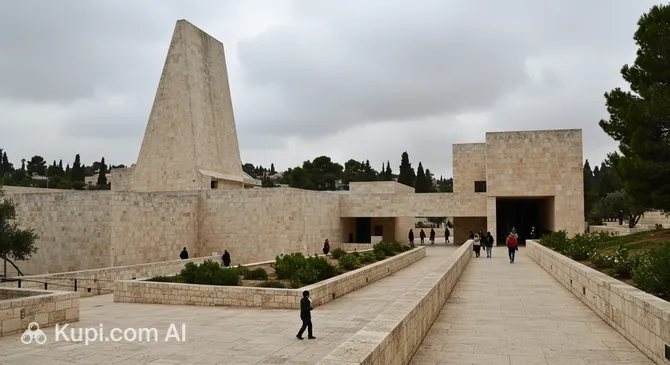
Yad Vashem. Illustration.
Source: Kupi.com AI

Traveler photos:

Yad Vashem is not just a museum but one of the most significant and visited memorials in Israel, welcoming over a million people annually. Its primary mission is not only to maintain the memory of the tragedy but also to conduct educational activities, passing on knowledge of the Holocaust to future generations. A visit here leaves a deep impression and is an essential part of understanding the country's history and culture.

Contacts

To plan your visit to the Yad Vashem memorial complex and confirm details such as opening hours, tour schedules, and visiting rules, we recommend using the official contact information. All current information is published on the memorial's website.

How to contactContact
AddressJerusalem, 9103401, Israel
Phone number+972 2-644-3400
Websitewww.yadvashem.org

What to Do

A visit to the Yad Vashem memorial complex offers a deep and multifaceted immersion into history. The central feature for visitors is the Holocaust History Museum, housed in a unique prism-shaped building that is partially built into the Mount of Remembrance. Inside the museum, a detailed chronicle of the tragedy unfolds across more than 4,200 square meters. The exhibition includes authentic documents, personal belongings of victims, photographs, and video testimonies that allow visitors to connect with personal stories and the scale of the Shoah.

In addition to the main museum, there are many other iconic sites on the complex's grounds, each of which leaves a powerful impression. You can visit the Hall of Remembrance, where the Eternal Flame burns and the names of 22 major Nazi death camps and mass murder sites are engraved on the floor. Especially moving is the Children's Memorial—a cave carved into the rock dedicated to the memory of the 1.5 million children who perished, where their names are heard in the darkness. You can also walk along the Avenue of the Righteous Among the Nations, where trees are planted in honor of non-Jews who saved Jews during the war.

Yad Vashem regularly hosts guided tours, educational programs, and temporary exhibitions that complement the main displays. Visitors can also stop by the Art Museum, which houses works of art created in ghettos and camps, or visit the active synagogue. It is important to remember that the atmosphere of the entire complex encourages a quiet, thoughtful, and respectful visit, providing an opportunity not only to learn the facts but to honor the memory of millions of people.

Getting There

The Yad Vashem memorial complex is located on the Mount of Remembrance (Har HaZikaron) in Jerusalem. It can be reached in several ways: by public transport, private car, or taxi.

The most convenient way to reach the memorial is by public transport. You can take the light rail (Line 1) to its final stop, "Mount Herzl" (Har Herzl). From there, a free shuttle bus runs regularly to the complex, which is particularly convenient for visitors. Additionally, many city buses serve Yad Vashem; the nearest stop is also named "Yad Vashem."

If you plan to travel by car, there is an underground parking lot available for 28 shekels for the entire day. You can use apps like Waze or Google Maps for navigation. A taxi ride from the city center is also quick and convenient.

Nearest city: Jerusalem

History & Facts

The history of Yad Vashem dates back to the years of World War II. As tragic news of the mass destruction of the Jewish people arrived, the idea emerged to create a memorial that would preserve the memory of the victims. This idea was officially realized after the establishment of the State of Israel: in 1953, the Knesset (the country's parliament) passed a law establishing Yad Vashem as the national center for the commemoration of the Holocaust and destroyed Jewish communities.

A symbolic site was chosen for the construction of the complex—the western slope of Mount Herzl in Jerusalem, also known as the Mount of Remembrance. The memorial officially opened in 1957. The first exhibitions were dedicated not only to the tragedy but also to courage, telling of the heroic resistance in ghettos and concentration camps, highlighting the strength of the human spirit even in the darkest of times.

Over time, the need arose to expand and modernize the complex. In the 1990s, a decision was made for a large-scale reconstruction to make the memorial even more technologically advanced and accessible to new generations. The project was led by the world-renowned architect Moshe Safdie. In 2005, the renovated Yad Vashem, with its impressive Holocaust History Museum, reopened its doors, offering visitors a deep and emotional immersion into history through modern exhibition solutions.

Time Needed

When planning a visit to Yad Vashem, it is important to budget enough time for a thoughtful and complete tour. For a general overview of the main exhibition at the Holocaust History Museum and the key memorials on the complex's grounds in Jerusalem, it is recommended to set aside at least 2–4 hours. This time will be sufficient to get a general sense of the scale and significance of this important place without rushing through the main halls.

If you wish to delve deeper into the history and visit all the major sites, including the Hall of Remembrance, the Children's Memorial, the Art Museum, and various temporary exhibitions, you should plan for up to half a day. Participating in a guided tour may also extend your stay but will provide a more comprehensive and structured understanding of Holocaust history and the memorial's significance for Israel and the entire world. Visiting Yad Vashem is a deeply emotional experience, and rushing is inappropriate here.

Working Hours

The Yad Vashem memorial complex is open to visitors year-round. The opening hours are as follows: from Sunday to Thursday, the complex is open from 9:00 to 17:00. On Fridays and holiday eves, hours are reduced—from 9:00 to 14:00. Yad Vashem is closed on Saturdays and Israeli holidays. Entry to the grounds and the Holocaust History Museum ends one hour before closing.

Admission to Yad Vashem is free; however, to guarantee entry, especially to the Holocaust History Museum, it is strongly recommended to book your visit in advance via the official online system on the memorial's website. This is particularly relevant for groups and during peak tourist periods. Entry without prior registration is only possible if space is available. For a deeper dive into the history, you can rent an audio guide, available in several languages, including Russian.

DayOpening hours
Monday9:00 – 19:00
Tuesday9:00 – 16:00
Wednesday9:00 – 16:00
Thursday9:00 – 19:00
Friday9:00 – 13:00
SaturdayClosed
Sunday9:00 – 16:00

Nearby

A visit to Yad Vashem leaves a profound emotional impression, and exploring the surrounding area can be a harmonious continuation of your day. Discovering nearby attractions will allow you to see other facets of Jerusalem—a city with thousands of years of history and a dynamic modern life.

Near the memorial, you will find other important commemorative sites as well as cultural landmarks and parks that will help you transition and complement your impressions of Israel's capital. Below is a list of interesting places located nearby.

NameDistance
National Memorial Hall for Israel's Fallen0.7 km
The Israel Museum2.7 km
Malha Mall2.8 km
Pais Arena Jerusalem3.1 km
Jerusalem Biblical Zoo3.1 km
Sacher Park3.1 km
Israel Aquarium3.4 km

Have you reached the end of the page?

So the route has been studied inside and out