Support

Zion Gate

About

The Zion Gate (or Sion Gate) is one of the eight ancient gates leading into the Old City of Jerusalem, the historical heart of Israel. Located in the southwestern part of the massive fortress walls, they serve as an important passage connecting the Jewish and Armenian Quarters with the revered Mount Zion. These gates are an integral part of the city's rich historical heritage and its unique atmosphere, representing a significant historical site.
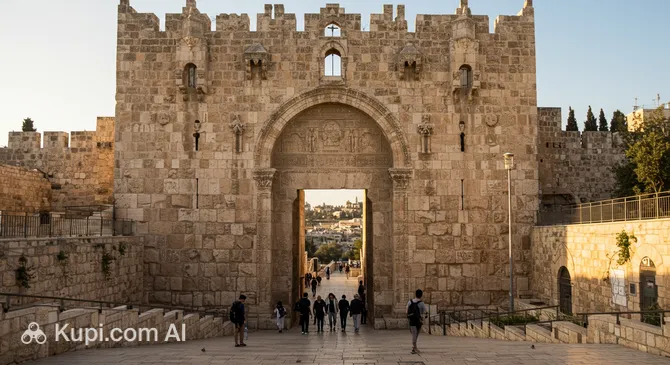
Zion Gate. Illustration.
Source: Kupi.com AI

Traveler photos:

The architecture of the Zion Gate clearly reflects its original defensive purpose. A characteristic feature is the narrow passage with an L-shaped turn inside, designed to prevent a frontal breakthrough by attackers. The walls around the gate are built from large limestone blocks, and above the arch itself, one can notice battlements and machicolations — special openings for vertical firing at the enemy. At the same time, the architectural decorations of the gate are minimal on both the inside and outside, emphasizing its austere functionality.

Passing through the Zion Gate, you feel as if you are taking a journey through the centuries. They were silent witnesses to many key events in the history of Jerusalem, and their stones still bear the marks of the past. For many pilgrims and tourists, these gates are not just an architectural monument but a symbolic entrance to the shrines of Mount Zion, which gives them special spiritual significance and makes them a must-visit point.

Contacts

Since the Zion Gate is a public historical site and part of the Old City of Jerusalem, it does not have separate contact details. For current information on visiting and routes, it is recommended to contact the Jerusalem tourist information center or visit the city's official tourism website. There, you can check access hours, if applicable, and find other useful information for planning your visit.

How to contactContact
AddressJerusalem

What to Do

When visiting the Zion Gate, travelers have a unique opportunity to closely examine its architectural features. Pay attention to the stone capitals with carved converging lines, which can be seen on the inner side of the gate. On the outer side, you will find a characteristic pointed arch with a tympanum where an Arabic inscription is carved. This inscription is not only historical evidence but also indicates the year the gate was built — 1540 — and the name of its creator, Suleiman the Magnificent. Studying these details allows you to delve deeper into the atmosphere of ancient Jerusalem.

The Zion Gate is not just an ancient fortification but also an important starting point for exploring both the Old City of Jerusalem and the sacred Mount Zion. Passing through these historical gates, you open the way to iconic sites such as the City of David and the Cenacle, better known as the Room of the Last Supper, where according to tradition, this important event took place. Thus, the gate serves as a kind of bridge between different historical and spiritual areas of Jerusalem, inviting further fascinating walks and discoveries.

Getting There

Getting to the Zion Gate is quite simple, especially if you are already exploring the Old City of Jerusalem. They are located in the southern part of its ancient walls. If you are inside the Old City, the most pleasant way is on foot. You will need to head towards the Armenian Quarter and move from there toward the southern wall, where the famous gate is located.

If you are starting your journey from other areas of Jerusalem, public transport is at your service. Numerous bus routes pass near the Old City. You will need to get off at one of the nearest stops and then take a short walk to the Zion Gate itself. This is also a great opportunity to see the surroundings and feel the atmosphere of the city.

Another convenient option is to take a taxi. Taxi drivers in Jerusalem are well-acquainted with the locations of major attractions, including the Zion Gate. A car can take you directly to the gate or to the nearest point accessible by transport, from where only a short walk remains. This is especially convenient if you are short on time or prefer maximum comfort.

Nearest city: Jerusalem

History & Facts

The Zion Gate, also known as the Sion Gate, holds a special place in the history of Jerusalem. Their construction was completed in 1540 by order of the Ottoman Sultan Suleiman the Magnificent, and they became the last of the eight gates built within the Old City's wall complex. This fact in itself is noteworthy, highlighting the final stage of a grand fortification project of that era.

The process of building the southern wall, where the Zion Gate is located, proved to be longer and more complex than other sections. The reason for this was a dispute over the feasibility of including Mount Zion within the city walls. The Ottoman authorities were reluctant to incur the significant expenses required to increase the length of the fortifications to encompass Mount Zion, which contained important holy sites such as the Cenacle (the site of the Last Supper) and the City of David. Efforts were made to shift the financial burden onto the Franciscans, but they did not have sufficient funds. As a result of this dispute, some revered sites remained outside the renovated city walls.

In Arabic tradition, the Zion Gate is called Bab Nabi Daud, which translates to "Gate of the Prophet David." This name is linked to the tradition that King David is buried on Mount Zion, to which these gates lead. Interestingly, although the gate opens the way to the mountain that today bears the name Zion, in antiquity the toponym "Zion" referred to a different hill. This fact adds another layer to the multifaceted history of this iconic site.

Time Needed

To see the Zion Gate itself as an architectural object, you will need relatively little time. Usually, 15-30 minutes is enough to carefully examine their construction, study historical details such as the traces of bullets and shells, and read information plaques if any are available. During this short interval, you can appreciate the power of the ancient fortifications and take a few photos.

However, the Zion Gate often serves as a starting point for longer excursions. They open the way to Mount Zion with its numerous attractions, and also lead to the Armenian and Jewish Quarters of the Old City of Jerusalem. If you plan not only to look at the gate but also to explore the adjacent areas, visit King David's Tomb, the Room of the Last Supper, or walk through the narrow streets of the quarters, then it is worth setting aside significantly more time – from 2 to 4 hours. This will allow you to immerse yourself in the unique atmosphere of this historical site without rushing.

Working Hours

The Zion Gate, as part of the defensive walls of the Old City of Jerusalem, is usually open for passage 24 hours a day and year-round. This allows visitors to freely pass through them at any time. No special booking or ticket purchase is required to pass through the gate, as they are a public architectural and historical monument.

Nevertheless, it is important to consider that during periods of heightened security or during major religious holidays, the access regime to some parts of the Old City, including the passage through the Zion Gate, may be temporarily changed or restricted. For the most comfortable and safe viewing of the gate's architectural details and the surrounding areas, it is recommended to plan your visit during daylight hours. To get the most up-to-date information on possible changes in access, it is always useful to check with the official tourist resources of Jerusalem or local information centers before your trip.

Nearby

Visiting the Zion Gate is just one facet of getting to know the many faces of Jerusalem. To truly feel the spirit of this ancient city, it is worth expanding your itinerary and exploring the attractions located nearby. Each will add new touches to your impression, allowing you to dive deeper into the history and culture of this unique place.

Exploring the surroundings of the Zion Gate will enrich your journey, as Jerusalem is a city where biblical legends and centuries-old traditions come to life at every step. Near the gate, you will find many other iconic sites, each keeping its own secrets and ready to share them with the curious traveler.

NameDistance
Tower of David0.4 km
Jerusalem Ramparts Walk0.4 km
Western Wall0.6 km
Church of the Holy Sepulchre0.6 km
Al-Aqsa Mosque0.7 km
Mamilla Avenue0.8 km
Dome of the Rock0.8 km

Have you reached the end of the page?

So the route has been studied inside and out