Support

The Two Towers of Bologna

About

The Two Towers of Bologna—Asinelli and Garisenda—are architectural symbols without which it is impossible to imagine Bologna. Located in the heart of the city, these medieval skyscrapers are among the most recognizable landmarks in Italy and the entire Emilia-Romagna region.
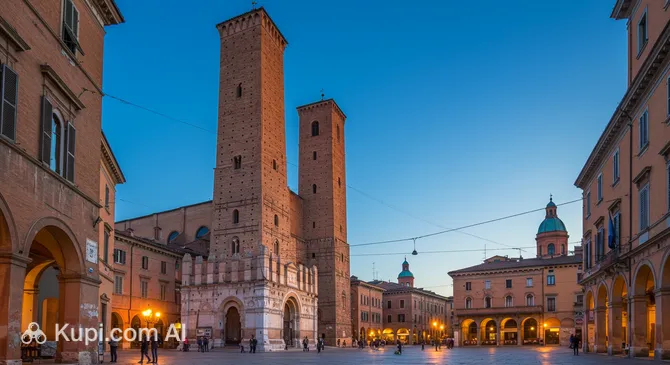
The Two Towers of Bologna. Illustration.
Source: Kupi.com AI

Traveler photos:

The towers were built in the 12th century by the city's influential families, not only as defensive structures but also as symbols of status and power. In those times, there were up to a hundred such towers in Bologna, but only a few have survived to this day, with Asinelli and Garisenda being the most famous.

The Asinelli tower, standing 97.2 meters tall, is the tallest leaning tower in the world, and its summit offers a breathtaking view of the city. Its neighbor, the Garisenda tower, though shorter (48 meters), has a more pronounced lean, giving it a unique and memorable appearance. Together, they create a unique architectural ensemble that attracts travelers from all over the world.

Contacts

For the most up-to-date information on operating hours, ticket purchases, and potential visiting restrictions related to restoration work, it is recommended to contact the official tourist information center of Bologna. All details can be found on the official website or via the provided contacts.

How to contactContact
AddressP.za di Porta Ravegnana, 40126 Bologna BO, Italy
Websitewww.bolognawelcome.com

What to Do

The main adventure awaiting you at the Two Towers is, without a doubt, the climb up the Asinelli tower. You will have to overcome 498 wooden steps via an ancient internal staircase, which is a small challenge in itself. But the reward for your effort will be a truly unforgettable panoramic view of all of Bologna. From a height of 97 meters, the city with its famous red roofs, narrow streets, and majestic palazzos will appear as if in the palm of your hand.

Even if you don't plan to climb, the towers offer plenty of impressions. They are considered one of the main symbols not only of the city but of all of Italy, so taking a few photos against their backdrop is a must. Additionally, the square at the base of the towers is an ideal starting point for a walk through the historic center. From here, you can explore ancient streets, duck into cozy cafes, souvenir shops, or visit the famous Quadrilatero market district located nearby.

Getting There

Finding the Two Towers in Bologna is easy—they are located in the very heart of the historic center at Piazza di Porta Ravegnana, where five busy streets intersect. This spot is just a few minutes' walk from other key attractions, such as Piazza Maggiore and the Basilica of San Petronio, making the towers an ideal starting point for exploring the city.

If you are arriving in the city by train, your journey will begin at Bologna Centrale station. From there, you can reach the towers in several ways: by taxi, city bus, or on foot. The most scenic option is a walk along the main street, Via dell'Indipendenza, which leads directly to the center. It takes about 20–25 minutes and allows you to immediately immerse yourself in the atmosphere of Bologna.

Since the towers are located in a limited traffic zone (ZTL), the most convenient way to get around the historic center is on foot. Moreover, thanks to their height, Asinelli and Garisenda serve as excellent landmarks visible from many parts of the city. Using them as a guide, you certainly won't get lost while exploring the narrow medieval streets. For those who prefer public transport, several bus routes stop near the towers, such as No. 11, 25, and 27.

Nearest city: Bologna

History & Facts

Behind every great landmark lies a fascinating story, and the Two Towers of Bologna are no exception. They appeared in the 12th–13th centuries, an era when Bologna resembled a medieval Manhattan: around 80–100 towers built by noble families pierced the sky. These structures were not just defensive posts but also a daring demonstration of power and wealth. According to historical records, the Asinelli and Garisenda towers were erected between 1109 and 1119, becoming eternal witnesses to the ambitions of their creators.

The most intriguing fact about the towers is their famous lean. This was not the original intention of the architects but the result of construction errors and ground instability under the foundation. The Asinelli tower leans at an angle of 1.3 degrees, resulting in a displacement of 2.2 meters at the very top. However, the lean of its "younger sister," the Garisenda tower, was so critical that in the 14th century, it had to be shortened from 60 to its current 48 meters to avoid collapse. This defect was so impressive that the great poet Dante Alighieri immortalized the Garisenda tower in his "Divine Comedy," comparing the leaning figure of the giant Antaeus to it.

The secret to the towers' longevity lies in their construction. They are built of brick and durable selenite blocks, with double walls: the space between the outer and inner masonry is filled with a mixture of rubble and cement for strength. Beyond their direct purpose, the towers also served science: in the 17th century, scientist Giovanni Battista Riccioli used the Asinelli tower to conduct experiments proving the Earth's rotation. At one time, these two landmarks of Italy were connected by a high wooden bridge, which, unfortunately, was destroyed by fire in 1398.

Time Needed

When planning a visit to the Two Towers of Bologna, expect that you will need between 1 to 1.5 hours to see them and climb the Asinelli tower. This time is usually enough to climb up without rushing, enjoy the panorama, and take photos at the base of the towers. It is important to note that visits to the observation deck are often organized by time slots, which last about 45 minutes.

The bulk of the time will be spent on the climb and descent via the 498 steps of the Asinelli tower, which can take 20–30 minutes depending on your pace. It is worth spending at least 15–20 minutes at the top to fully enjoy the breathtaking views of the red roofs and the historic center of Bologna. The remaining time can be spent taking photos from the outside, where the contrast between the tall Asinelli and the steeply leaning Garisenda tower is particularly noticeable.

Working Hours

Only one of the towers—Asinelli—is open to the public. It is important to know that its operating hours change depending on the season. Generally, during the warmer months (roughly from March to early November), the tower is open to visitors longer, usually from 9:30 AM to 7:30 PM, while in the winter period (from November to late February), hours are reduced to 9:30 AM to 5:45 PM. As the schedule is subject to change, it is highly recommended to check current information on Bologna's official tourism website before your visit. The second tower, Garisenda, is closed to the public.

The most important rule for those wishing to climb the Asinelli tower is that booking tickets is mandatory. This must be done in advance online, as the number of spots for each time slot is limited. This is especially relevant during the peak tourist season when tickets can be sold out several days in advance. Please note that the Asinelli tower may currently be temporarily closed to visitors due to safety work being carried out around the Garisenda tower. Be sure to check its operational status on official resources.

Nearby

Visiting an iconic site like the Two Towers leaves an unforgettable impression, but true immersion into the city's atmosphere begins when you go beyond a single attraction. Exploring the surroundings allows you to see how history and modernity intertwine on the streets and feel the true spirit of Bologna.

Fortunately, the location of the Two Towers is ideal for walking. They are in the very center of the historic part of the city, with many other interesting places within walking distance—from famous squares and ancient palaces to authentic restaurants where you can get to know the gastronomic culture of Italy. Below is a list of attractions located nearby.

NameDistance
Sfoglia Rina0.1 km
Osteria del Sole0.2 km
Piazza Santo Stefano0.2 km
Mercato di Mezzo0.2 km
Fountain of Neptune0.3 km
Palazzo Re Enzo0.3 km
Palazzo d'Accursio0.3 km

Have you reached the end of the page?

So the route has been studied inside and out