Support

Palazzo Ercolani

About

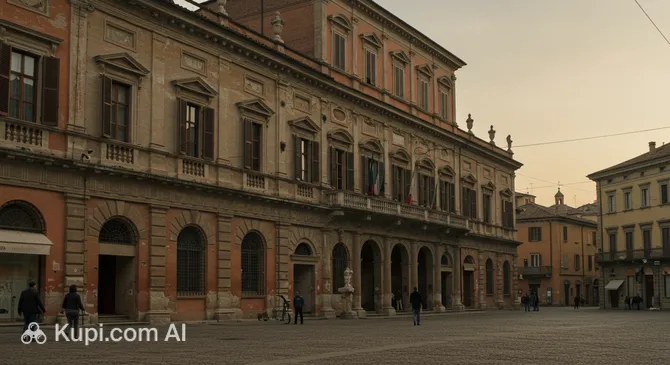
Palazzo Hercolani is a majestic architectural monument and a true gem of Bologna. Located in the beautiful country of Italy, this palace is an exquisite blend of Neoclassical restraint and lavish Rococo decoration.
Palazzo Ercolani
Palazzo Ercolani. Иллюстрация. Источник: Kupi.com AI

Today, the building houses the University of Bologna's Faculty of Political Sciences, but its historical value goes far beyond its educational role. The facade, inspired by 16th-century traditions, hides incredible interiors that are considered among the most luxurious in the city. The palace is particularly famous for its halls, painted by the leading masters of the time.

Inside, visitors will find the famous "Forest Room" (Sala Boschereccia), where the walls are transformed into an illusory landscape, and a monumental staircase adorned with mythological statues and the "Apotheosis of Hercules" fresco. The building is surrounded by a picturesque inner garden created in the early 19th century, offering a sense of seclusion amidst the city's hustle and bustle.

Contacts

To contact the institution or inquire about access to Palazzo Hercolani, you can use the official resources of the University of Bologna. Please note that the building is an active academic facility, so access may depend on the lecture schedule.

How to contactContact
AddressStr. Maggiore, 45, 40125 Bologna BO, Italy
Websitearchiviostorico.unibo.it

What to Do

Visiting Palazzo Hercolani is primarily about the aesthetic pleasure of contemplating artistic masterpieces. Be sure to climb the monumental staircase to see the "Apotheosis of Hercules" fresco crowning the dome. This space, decorated with masterful stucco work by Giacomo De Maria, sets a solemn tone for the entire visit.

One of the most memorable moments will be exploring the Sala Boschereccia. This "landscape room" is designed to make the viewer feel as though they are in the middle of a dense forest, with the wall paintings harmonizing perfectly with the view of the real garden outside. It is also worth visiting the Zodiac Room and the elegant rooms decorated in the Chinese style, which was popular at the time.

The best way to end your tour is with a stroll through the inner garden. Here you can find a replica of the famous "Cupid and Psyche" sculpture by Adamo Tadolini and enjoy the silence in the shade of ancient trees. Since the palace is part of the university, you may occasionally find open lectures here, allowing you to feel like part of the city's renowned academic culture.

Getting There

The palace is located at Strada Maggiore, 45, in the city's historic center. This is one of the most elegant streets, so the route to the attraction becomes an engaging walk. From the famous Two Towers, the entrance to the palace is just a 5–10 minute walk away.

If you are using public transport, look for bus routes 25 or 30, as well as the BLQ line, which stop on Strada Maggiore. From the main railway station, Bologna Centrale, the journey by bus or taxi will take no more than 10–15 minutes.

For those arriving from Bologna Airport, it is most convenient to take the express bus to the center and then walk a short distance. Remember that parking in the city center is very limited, so the best choice is to use public transport or walk through the ancient streets.

Ближайший город: Bologna

History & Facts

The history of this magnificent building began in 1793. It was commissioned by Marquis Filippo Hercolani, a representative of one of Bologna's most influential senatorial families. The prominent architect Angelo Venturoli was invited to design the palace, which he built on the site of several older structures belonging to the noble Muzza and Manzi families.

In the early 19th century, the Hercolani family continued to improve their property by creating a luxurious inner park. It was laid out according to the European fashion of the time, combining elements of the French formal style and the English landscape tradition. The garden was decorated with artificial hills and elegant statues that have survived to this day.

A new chapter in the palace's life opened in 1973 when it became the property of the University of Bologna. After a large-scale restoration in the late 1980s, the Faculty of Political Sciences moved in. During the work, the unique frescoes by Filippo Pedrini and Rodolfo Fantuzzi were carefully restored, preserving the historical appearance of one of the city's most beautiful buildings.

Architecturally, the palace is a harmonious blend of the Neoclassical austerity of the facade and the Baroque luxury of the interiors. The building's monumental staircase is considered one of the last great examples of Baroque grand staircases in Bologna, marking the end of the era of grand palace construction in the city.

Time Needed

To leisurely explore the main halls and grand staircase and take a stroll through the inner garden, you will need about 1–2 hours. This is quite enough time to soak in the atmosphere of an aristocratic home and appreciate the skill of the Italian decorators.

If you decide to stay in the garden to relax or happen to catch an open university event, plan to spend a bit more time. Keep in mind that classes take place in the building on weekdays, so access to some halls may depend on the academic schedule.

Working Hours

Palazzo Hercolani is open to the public on weekdays. The schedule is as follows: from Monday to Friday, the palace doors are open from 09:00 to 17:00. These are the standard operating hours for the University of Bologna's academic buildings.

Please note that the building is closed to visitors on Saturday and Sunday. We also recommend checking for possible schedule changes during public holidays or university vacations.

DayWorking hours
Понедельник9:00 – 17:00
Вторник9:00 – 17:00
Среда9:00 – 17:00
Четверг9:00 – 17:00
Пятница9:00 – 17:00
СубботаЗакрыто
ВоскресеньеЗакрыто

Nearby

The palace's location on Strada Maggiore makes it an ideal starting point for further exploration of the city. The surrounding neighborhoods are filled with hidden courtyards and cozy cafes where you can feel the true spirit of Italy.

Exploring the area will help you better understand Bologna's multifaceted history, where medieval walls stand alongside Renaissance facades. Be sure to include nearby points of interest in your itinerary, all within walking distance.

NameDistance
Porta San Vitale0.4 km
Piazza Santo Stefano0.5 km
Sfoglia Rina0.6 km
National Art Gallery of Bologna0.7 km
The Two Towers of Bologna0.7 km
Porta San Donato0.8 km
Osteria del Sole0.8 km

Reached the end of the page?

That means the route is fully explored