Support

Palazzo d'Accursio

About

In the very heart of Piazza Maggiore stands the majestic Palazzo d’Accursio (also known as the Palazzo Comunale) — a monumental architectural complex that for centuries has embodied the secular power of the city of Bologna. This is a place where medieval austerity meets Renaissance elegance, creating a unique landmark that Italy is proud of.
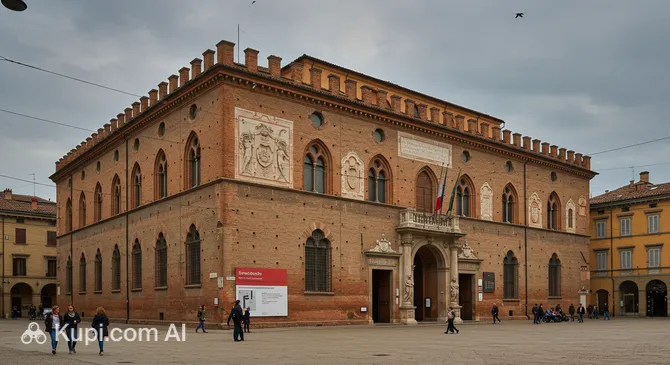
Palazzo d
Palazzo d'Accursio. Иллюстрация. Источник: Kupi.com AI

The palace is a combination of several historical buildings, the oldest of which once belonged to the famous jurist Francesco d’Accorso. Today, it is not just an administrative building but a true open-air museum and a treasure trove of art. The facade is adorned with a magnificent portal by Galeazzo Alessi and a statue of Pope Gregory XIII, while the clock tower with its terracotta decor rises proudly over the square.

Inside, guests will find luxurious frescoed halls and the Municipal Art Collection located on the upper floors. Palazzo d’Accursio is a must-see for those who want to feel the spirit of "learned" and "red" Bologna by touching its political and cultural history.

Contacts

To clarify visit details or obtain up-to-date information about temporary exhibitions, you can use the official communication channels. Please note that the Bologna administration actively supports the operation of the complex as a cultural and administrative center.

How to contactContact
AddressPiazza Maggiore, 6, 40121 Bologna BO, Italy
Phone+39 051 203040
Websitewww.comune.bologna.it

What to Do

Your exploration of the palace should begin with its impressive halls. Be sure to climb the double staircase by Donato Bramante — a 16th-century architectural masterpiece that leads to a suite of ceremonial rooms. Inside, you'll find the Hall of Hercules with its majestic statue and the Farnese Hall, where you can spend hours admiring the ceiling frescoes and ancient coats of arms.

The Municipal Art Collection (Collezioni Comunali d'Arte) is located on the top floor. Here, you'll find not only paintings and sculptures but also luxurious interiors that allow you to imagine how the city's rulers lived and worked in past centuries. Pay special attention to the details: from terracotta ornaments to the preserved elements of the ancient clock with a carousel.

Don't forget to step out onto the square to appreciate the scale of the facade, and if time permits, take a look at the Torre d’Accursio. From its heights, one of the best panoramic views of the tiled roofs and towers that Bologna is so famous for opens up. It is the perfect spot for those seeking inspiration and wanting to take spectacular shots of the city.

Getting There

Palazzo d’Accursio occupies a place of honor at Piazza Maggiore, 6, in the very heart of the historical center. If you arrive at the Bologna Centrale main railway station, the walk to the palace will take about 15–20 minutes through the picturesque streets of Bologna.

For those who prefer public transport, numerous city buses run to the Piazza Maggiore stop. Travelers arriving from Bologna Guglielmo Marconi (BLQ) airport will find it most convenient to take the Aerobus shuttle, which will take you to the station in 20 minutes, after which you can continue on foot or by local transport.

Keep in mind that the city center is a Limited Traffic Zone (ZTL), so taking a taxi or walking will be the most convenient options. Using a car inside the old city is difficult due to the lack of parking spaces and strict entry rules.

Ближайший город: Bologna

History & Facts

The history of this grand complex began back in 1290, when the prominent jurist and law professor Francesco d’Accorso started building his home. A few decades later, in 1336, the building acquired the status of the residence of the Anziani — the city's highest magistrates — and since then, it has remained the administrative heart of municipal power.

The building has changed its appearance many times under the influence of time and circumstances. After a devastating fire in 1425, the reconstruction was led by the famous architect Fioravante Fioravanti. It was then that the ensemble was complemented by the majestic Torre d’Accursio clock tower. In subsequent centuries, the facade was decorated with an exquisite Gothic portal and a bronze statue of Pope Gregory XIII, who is famous for reforming the calendar.

The interior of the palace also bears the marks of great masters. For example, the monumental double staircase, designed so that it could be climbed on horseback, is attributed to the genius Donato Bramante. Today, every hall and every stone of this building tells the story of the centuries-old and eventful history of Bologna.

Time Needed

To take a leisurely tour of the palace interiors, climb the famous staircase, and explore the municipal art collection, most tourists need between 1.5 and 2.5 hours. This is enough time to appreciate the architectural details and take memorable photos.

If you also plan to visit the clock tower or spend more time in Piazza Maggiore admiring the facade, it’s worth setting aside an additional 30–40 minutes. In any case, a visit to the palace easily fits into a busy one-day itinerary.

Working Hours

Palazzo d’Accursio welcomes visitors daily, making it a very convenient site for planning an excursion any day of the week. Standard opening hours for the complex are:

  • Monday — Sunday: 10:00 – 18:30.

It is recommended to arrive an hour before closing to have enough time to see the main exhibition. On public holidays, opening hours may change, so it is worth checking the city’s official website before your visit.

10:00 – 18:30

Nearby

The palace's location on the city's main square makes it an ideal starting point for further exploration. A walk through the surrounding area will allow you to see both famous architectural monuments and cozy hidden corners that create the city's unique character.

NameDistance
Fountain of Neptune0 km
Palazzo Re Enzo0.1 km
Piazza Maggiore0.1 km
Osteria del Sole0.2 km
Mercato di Mezzo0.2 km
Archiginnasio Municipal Library0.2 km
Sfoglia Rina0.3 km

Reached the end of the page?

That means the route is fully explored