Support

Ostia Antica

About

Ostia Antica is a remarkable open-air archaeological complex located near Rome, in the modern city of Fiumicino, Italy. In ancient times, Ostia played a key role as Rome's main sea gateway and a bustling port city of the Roman Empire. Today, it is a unique historical monument that allows you to literally touch the past.
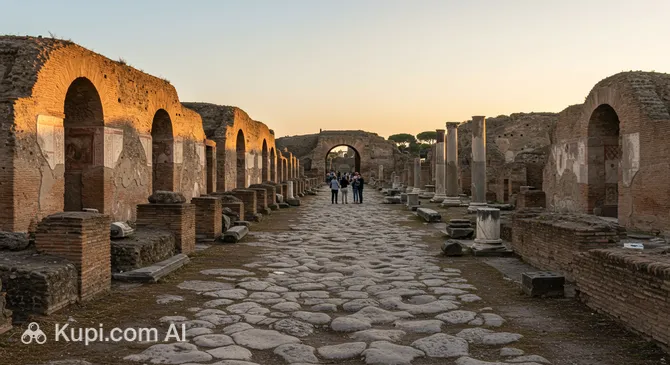
Ostia Antica. Illustration.
Source: Kupi.com AI

Traveler photos:

What makes Ostia Antica so special is its incredible state of preservation. Unlike the Eternal City of Rome, where ancient structures are intertwined with the architecture of subsequent eras, Ostia was abandoned by its inhabitants in the 9th century AD. Because of this, the city was "frozen" in time, keeping its appearance virtually unchanged for centuries. This provides a rare opportunity to see an ancient Roman city in its nearly original form.

A walk through the ancient paved streets of Ostia, past the ruins of temples, public baths (thermae), apartment blocks (insulae), and warehouses, immerses you in the atmosphere of a long-gone era. Here you can explore the remains of an ancient theater, a marketplace, and even ancient eateries. Visitors often note that the only reminder of the modern world is sometimes the planes taking off from nearby Fiumicino airport and flying over the two-thousand-year-old ruins, creating a striking contrast between eras.

Contacts

Since Ostia Antica is a vast archaeological park, it is recommended to visit the official website or contact tourist information centers in Fiumicino or Rome for the most up-to-date information on opening hours, ticket prices, and available tours. You can also clarify details upon arrival.

The most convenient way to reach Ostia Antica from Rome is by the Roma-Lido suburban train, which departs from the Porta San Paolo station (next to the Piramide metro station). You need the Ostia Antica stop; the trip takes approximately 30-40 minutes, and the entrance to the archaeological park is just a few minutes' walk from the station.

How to contactContact
AddressViale dei Romagnoli, 717, 00119 Roma RM, Italy
Phone number+39 06 5635 8099
Websitewww.ostiaantica.beniculturali.it

What to Do

A visit to Ostia Antica is a true journey back in time, allowing you to immerse yourself in the daily life of the Roman Empire. Here, you can explore numerous ruins that eloquently tell the story of the city's former greatness. The heart of ancient Ostia was the Forum—the main square where you can still see the majestic remains of the Capitolium, a temple dedicated to the primary Roman deities: Jupiter, Juno, and Minerva. Nearby are the ruins of the Temple of Rome and Augustus, a reminder of the political and religious life of the ancient port.

The impressive ancient theater of Ostia deserves special attention. Imagine that it once held nearly 4,000 spectators, and even today its stage comes to life during concerts, creating a unique atmosphere. Walk along the Decumanus Maximus, the city's main street, where the ruts from ancient wagon wheels are still visible—it feels as though you might hear the clatter of hooves and the roar of the crowd at any moment. This is a unique opportunity to feel the rhythm of life that bustled here centuries ago.

As you explore Ostia Antica, you will also discover the everyday lives of its residents. Peek into the insulae—multi-story apartment buildings where the townspeople lived. Visit the ancient thermae (public baths), such as the Baths of Mithras, the Marine Baths, or the Baths of Neptune, and imagine how Romans spent their time there. The remains of ancient bars, taverns, and thermopolia (ancient Roman snack bars) are remarkably well-preserved, where you can almost smell the aromas of the past. Additionally, within the complex, you will find ruins of private houses, other temples, old barracks, bakeries, and even laundries, as well as places of worship for the mysterious god Mithras.

Getting There

While many travelers prefer to reach Ostia Antica from Rome by train due to the convenient direct connection, those who value independence might consider driving. From Rome, the Via del Mare or the Roma-Fiumicino (A91) highway leads to the ancient port; simply follow signs for "Ostia Antica." Keep in mind that there are parking areas near the archaeological zone, though they can fill up during the peak tourist season.

Since the Ostia Antica archaeological complex is located within the territory of Fiumicino, getting there from various parts of Fiumicino itself or from the airport is quite simple. You can use local bus routes that connect the city to the park, or choose a short taxi ride. It is recommended to check the current route numbers and bus schedules in advance at tourist information centers or online to ensure your visit goes as smoothly as possible.

If you are heading to Ostia Antica directly from central Rome and prefer maximum comfort, you might consider taking a taxi or using a ride-sharing app. This option will be more expensive than public transport, but it can be convenient for small groups or travelers with luggage, providing door-to-door service to the entrance of the archaeological park.

Nearest city: Fiumicino

History & Facts

Ostia Antica, whose name derives from the Latin word 'ostia' meaning 'mouth,' was founded, according to legend, as early as the 7th century BC. The city owed its birth to its strategic location at the mouth of the Tiber River. Almost from its inception, Ostia played a vital role in the life of Ancient Rome, becoming its main gateway to the sea and a key hub of bustling trade, supplying the capital of the Roman Empire with everything it needed.

During the height of the Roman Empire, Ostia Antica transformed into a flourishing and densely populated port city. A magnificent infrastructure was established here, as evidenced by the impressive ruins today. The city boasted well-planned residential quarters, grand public buildings, numerous temples, famous Roman baths, and, of course, entertainment venues for its citizens. Political and economic life bustled in Ostia, centered around the Forum with its Capitolium, the Curia (where the city council met), and the Basilica, which served as a law court.

One of the most remarkable facts about Ostia Antica is its extraordinary level of preservation. The city was finally abandoned by its inhabitants in the 9th century AD, and since then, it has remained virtually untouched by time. This turned ancient Ostia into a unique archaeological reserve. Unlike many other ancient cities, there are no later layers here, allowing modern visitors to see what a typical city of the Roman Empire actually looked like during its peak.

Time Needed

When planning a visit to Ostia Antica, keep in mind that it is an extensive archaeological park, and the time needed to explore it can vary greatly depending on your interest in history and detail. For a general overview of the main highlights, such as the theater, the forum, and the primary streets, you will need at least 2-3 hours. This is enough time to get a first impression and see the most iconic ruins.

However, to truly immerse yourself in the atmosphere of the ancient city, explore the side streets, peek into the numerous insulae (apartment blocks), thermae (baths), and warehouses, and carefully examine the mosaics and frescoes, it is recommended to allocate at least 4-6 hours, or half a day. Some travelers, especially those passionate about archaeology and ancient history, enjoy spending a whole day here, leisurely wandering among the ruins and absorbing the spirit of the past.

Please note that the territory of Ostia Antica is quite large, and you will be doing a lot of walking, often on the uneven surfaces of ancient stone streets. Therefore, if you plan a long visit, be sure to wear comfortable shoes and bring water, especially during the hot season. Ultimately, how much time you spend in Fiumicino exploring ancient Ostia depends on your pace and how deeply you wish to dive into the history of this remarkable corner of Italy.

Working Hours

The Ostia Antica archaeological park is usually open to visitors year-round; however, opening hours may change depending on the season (for example, the park may stay open longer in summer and close earlier in winter due to shorter daylight hours). Generally, the ticket offices close one hour before the park's final closing time. To get the most accurate and up-to-date information on hours for the specific date of your visit, it is strongly recommended to check the official Ostia Antica archaeological park website or contact them directly. Also, keep in mind that the park may be closed on certain public holidays.

While advance ticket booking for Ostia Antica is not always mandatory, especially during the low season, it can be a good idea if you plan to visit during the peak tourist season or on weekends to avoid potential queues. Some special guided tours or events may require advance registration. It is also best to check the official website or tourist information centers in Fiumicino for booking requirements.

DayOpening hours
MondayClosed
Tuesday8:30 – 15:30
Wednesday8:30 – 15:30
Thursday8:30 – 15:30
Friday8:30 – 15:30
Saturday8:30 – 15:30
Sunday8:30 – 15:30

Nearby

A visit to Ostia Antica is undoubtedly the highlight for many tourists visiting Fiumicino. However, to make your journey even more enriching and complete, it is worth exploring other interesting places nearby. Investigating the surroundings will allow for a deeper understanding of the history and culture of this region of Italy, as well as add variety to your travel experiences.

Near the majestic ruins of the ancient port, you will find both historical monuments and modern spots where you can relax and enjoy the atmosphere of an Italian town. By expanding your itinerary, you can gain a fuller perspective of Fiumicino and its unique heritage. Here are a few attractions near Ostia Antica that might interest you:

NameDistance
Theatre of Ostia0.2 km
Castle of Julius II0.7 km
Necropolis of Porto2.8 km
Parish of Saint Mary Queen of Peace2.9 km
QuarantunoDodici Restaurant & Bar3.1 km
Mit Bistrot3.2 km
Canal Park of the Stagno3.3 km

Have you reached the end of the page?

So the route has been studied inside and out