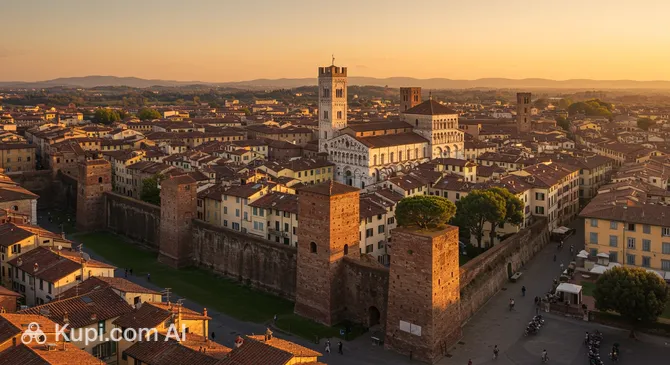
Lucca is a true gem of Tuscany, where time seems to slow down, giving way to beauty and harmony. Nestled comfortably on the western bank of the Serchio River, this city embodies all the best that Italy is famous for. Located just 20 kilometers from the Ligurian coast, Lucca offers travelers a unique combination of cultural richness and a relaxed atmosphere.
Lucca. Illustration.
Source: Kupi.com AI
With a population of about 89,000, the city maintains a wonderful sense of intimacy, avoiding the bustle of overcrowded metropolises. The main feature of its architectural appearance is the massive Renaissance fortress walls that completely encircle the historic center. The ancient history of Lucca is felt everywhere here, but it is these wide walls, transformed into a green boulevard, that have become a favorite spot for promenades and bike rides for both locals and tourists alike.
Inside the fortress ring, a labyrinth of cobbled streets, majestic churches, and medieval towers awaits you. Here, it is easy to feel the authentic Italian flavor: the scents of fresh pastries, the ringing of bicycle bells, and cozy squares bathed in sunlight. Lucca is a city that is definitely worth visiting for inspiration, tranquility, and the chance to enjoy a cup of espresso in the shade of century-old plane trees.
Weather Overview
The climate in this corner of Tuscany can be described as temperate and pleasant, making the city attractive for visiting at any time of year. Summer in Lucca is warm and sunny: in July and August, the average temperature stays around 23°C, and during the day, the air often warms up to a comfortable 27–28°C. During this period, rains happen less frequently, especially in July, when the minimum amount of precipitation is recorded.
Winter here is mild and not at all harsh. In the coldest months, January and December, the average temperature is about 6–7°C, and night frosts are very rare (the minimum usually does not drop below 2–3°C). However, the high humidity should be taken into account: December and May often become record holders for the number of rainy days.
Expect a warm summer with occasional rain and cool, wet winters. Spring comes gradually, with temperatures rising from 8°C in March to 15°C in May, but an umbrella for a spring trip will not be superfluous. To plan your wardrobe accurately for the trip, we recommend checking the current weather in Lucca for the dates you are interested in.
Average monthly temperature
Average monthly precipitation
Interesting Facts
In addition to its main architectural masterpieces, Lucca holds many fascinating secrets and unique traditions that make this city special even compared to its famous Tuscan neighbors.
It is one of the few cities in Italy where the ancient fortifications have survived completely rather than being dismantled for stone. The majestic Walls of Lucca stretch for 4 kilometers and today serve not for defense, but for recreation: a picturesque alley for walking and cycling is laid out along their wide crest.
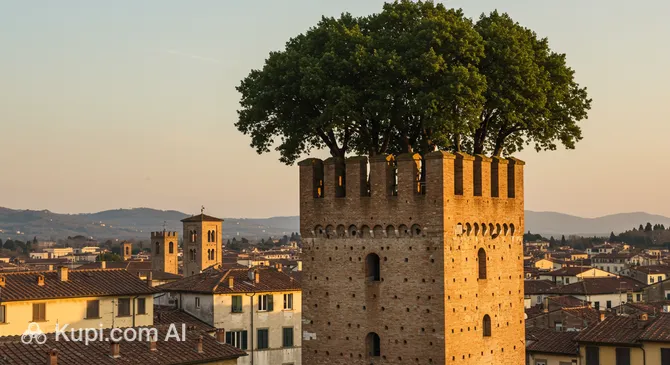
The city's most recognizable skyline feature, the Guinigi Tower, is known for its unusual "living" decoration. At its summit, at a height of over 40 meters, there is a real garden with centuries-old holm oaks — an amazing sight that symbolizes rebirth and never fails to impress tourists.
Lucca is the birthplace of the renowned opera genius Giacomo Puccini, and music is literally in the air here. Art lovers can visit the Puccini Museum, and during regular festivals, arias from his operas ring out directly in the city squares.
Mystery seekers will find an interesting detail while examining the Lucca Cathedral. Carved onto its facade is a small but mysterious bas-relief called the "Magic Labyrinth," which, according to legend, served as a symbolic reminder to pilgrims of the complexity of life's journey.
Guinigi Tower. Illustration.
Source: Kupi.com AI
Traveler photos:
How to Get There
Getting to this picturesque Tuscan city is quite easy thanks to its convenient location relative to Italy's major transport hubs. You can find more details on how to get to Lucca, but the region's main air and rail gateways are in nearby major cities, from which it is easy to reach your destination by train, bus, or car.
The nearest and most convenient option is Pisa International Airport (IATA: PSA), also known as Galileo Galilei. There is no airport in the city of Lucca itself, but this aviation hub is located in the city of Pisa, just 20 km from the center of Lucca. This is the main airport of Tuscany, receiving many flights. The trip by taxi or transfer will take only about 25–30 minutes.
The second popular option is Florence Peretola Airport (IATA: FLR), located in the city of Florence. It is approximately 55 km from Lucca. This is an excellent choice if you plan to combine your trip with a visit to the regional capital. Travel time by car is about 50–60 minutes.
If you cannot find convenient tickets to Pisa or Florence, consider Guglielmo Marconi Airport (IATA: BLQ) in Bologna. It is further away, about 99 km from Lucca, but is a major international hub with a large number of flights. The drive from there takes about 1 hour and 30 minutes.
For clarity, here is a summary of the main airports:
Regarding rail connections, Lucca is integrated into the regional network; however, high-speed trains usually arrive at major stations in neighboring cities. One of the key hubs is Florence Santa Maria Novella Station. This station is not in the city of Lucca; it is located in Florence, about 59 km away. It is one of Italy's busiest stations, with trains arriving from all over the country. From here, regional trains run regularly directly to Lucca, with a travel time of about 1 hour and 20 minutes.
Another important transport hub is Bologna Centrale in the city of Bologna (about 99 km from Lucca). This is a strategic intersection for many railway lines. After arriving here by high-speed train, you can transfer to a regional train or rent a car to reach Tuscany in about an hour and a half.
Below is a table with the nearest major railway hubs through which it is convenient to plan your route:
Lucca is an incredibly compact city, so the main architectural treasures are within walking distance of each other. Strolling through the historic center, you will encounter majestic basilicas, elegant palazzos, and cozy squares preserving the spirit of past centuries at literally every step.
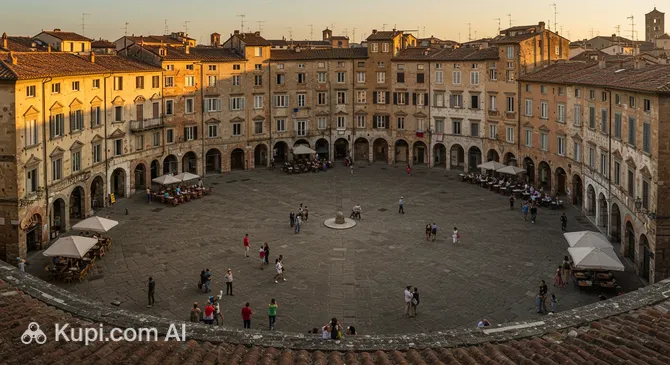
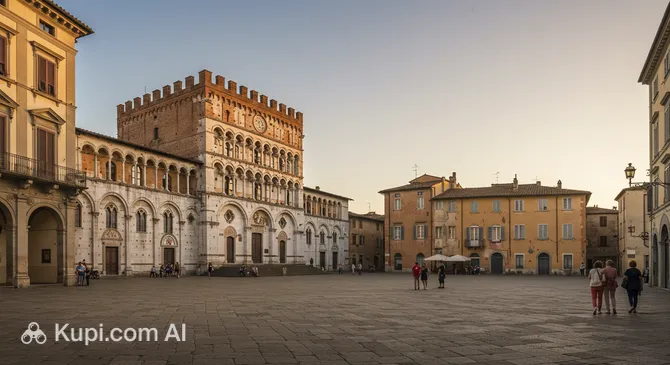
One of the most photographed and unusual locations is Piazza dell'Anfiteatro. This square is unique for its enclosed oval shape: it was built exactly on the foundation of an ancient Roman amphitheater. Today, there are no gladiator fights; instead, a cozy atmosphere reigns with many cafe tables set right on the cobblestones and colorful medieval houses surrounding the space in a tight ring.
Piazza dell'Anfiteatro. Illustration.
Source: Kupi.com AI
Traveler photos:
In the heart of the city, on the site of the ancient forum, rises the magnificent Church of San Michele in Foro. Its white marble facade is striking for the complexity of its carvings, tiers of arcades, and numerous columns, no two of which are alike. At the top of the church stands a four-meter statue of the Archangel Michael, which, legend has it, sparkles with a special brilliance thanks to a precious stone in the saint's ring.
The city's main religious building is the Lucca Cathedral (San Martino). An observant tourist will immediately notice its unique feature — an asymmetrical facade, the right arch of which is smaller than the others due to the adjacent bell tower. Inside the cathedral, priceless masterpieces of art are kept, including the famous wooden crucifix "Holy Face" (Volto Santo) and the exquisite marble sarcophagus of Ilaria del Carretto.
Art lovers and fans of luxurious interiors should stop by the National Museum of Palazzo Mansi. This palace is a vivid example of Baroque luxury, where original interiors, antique furniture, and an impressive collection of Flemish tapestries have been preserved. A walk through the palace halls allows you not only to enjoy the paintings in the pinacotheca but also to feel how the wealthy aristocracy of Lucca lived in the 17th and 18th centuries.
Local Cuisine
A gastronomic journey through Lucca is an immersion into the world of authentic Tuscan flavors, where simplicity of ingredients is combined with masterful preparation. Local cuisine is famous for being hearty and using the freshest farm products. The foundation of many recipes is the famous Tuscan bread, which is baked here without salt so that it perfectly complements the flavor of rich meat dishes, sauces, and savory cheeses.
Among the main dishes that are definitely worth trying, tortelli lucchesi stand out. This is a type of pasta resembling large ravioli, generously filled with minced meat and served with a thick meat ragu; traditionally prepared for holidays, they can be found in restaurants at any time. Another hallmark of the city is the thick and flavorful spelt soup (zuppa di farro), which will warm you up on a cool day. For lovers of unusual flavors, "cibreo" — a delicate stew made from chicken giblets — will be an interesting discovery.
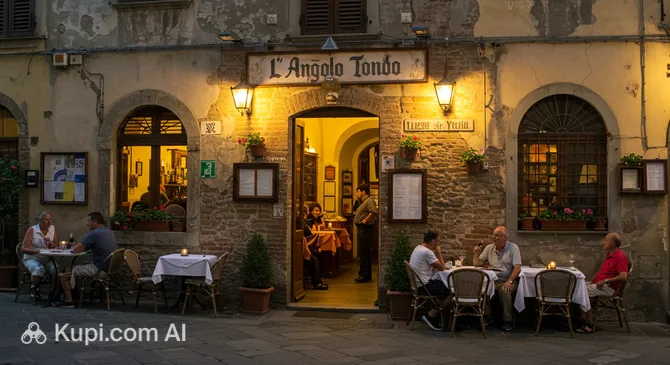
L'Angolo Tondo. Illustration.
Source: Kupi.com AI
Traveler photos:
No lunch in Lucca is complete without a glass of local wine. The Tuscan hills provide magnificent red and white wines that perfectly complement the meal. A special place in the hearts of locals is held by the dessert buccellato di Lucca. This is a ring-shaped sweet bread with raisins and anise. There is even a saying: "Those who have been to Lucca and haven't tried buccellato haven't been to Lucca." It is often eaten dipped in wine or enjoyed with a cup of coffee.
The food culture here encourages a slow pace. It is customary to start the morning in cozy coffee shops, such as Pasticceria Stella, where the displays are bursting with fresh pastries. Locals prefer to have lunch and dinner in osterias and trattorias, many of which are located in historical buildings. For example, the restaurant L'Angolo Tondo offers guests exquisite dishes in an atmospheric setting. And if you are looking for a place for an evening aperitivo, it is worth stopping by Franklin 33 Bar to feel the lively atmosphere of the night city.
Travel Tips
Lucca is an incredibly cozy and welcoming city, but even in this peaceful corner of Tuscany, there are nuances that will make your trip much more comfortable. We have gathered some practical recommendations to help you avoid typical tourist mistakes and feel right at home.
Clothing and belongings: It can be hot in the city in summer, so choose light natural fabrics and be sure to bring a hat. In winter and spring, the weather is changeable, so a waterproof jacket and an umbrella won't go amiss. Most importantly — comfortable shoes with flat soles. The historic center is paved with ancient cobblestones, and high heels are completely unsuitable for walks along the fortress walls. Remember the dress code: when visiting active churches, shoulders and knees should be covered.
Transport: Inside the fortress walls, the best way to get around is on foot or by bicycle. Lucca is perhaps the most bike-friendly city in Italy; two-wheeled transport is literally everywhere here. Renting a car to see the city itself is unnecessary and even counterproductive due to the narrow streets. For trips to neighboring Pisa or Florence, regional trains are ideal — the station is located right by the city walls.
Finances: Currency — Euro (€). Bank cards are accepted in most restaurants and shops, but always have some cash with you (5–20 euro bills) for paying for coffee, ice cream, or souvenirs in small shops. ATMs (Bancomat) are everywhere. Tipping is not a strict obligation, as a service charge ("coperto") is often included in the bill, but leaving 1–2 euros or rounding up the amount is considered good manners.
Health and Safety: Lucca is a very safe city where you can peacefully walk even in the evening. Pharmacies are marked with a green flashing cross, and you can always get advice from a pharmacist. Water from street fountains is safe to drink — it is clean and tasty. As in all tourist places, just keep an eye on your bags in crowds, although pickpockets are much less common here than in Rome or Milan.
Communication: In the center, restaurant and hotel staff speak English well. However, in small family-run shops, knowing a few phrases in Italian ("Buongiorno" — good day, "Grazie" — thank you) will help you get better service and a sincere smile. Free Wi-Fi is available in many cafes, but for reliable connection and maps, it is better to buy a local SIM card (TIM, Vodafone, WindTre) at mobile phone shops or tobacco kiosks (Tabacchi).
Local Etiquette: Italians value politeness highly: when entering a shop or cafe, be sure to say hello. At markets and vegetable stalls, you must not touch the produce with bare hands — it is considered bad manners and unhygienic. Use disposable gloves or ask the seller to pick the items for you.
What to avoid: Categorically avoid driving a car into the historic center behind the fortress walls unless you have a special permit. This is a ZTL (Zona a Traffico Limitato) zone, and cameras will automatically issue you a hefty fine. Also, you shouldn't order a cappuccino after lunch or dinner — for Italians, this is exclusively a morning drink, and such an order will immediately mark you as a tourist.
Additional tip: Be sure to set aside time to rent a bicycle (or a pedal car for the whole family) and ride a full circle along the top of the fortress wall. This is a unique feature of Lucca: the walls are transformed into a wide green boulevard 4 km long, where there are no cars, but there are stunning views of the city and the surrounding mountains.
Following these simple tips, you can avoid minor troubles and fully immerse yourself in the atmosphere of the Italian dolce vita. We wish you unforgettable impressions, easy walks, and the most delicious gastronomic discoveries in sunny Lucca!
Entertainment & Nightlife
Lucca offers its guests entertainment that perfectly harmonizes with its aristocratic and calm character. You won't find noisy discos thumping until morning here; instead, the city immerses travelers in an atmosphere of high culture, refined festivals, and cozy evenings over a glass of Tuscan wine.
The city's cultural life is inextricably linked with the name of Giacomo Puccini. Opera fans can not only visit the Puccini Museum, located in the house where the composer was born, but also enjoy his music performed live. Concerts are regularly held in the city, where the maestro's arias resonate within the interiors of ancient basilicas, creating a unique mood.
Despite its classical appearance, the city serves as a venue for world-scale events. In summer, the famous Lucca Summer Festival takes place here, bringing top-tier stars to the stages of the historic center. And in autumn, the streets are filled with comic book and video game characters: the Lucca Comics & Games festival is considered the largest event of its kind in Europe, turning the medieval fortress into a fantastic stage set.
Evening life in Lucca centers around the tradition of the aperitivo. As the sun sets, locals and tourists fill the outdoor terraces. Franklin 33 Bar is particularly popular, where you can try signature cocktails in a 1930s atmosphere. For those who prefer a quieter setting with dessert and coffee, the historic Pasticceria Stella is well worth a visit.
Shopping enthusiasts should head to the city's main shopping artery — Via Fillungo. Strolling among elegant storefronts integrated into ancient facades, you will find both boutiques of famous Italian brands and unique shops of local artisans offering leather goods, jewelry, and traditional embroidery.
For active recreation, the Walls of Lucca remain the constant center of attraction. The wide alley atop the bastions is ideal for morning jogs or bike rides. Here, you can rent a bicycle or a rickshaw for the whole family and take an unforgettable victory lap above the city, enjoying the panorama of rooftops and towers.
Parks & Museums
Lucca harmoniously combines the stone majesty of the Middle Ages with the freshness of green oases, offering tourists a perfect balance between educational excursions and outdoor relaxation. The city is famous not only for its architectural masterpieces but also for its surprising garden and park areas, which are found in the most unexpected places — from fortress ramparts to tower rooftops.
The city's main green space is undoubtedly the Walls of Lucca. This is not just a historical monument, but a full-fledged circular park over 4 kilometers long. Wide alleys lined with century-old plane trees, chestnuts, and oaks create deep shade even on a hot afternoon. There are no cars here, but plenty of lawns for picnics, benches for reading, and play areas. It is the perfect place to feel the rhythm of life of the locals, who come here for jogs or family walks.
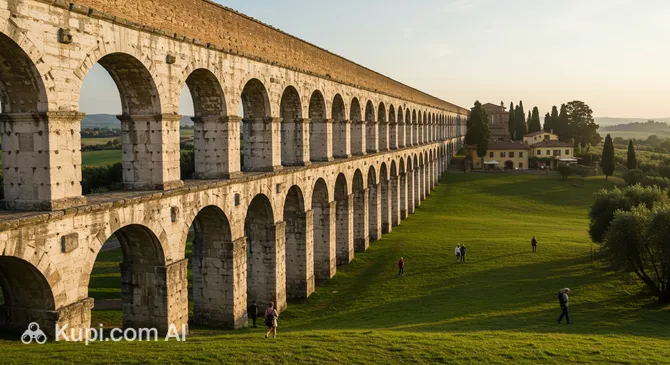
For those seeking solitude and picturesque landscapes outside the center, a route along a structure like the Nottolini Aqueduct will be a real discovery. This grandiose 19th-century engineering structure, resembling Roman ruins, stretches from the foot of the mountains to the city. A convenient pedestrian trail is laid out along its arches, surrounded by Tuscan fields and greenery. A walk here allows you to enjoy the silence and take magnificent photos, especially during the golden hour before sunset.
Nottolini Aqueduct. Illustration.
Source: Kupi.com AI
Traveler photos:
Speaking of Lucca's gardens, it is impossible not to mention the unique "sky garden" that crowns the Guinigi Tower. Climbing to a height of 45 meters, you will find yourself in the shade of seven holm oaks growing right on the roof. This is a surreal sight and a rare opportunity to see the city from a bird's-eye view through the leaves of the trees.
The city's museum map is no less rich. Music and history buffs should definitely visit the Puccini Museum. It is located in the apartment where the great composer was born. The exhibition carefully preserves the maestro's personal belongings: his piano, scores with notes, stage costumes of his opera characters, and letters. An intimate atmosphere reigns here, allowing you to touch the life of the genius who made Lucca famous throughout the world.
For lovers of painting and luxurious interiors, the National Museum of Palazzo Mansi opens its doors. Besides its magnificent collection of tapestries, it houses an impressive pinacotheca with canvases by Italian masters. And if you are interested in the region's political history, take a look at the majestic Ducal Palace of Lucca on Piazza Napoleone. Its state rooms are decorated with frescoes and stucco, and it often hosts temporary exhibitions of contemporary art and photography.
Insider tip: If you go for a walk along the aqueduct, reach the spot known as Golden Words (Parole d'Oro). This is a small monument-bridge with an inscription in brass letters, located in a picturesque wooded area. Locals love this place for its cool streams and peaceful atmosphere, hidden away from the main tourist flows.
Getting Around
Lucca's transport system has its own unique features due to the city's historical architecture. Since the historic center is compactly located within the fortress walls, the need for complex public transport here is minimal. There is no metro or tram system, and walking remains the primary way for tourists to get around. Nevertheless, an established bus network operates for connections to the outskirts and neighboring areas.
The only form of public transport in the city is buses, operated by the regional operator Autolinee Toscane. Routes are divided into urban (urbano) and suburban (extraurbano). The main transport hub within the walls is Piazzale Verdi — this is where most buses arrive and from here it is convenient to start trips outside the center. Small eco-friendly electric buses (navette) run through the narrow streets of the old city, connecting parking lots and main attractions without harming the ancient buildings.
The fare payment system is unified. A ticket for a single trip (usually valid for 70–90 minutes) costs about 1.50–1.70 euros when purchased in advance. You can buy tickets at newsstands, tobacco shops with a Tabacchi sign (marked with a "T"), or at ticket offices at the bus station. Also, the mobile app "at bus" (Autolinee Toscane) is becoming increasingly popular, where you can buy a digital ticket. Drivers rarely sell tickets and, as a rule, they cost more.
It is critical to remember the validation rules. Upon entering the bus, you must immediately stamp your paper ticket in a special yellow or green machine. For digital tickets in the app, activation is also required upon boarding. Inspectors work frequently, and fines for unpaid or unvalidated travel can be quite substantial.
However, the most popular and authentic "transport" in Lucca is the bicycle. The city is perfectly suited for two-wheeled transport: it has flat terrain and car traffic in the center is limited. Bike rental points (noleggio bici) are literally at every turn, especially near the main city gates. Renting a bike for an hour or for the whole day is the best way to feel like a local and ride with the breeze along the wide alley on the fortress walls.
If you need to get somewhere quickly or with heavy luggage, you can use a taxi. It is important to know that in Lucca, it is not customary to "hail" a cab on the street. You should look for a car at special stands (for example, at the station or on Piazza Napoleone) or order by phone through the Radio Taxi service. Apps like Uber work limitedly or not at all here, so a classic phone call remains the most reliable option.
For those traveling by car, remember the strict limited traffic zone (ZTL) inside the fortress walls. Entry is permitted only to residents and special vehicles. Cameras record violations automatically, so tourists are strongly advised to leave their cars in paid parking lots (parcheggi a pagamento) located along the outer perimeter of the walls and enter the city on foot.
Accommodation
Choosing accommodation in Lucca is an opportunity to find the perfect balance between historical charm and modern comfort. The city offers a wide range of accommodation options: from cozy family-run guesthouses (B&B) and budget hostels to luxurious apartments in ancient palazzos and boutique hotels. It is difficult to find huge chain hotels here; instead, intimate establishments predominate, where the owners personally care for their guests, creating a home-like atmosphere.
The most desirable place to stay is undoubtedly the historic center within the city walls. By staying here, you will be within walking distance of the main attractions. Imagine waking up and immediately heading out for a walk to the famous Piazza dell'Anfiteatro or drinking your morning coffee with a view of medieval towers. However, it is worth remembering that car access to this zone is strictly limited (ZTL), so if you are traveling by car, check with the hotel in advance regarding parking or an entry permit.
Piazza Napoleone. Illustration.
Source: Kupi.com AI
Traveler photos:
For those traveling by car, the areas just outside the city walls are an excellent option. Accommodation here is often slightly cheaper, rooms are more spacious, and parking problems are much fewer. At the same time, the city center can be reached on foot in just 10–15 minutes through one of the historical gates, such as Porta San Pietro. Also popular in the vicinity of Lucca are agriturismos — restored farmhouses and villas set among vineyards and olive groves, offering complete immersion in the Tuscan countryside.
Booking tip: Lucca is a popular destination, so it is better to look for accommodation in advance, especially if your trip falls during the summer season (July–August). It is critical to book rooms several months ahead if you plan to visit the city during major events, such as the Lucca Comics & Games festival (late October – early November) or the Summer Festival music event. On these dates, the city is overcrowded, and prices skyrocket.
The price range varies from budget (small guesthouses and hostels) to high (exclusive hotels in historical buildings). Booking is most convenient through popular international online platforms where you can read reviews, but many small apartments and villas also accept direct bookings through their websites, sometimes offering a small discount or a welcome bonus.
Nearby Cities
For those who want to explore the surrounding area, Lucca serves as an excellent starting point for day trips to several interesting nearby places. The city's convenient location allows you to reach world-famous landmarks or the seacoast in just half an hour, making your journey through Tuscany even richer.
An absolute favorite for a short trip is Pisa, located just 16 km from Lucca. This city needs no introduction: millions of tourists come here to see the famous Leaning Tower on the Square of Miracles. However, Pisa is not just the tower, but also a lively university city with a beautiful promenade along the Arno River and atmospheric medieval quarters.
If you want to swap medieval walls for a sea breeze, head to Viareggio. This popular resort on the Versilia coast is about 22 km away. It is famous for its endless sandy beaches, elegant Liberty-style architecture, and one of the most grandiose carnivals in Italy. A stroll along the seaside promenade with an ice cream is a great way to end the day.
For lovers of quiet and aristocratic luxury, Capannori is worth noting. Located almost in the suburbs of Lucca (just 5 km away), this area is known for its magnificent historical villas (Villa Torrigiani, Villa Reale), surrounded by luxurious gardens and parks that are open to visitors.
City
Population
Distance
Capannori
46 072
5 km
Porcari
8 904
8 km
San Giuliano Terme
31 447
11 km
Vecchiano
12 082
12 km
Chiari
18 944
13 km
These nearby destinations provide a glimpse into the region's diverse culture and landscapes, from architectural masterpieces to relaxed beach holidays.
Shopping & Souvenirs
Shopping in Lucca is not just a shopping trip, but an elegant pastime in the setting of a medieval city. You won't find huge, noisy malls in the historic center; instead, the city offers strolls through winding streets dotted with boutiques, artisan shops, and old stores with Liberty-style windows. Lucca is famous for its traditions of silk and leather processing, as well as the high quality of local products, so purchases here often have an exclusive character.
The main shopping artery of the city is rightfully considered Via Fillungo. It crosses the historic center and is home to the most prestigious shops. Famous Italian clothing brands, jewelry salons, and historical cafes stand side by side here. Walking along Via Fillungo, pay attention to the signs: many shops have preserved their historical appearance from the early 20th century. Another important shopping area is Via Santa Croce, where you can also find many interesting boutiques and souvenir shops.
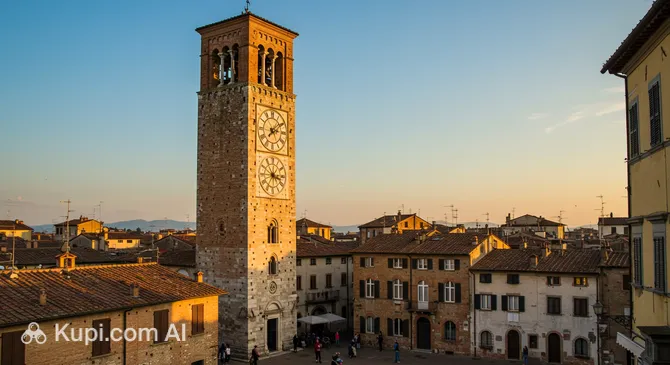
Torre delle Ore. Illustration.
Source: Kupi.com AI
Traveler photos:
Large shopping centers are located outside the fortress walls, which allows for the preservation of the authentic atmosphere of the old city. If you need large-scale shopping with mass-market brands and hypermarkets, you should head to the areas outside the wall ring, for example, toward the commercial zones along the ring road. Inside the city, trade is concentrated in small shops, family-run stores, and department stores.
Special attention should be paid to Lucca's markets. A true legend is the Antiques Market (Mercato Antiquario), which takes place every third weekend of the month. The stalls occupy the squares around the Lucca Cathedral and neighboring streets, offering unique antiques, furniture, jewelry, and books. This event attracts collectors from all over Europe. For gastronomy lovers, the farmers' markets are of interest, selling fresh vegetables, cheeses, and olive oil.
As souvenirs from Lucca, it is definitely worth bringing back local olive oil, which is considered one of the best in Tuscany thanks to its light and fruity taste. Another must-have is the famous sweet bread buccellato, which can be bought in historical bakeries like Pasticceria Stella. Leather goods, ceramics, and textiles reflecting the region's rich artisan traditions are also popular.
Shops in Lucca usually operate from 9:00 or 10:00 to 19:30, but it is worth remembering the traditional lunch break (siesta), which can last from 13:00 to 15:30. At this time, many small shops close. Bank cards and cash euros are accepted almost everywhere. In large tourist shops and boutiques for non-EU citizens, a Tax Free system is available. You can arrange a tax refund upon reaching the set minimum purchase amount, allowing for pleasant savings when leaving the country.