Support

Acquedotto Nottolini

About

Surrounded by picturesque Tuscan landscapes, the Nottolini Aqueduct is a majestic 19th-century engineering marvel located near the city of Lucca, Italy. It is an impressive Neoclassical monument that harmoniously combines strict functionality with refined aesthetics, its scale reminiscent of ancient Roman structures.
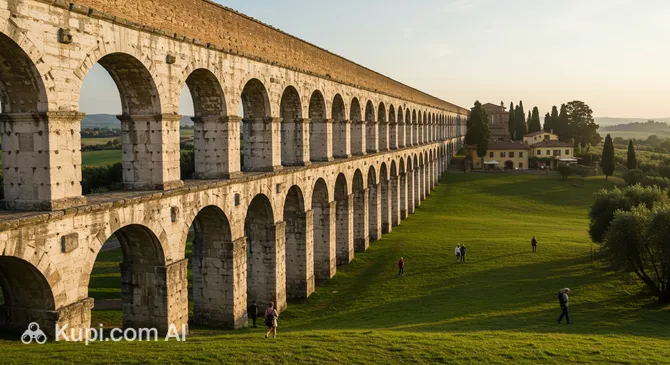
Nottolini Aqueduct
Nottolini Aqueduct. Иллюстрация. Источник: Kupi.com AI

Stretching for over 3 kilometers, the aqueduct consists of more than 400 brick arches that once carried pure mountain water from the Monte di Vorno springs to the heart of the city. The system operated solely by gravity, making it a masterpiece of hydraulic engineering for its time. Of particular interest are the stone cisterns, designed as small temples, which served for water collection and purification.

Today, the Nottolini Aqueduct is more than just a historical site; it is an ideal place for walks and photography. Although part of the structure was separated by a modern highway, most of the construction is perfectly preserved, offering tourists a unique opportunity to see how the technologies of the past transformed the Tuscan landscape.

Contacts

For those planning to visit this unique engineering feat, it is helpful to have the exact coordinates on hand. The site is freely accessible; however, having the official address will help you orient yourself and plan your route more accurately. Please note that the monument does not have direct communication channels through social media, so it is best to rely on general tourist information.

How to contactContact
AddressVia Tempietto, 388, 55100 Lucca LU, Италия
Phone+39 0583 416541

What to Do

The main highlight of visiting the aqueduct is a walk or bike ride along its endless arches. You can follow the route, admiring how the brick colonnade cuts through green fields and hills. It is an excellent spot for photography enthusiasts: the perspective of the receding arches creates truly epic shots, especially in the glow of the setting sun.

Be sure to visit the temple-cisterns. The first one, in the Guamo area, impresses with its classical architecture and serves as the starting point of the water's journey. The second, San Concordio, is located closer to the city and demonstrates how skillfully past engineers integrated technological hubs into the urban environment. Here you can examine the details of the filtration wells and understand the principles behind the entire system.

For those seeking solitude, the area around the aqueduct is a wonderful place for an outdoor picnic. The tranquil atmosphere of the Tuscan countryside, views of the Serra Vespaia mountains, and the sound of the wind through the arches allow you to temporarily forget the city bustle. If you are interested in industrial history, look for the preserved iron pipes and small bridges—they clearly show the evolution of 19th-century engineering.

Getting There

Getting to this architectural landmark in Lucca is quite simple, especially if you are traveling by train. The aqueduct is located in the southern part of the city, just a 10–15 minute walk from the Lucca Railway Station (Stazione Lucca). Exiting the station on the side opposite the historical center, you will see the start of the impressive arcade almost immediately.

For those who prefer cycling, Lucca offers excellent conditions: you can rent a bike in the city center for about 5–10 euros per hour. The path along the arches on Via Tempietto allows you to enjoy suburban views and old wells. If you are traveling by car, parking spaces are available near the main viewing points (for example, by the cistern temple).

A taxi from the city center is also a convenient option, and the trip takes only a few minutes. If you want to walk the entire route, it is recommended to start from the cistern in the Guamo area and move toward San Concordio, following the direction of the water flow that the mountains once provided to the city.

Ближайший город: Lucca

History & Facts

The history of this majestic structure began in 1823 at the initiative of Maria Luisa of Spain, Duchess of Lucca. The project was entrusted to the outstanding architect Lorenzo Nottolini, after whom the aqueduct is named to this day. Construction spanned nearly three decades and was completed only in 1851, serving as a triumph of Neoclassical engineering for its time.

Although the massive brick arches are often mistaken for ancient Roman ones, the aqueduct is a 19th-century creation. It was designed to deliver the purest water from the mountain springs of Monte di Vorno directly to the city's fountains. The engineering solution was flawless: water moved solely by force of gravity, passing through a system of gravel and stone filters in specialized cisterns resembling ancient temples.

In the early 20th century, between 1928 and 1932, the continuity of the structure was disrupted by the construction of the A11 motorway, which literally "cut through" the line of arches. Nevertheless, most of the structure remains in excellent condition. Today, the Nottolini Aqueduct is considered not just a monument of hydraulic engineering, but an important cultural landmark demonstrating the continuity of ancient traditions and modern-era technology.

Time Needed

To leisurely explore the main sections of the aqueduct and take beautiful photos, most travelers will need 1 to 2 hours. This is enough time to walk along the best-preserved arches and visit one of the majestic cisterns—San Concordio or Guamo.

If you plan to walk the entire 3-kilometer route or rent a bike to study the engineering features and surrounding landscape in detail, you should set aside about 3 hours. The aqueduct invites quiet contemplation, so there is no need to rush.

Working Hours

Since the Nottolini Aqueduct is an open-air historical monument and part of the landscape, it is accessible 24 hours a day. You can visit any day of the week, including weekends and holidays, to walk along the arches freely.

There are no ticket offices or restricted zones for most sections of the aqueduct; however, it is recommended to check for current information on official Lucca tourism portals before your trip, as restoration work may be underway on certain sections.

Круглосуточно

Nearby

A trip to the aqueduct can easily be combined with visits to other iconic landmarks that this region is so rich in. The variety of attractions nearby allows you to create a fulfilling itinerary, including both historical towers and entertainment spots for the whole family.

Exploring the surroundings will help you feel the atmosphere of old Tuscany more deeply, as many interesting sites are within walking distance or just a few minutes away by bike.

NameDistance
Lucca Cathedral0.6 km
Porta San Pietro0.6 km
Walls of Lucca0.7 km
Piazza Napoleone0.8 km
Ducal Palace of Lucca0.8 km
Guinigi Tower0.9 km
Torre delle Ore0.9 km

Reached the end of the page?

That means the route is fully explored