Support

Domus Romana Lucca

About

Once you find yourself in the heart of the ancient city of Lucca, it's easy to forget that entire layers of ancient history lie beneath the modern pavements. Domus Romana in Lucca is a unique archaeological museum that literally transports visitors two millennia back in time. Here, several meters below the foundation of a Renaissance building, the remains of a wealthy Roman house from the 1st century AD have been preserved.
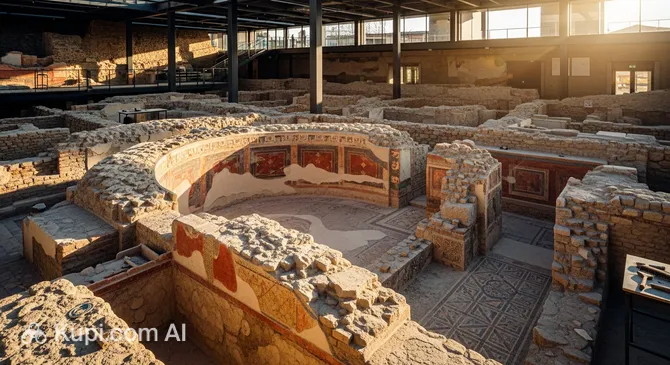
Domus Romana of Lucca
Domus Romana of Lucca. Иллюстрация. Источник: Kupi.com AI

This site in Italy is a rare example of how ancient architecture is woven into the fabric of a living city. The main gem of the exhibition is the famous "Child on a Dolphin" mosaic, which impresses with its refined execution. In addition to it, the museum displays fragments of frescoes, ancient masonry, and everyday items that allow you to visualize the daily life of the Roman elite in the colony of Luca.

The museum stands out for its atmosphere and authenticity. It is not just an exhibition of artifacts behind glass, but a real excavation site where every stone sits exactly where the builders of the imperial era laid it. Its high rating among travelers confirms that it is one of the most interesting "hidden" spots, a must-visit for history lovers.

Contacts

To clarify visiting information or book a tour, you can use the museum's official contact details. The administration usually responds promptly to tourist inquiries by phone.

How to contactContact
AddressVia Cesare Battisti, 15, 55100 Lucca LU, Италия
Phone+39 0583 050060
Websitewww.domusromanalucca.it

What to Do

A visit to Domus Romana begins with immersion: visitors are invited to watch a short film in Italian with English subtitles. The video visually recounts the history of the house's discovery and what Lucca looked like during the Roman period. This helps set the right mood before you see the ruins themselves.

The main reason people come here is the opportunity to see ancient mosaics from up close. You can study not only the famous "Child on a Dolphin" but also the geometric patterns that decorated the floors of noble citizens. Pay attention to the surviving fresco fragments on the walls and the remains of the hypocaust—you will see how the ancient underfloor heating system worked, which inspires genuine admiration for Roman engineering talent.

The museum has a quiet, almost mystical atmosphere. Photography is permitted (without flash), so you can capture the details of the ancient masonry as a souvenir. Thanks to the information panels and interior reconstructions, it is easy to understand the purpose of various rooms even without a guide, as you imagine people in togas once walking through these halls.

Getting There

Finding this archaeological site is quite easy, as it is located in the very heart of the historic center at Via Cesare Battisti, 15. If you are already walking within the city walls, the path from St. Martin's Cathedral or Piazza Napoleone will take no more than 5–10 minutes. The nearest city gates are Porta Santa Maria and Porta San Pietro, from which the museum is a 10–15 minute walk.

For those arriving in the city by train, Lucca railway station is approximately 1.5 km away. This distance is a pleasant 20-minute walk while enjoying the architecture, but you can also use a local bus or take a taxi directly from the station. If you are traveling by car, remember that the city center is a Limited Traffic Zone (ZTL). It is better to leave your car in one of the parking lots outside the walls, such as Parcheggio Carducci, and then continue on foot.

Getting around the city itself is most comfortable on foot or by bicycle. The narrow streets of Lucca were practically made for leisurely strolls, and smartphone navigation will easily guide you to the building—unassuming at first glance—that hides ancient treasures beneath it.

Ближайший город: Lucca

History & Facts

The history of this place is remarkable because it remained hidden from view for many centuries. Domus Romana in Lucca was only discovered by chance in 1973 during renovation and construction work in the basement of a 16th-century building. Archaeological excavations revealed the remains of a luxurious Roman mansion dating back to the 1st century BC – 1st century AD.

In antiquity, the city was called Luca and was an important strategic point in Etruria. Judging by the richness of its decoration, the discovered domus belonged to a very influential and wealthy citizen. The "Child on a Dolphin" mosaic is of particular historical value. This motif, popular in Roman art, is executed here with striking skill and is perfectly preserved, becoming a symbol of the museum and a living testament to the aesthetic preferences of ancient Tuscany's residents.

In addition to the living quarters, the excavations exposed elements of sophisticated ancient engineering—fragments of a hypocaust, a central heating system that distributed hot air under the floors. This proves that even thousands of years ago, the level of comfort in Roman homes was incredibly high. The museum was opened to the general public in the 1980s, allowing everyone to touch authentic stones that remember the heyday of the Roman Empire.

Time Needed

A visit to this museum won't take much time, making it an excellent addition to a busy walking itinerary. Most guests find 30–45 minutes sufficient to carefully examine the archaeological finds, study the information stands, and watch the introductory film.

If you are deeply interested in ancient archaeology and plan to examine every mosaic fragment and architectural drawing in detail, we recommend allowing about 1 hour for your visit. It is a small, intimate space that allows you to enjoy history in a quiet atmosphere without the hustle and bustle of large museum halls.

Working Hours

The museum welcomes visitors according to a schedule that includes a lunch break, which is typical for many cultural sites in Tuscany. Monday and from Wednesday to Sunday, the doors are open from 10:30 AM to 1:00 PM and from 3:00 PM to 5:00 PM. Please note that Tuesday is the closing day.

Since the schedule may change slightly depending on the season or special events, it is recommended to check the official website or verify the opening hours at the city's tourist information center before your visit.

DayWorking hours
понедельник10:30–13:00, 15:00–17:00
вторникЗакрыто
среда10:30–13:00, 15:00–17:00
четверг10:30–13:00, 15:00–17:00
пятница10:30–13:00, 15:00–17:00
суббота10:30–13:00, 15:00–17:00
воскресенье10:30–13:00, 15:00–17:00

Nearby

After immersing yourself in ancient history beneath the vaults of the domus, be sure to take some time to explore other iconic sites located just steps away. The entire city center is a unified architectural ensemble where Roman heritage sits alongside medieval towers and Renaissance squares.

A stroll through the surroundings will allow you to see the famous towers offering panoramic views of the city rooftops, as well as visit a unique square that has preserved the shape of an ancient Roman amphitheater. Below are the nearest points of interest:

NameDistance
Franklin 33 Bar0.1 km
Torre delle Ore0.2 km
Royal College of Lucca0.2 km
Puccini Museum0.2 km
Sottosotto0.2 km
L'Angolo Tondo0.2 km
Church of San Michele in Foro0.2 km

Reached the end of the page?

That means the route is fully explored