Support

Milan Cathedral

About

Milan Cathedral, also known as Duomo di Milano, is the heart and primary symbol of Milan. Officially named the Cathedral-Basilica of the Nativity of Saint Mary, it is one of the most significant and recognizable architectural masterpieces in Italy. This majestic cathedral, located in the historic city center, has been attracting travelers from all over the world for centuries.

The cathedral is built of white marble in a unique Flamboyant Gothic style, which creates a visual effect reminiscent of flickering flames. Its unmistakable silhouette is adorned with numerous spires, marble pinnacles, columns, and about 3,400 statues, each of which deserves individual attention. This complex and exquisite architecture makes the Duomo one of the greatest examples of Gothic art in the world.
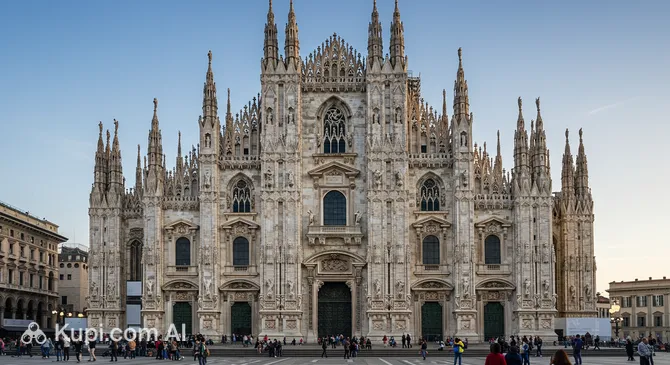
Milan Cathedral. Illustration.
Source: Kupi.com AI

Traveller photos:

In terms of size, Milan Cathedral is one of the largest in Europe. Among Gothic churches, it is second in capacity only to Seville Cathedral, and in Italy, only to St. Peter's Basilica in the Vatican. A visit to this grand structure, which can accommodate up to 40,000 people, leaves an unforgettable impression and allows you to touch centuries of history and culture.

Contacts

To plan your visit, check opening times, or purchase tickets, we recommend consulting official sources. All up-to-date information is available on the cathedral's website and via the contact details provided below.

How to contactContact
AddressP.za del Duomo, 20122 Milano MI, Italy
Phone+39 02 7202 3375
Websitewww.duomomilano.it

What to Do

A visit to Milan Cathedral offers tourists a wealth of experiences. Inside, rich decorations await you: thousands of statues, magnificent stained-glass windows creating a special atmosphere, and impressive architecture. A walk through the spacious naves allows you to fully feel the cathedral's grandeur, while the main altar, consecrated back in 1417, deserves special attention.

One of the main highlights of the cathedral that should not be missed is its rooftop. It offers breathtaking panoramic views of Milan, and on clear days, you can even see the Alps. Climbing up by stairs or elevator, you can not only take stunning photos but also get a close-up look at the numerous spires and sculptures that adorn the cathedral, appreciating the details of Gothic architecture from a unique perspective.

No less interesting is the cathedral's intricate facade, which was completed at the behest of Napoleon in the early 19th century. Interestingly, in the 15th century, Leonardo da Vinci himself was involved in the design work. He proposed the idea of "twin doors" (porta gemella)—a pair of doors with two arches, adding another historical touch to this multifaceted structure.

Getting There

Milan Cathedral is located in the very heart of Milan, on the city's main square—Piazza del Duomo—making it easily accessible for tourists. You can reach this iconic landmark in Italy in several convenient ways using the city's extensive public transport system.

The easiest and fastest way to reach the cathedral is by using the Milan Metro. You need the Duomo station, which is located at the intersection of two key lines: M1 (red) and M3 (yellow). The metro exit is right on the square, so you will immediately find yourself at the foot of the majestic cathedral.

In addition to the metro, the Piazza del Duomo can be reached by surface transport. Trams No. 2, 3, and 14 stop near the cathedral. You can also take one of the many bus routes that pass through the center of Milan. This option is perfect for those who want to combine their commute with a mini sightseeing tour of the city streets.

If you are staying in the central part of the city, a walk to the cathedral can be a pleasant addition to your day, as many hotels and other attractions are within walking distance. Alternatively, you can always use a taxi, which will quickly take you to Piazza del Duomo from anywhere in Milan.

Nearest city: Milan

History & Facts

The history of Milan Cathedral is a true epic spanning nearly six centuries. It all began in 1386, when the ruler of Milan, Gian Galeazzo Visconti, decided to erect a cathedral that would surpass all others. He made the bold choice of Flamboyant Gothic—a style completely atypical for Italy at the time—inviting masters from France and Germany to work on it. Legend even says the devil appeared to Visconti in a dream and ordered him to build a temple adorned with many demonic images, giving the project a mystical aura from the very start.

Construction progressed extremely slowly and was full of difficulties. The cathedral was intended as a symbol of the power of the Milanese dukes, a real "skyscraper of the Middle Ages," but changes in rulers often led to modifications of the original design. Sometimes new rulers even ordered the demolition of what their predecessors had built. In the 15th century, during the reign of Ludovico Sforza, even the genius Leonardo da Vinci was involved in the project, which testifies to the high level of ambition associated with this grand structure.

The construction stages stretched across centuries. Although the main altar was consecrated as early as 1417, the cathedral itself was only fully consecrated in 1572, and even then, it was far from finished. The facade only took on its final appearance in 1813 by personal order of Napoleon Bonaparte, who wanted the cathedral ready for his coronation as King of Italy in 1805. However, even after this, individual details were added until 1965, when the last of its famous doors was installed. Thus, the cathedral became more than just a building—it is a living chronicle reflecting the change of eras, styles, and rulers.

Time Needed

To fully enjoy the grandeur of Milan Cathedral and explore all its main sections, it is recommended to set aside 2 to 3 hours. This time is generally sufficient for a leisurely and detailed introduction to the landmark. By planning for such a window, you can explore the interior decorations, climb the famous rooftop, and admire the intricate facade and the surrounding square without rushing.

This amount of time allows you to immerse yourself in the cathedral's atmosphere: examine the impressive stained-glass windows and statues inside, and then head up to the roof for an unforgettable panoramic view of Milan. It is important to remember that during the high tourist season or on weekends, there may be queues at the entrance and for the rooftop ascent. Therefore, if you plan to visit during these periods, it is worth adding extra time to your schedule to avoid any haste.

Working Hours

Milan Cathedral is open to visitors daily throughout the year, except for January 1, May 1, and Christmas. Generally, the cathedral itself is open to tourists from 8:00 AM to 7:00 PM. It is important to note that the last entry is at approximately 6:10 PM. Access to the famous rooftop also has its own schedule, which depends on the season: during the summer period (usually from May to October) it is open from 9:00 AM to 7:00 PM, and in winter (from November to April) from 9:00 AM to 5:00 PM.

As opening hours may change due to religious holidays and special events, it is highly recommended to check the current schedule on the official cathedral website before your visit. To avoid long queues, especially at the height of the tourist season, we suggest purchasing tickets online in advance. This will not only save you time but also guarantee access to one of Milan's main attractions.

9:00 – 19:00

Nearby

Visiting Milan Cathedral is undoubtedly a key highlight for any traveler in Milan. However, to fully experience the atmosphere of this historic site, it is worth spending time in its surroundings. The area around the Duomo is packed with other iconic attractions located just steps away, which will help create a more comprehensive picture of the city's cultural and historical wealth.

A walk through the neighborhood will not only enrich your impressions but also allow you to see how closely history and modernity are intertwined in the heart of Milan. Many of these places are an integral part of Italy's cultural landscape and deserve your attention. Below is a list of interesting sites located in the immediate vicinity of the cathedral.

NameDistance
Royal Palace of Milan0.1 km
Galleria Vittorio Emanuele II0.2 km
Piazza della Scala0.4 km
Ca' Granda0.4 km
Hotel Milano0.6 km
Brera Art Gallery0.9 km
Villa Necchi Campiglio1 km

Reached the bottom of the page?

Looks like you know this route inside out