Support

Amphitheatre of Pompeii

About

The Amphitheatre in Pompeii is more than just ancient ruins; it is the oldest surviving Roman amphitheatre in the world, built back in 70 BC. This unique historical monument is located in the southeastern part of the ancient city, in modern-day Italy, and is one of the first stone structures of its kind, as amphitheatres were previously built primarily of wood.

The uniqueness of the amphitheatre's design is closely tied to the landscape. Its arena, measuring approximately 67 by 35 meters, is located below ground level, and part of the seating was excavated directly into the earth. The excavated soil was used to create embankments that support the upper tiers of seats. On two sides, the structure rests against the city's fortification walls, which was a practical engineering solution.

The facade of the structure is formed by two tiers of elegant arcades, giving it a sense of monumentality and grandeur. Visiting this site is an opportunity to touch living history and imagine how thousands of years ago, gladiatorial battles and other spectacles drew the residents of ancient Pompeii together.
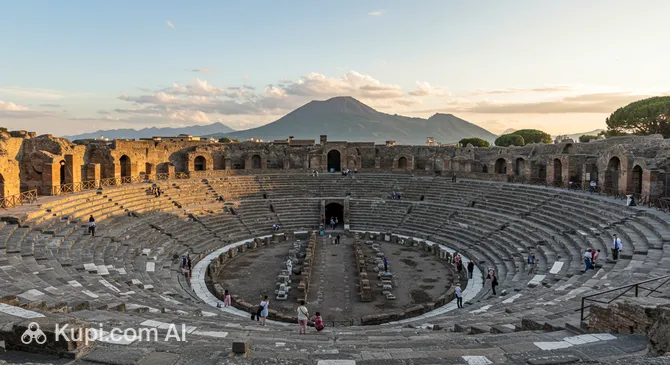
Amphitheatre of Pompeii. Illustration.
Source: Kupi.com AI

Traveler photos:

Contacts

Since the Amphitheatre is part of the larger Pompeii Archaeological Park, it is recommended to check official resources for all up-to-date planning information, including opening hours, ticket prices, and visiting rules. One of the park entrances is located directly by the amphitheatre at Piazza Anfiteatro.

How to contactContact
AddressPiazza Immacolata, 80045 Pompei NA, Italy
Phone number+39 081 857 5111
Websitepompeiisites.org

What to Do

Visiting the amphitheatre in Pompeii is a unique opportunity to immerse yourself in the atmosphere of Ancient Rome and explore the unique architecture of one of the first stone structures of its kind. As you walk through its ancient corridors and stands, you can see firsthand how the venue for gladiatorial combat and other mass spectacles that drew thousands of residents was organized. It is a true historical monument where every stone holds memories of events from two thousand years ago.

To get the most out of your visit, be sure to climb to the upper tiers of the amphitheatre. They offer breathtaking panoramic views of the entire arena as well as the surroundings of the ancient city. Afterward, head down to the arena floor itself to experience its scale and imagine yourself in the place of the gladiators who entered here to the roar of the crowd. This allows you to appreciate the acoustics and grandeur of the structure from completely different perspectives.

Remember that the Amphitheatre is an integral part of the massive Pompeii Archaeological Park. A visit here is usually included in the general route through the ancient city, allowing you to combine it with exploring other famous ruins, villas, and temples in modern Italy. This is a comprehensive adventure that will transport you back in time and leave you with unforgettable impressions.

Getting There

The Amphitheatre is located in the southeastern part of the famous Pompeii Archaeological Park. The most convenient way to reach the park is from Naples. One of the most popular options is the Circumvesuviana suburban train, which runs from Napoli Centrale station to the Pompei Scavi - Villa dei Misteri station. The journey takes about 30–40 minutes. You can also reach Pompeii by bus from Naples or Sorrento.

For those traveling by car, there are paid parking lots near the archaeological complex. After entering the park, you will need to walk to the amphitheatre, as it is located in the section furthest from the main entrance. Follow the signs and plan your route in advance to make your walk through the ancient city as comfortable as possible.

Nearest city: Pompeii

History & Facts

The history of the Amphitheatre in Pompeii is rich with fascinating details. Its construction around 70 BC was funded by the private means of two magistrates, Gaius Quinctius Valgus and Marcus Porcius. Interestingly, at the time, the structure was called "spectacula" (spectacle), as the term "amphitheatre" had not yet come into common use. Building the arena was not just an architectural project but a political gesture intended to demonstrate the "honor of the colony" and strengthen Roman influence in the city.

The early discovery of the amphitheatre by archaeologists in the 18th century allowed for a detailed study of the evolution of such structures in Ancient Rome. Its design differs significantly from later counterparts like the Colosseum. Engineers of the time cleverly utilized the landscape: two nearby fortress towers served as supports for tensioning a massive awning that protected spectators from the scorching sun. This solution demonstrates how practicality and adaptation to local conditions were vital for ancient builders.

The arena was not only a venue for entertainment but also a stage for real-life drama. In 59 AD, a notorious mass brawl broke out here between residents of Pompeii and visitors from the neighboring town of Nuceria. The conflict, which began as a verbal altercation, escalated into a bloody massacre involving weapons. As a result, by decree of the Roman Senate, gladiatorial games at the amphitheatre were banned for a full 10 years.

Nearly two millennia later, the amphitheatre found new life in the world of art. In 1971, the legendary British band Pink Floyd recorded their famous concert film "Live at Pompeii" here. The musicians performed in the empty ancient arena, creating a unique and mystical atmosphere that forever etched this historical monument into the history of modern culture.

Time Needed

When planning a visit to the Pompeii Amphitheatre, keep in mind that it is part of a vast archaeological complex. To explore the amphitheatre itself—leisurely walking across its arena, climbing the stands, and soaking in the atmosphere of this ancient structure—it is recommended to set aside approximately 1–1.5 hours. This will be enough time to take photos and closely examine the design of the oldest surviving Roman amphitheatre.

However, it is important to remember that visiting the amphitheatre alone will not give you a full sense of the scale of ancient Pompeii. As it is an integral part of the entire archaeological park, most travelers combine its visit with a tour of the whole complex. To fully experience the main attractions of the ancient city, including the Forum, baths, and villas, you should plan for 3–5 hours or even a full day. Thus, a visit to the amphitheatre will be a highlight in a grand and fascinating journey through the history of Italy.

Working Hours

The Pompeii Amphitheatre is part of the larger Pompeii Archaeological Park, so its opening hours coincide with those of the entire complex. The park is open to visitors year-round, except for a few holidays such as January 1st, May 1st, and December 25th. Opening hours depend on the season: during the summer period (April to October), the complex is open from 9:00 AM to 7:00 PM or 7:30 PM, and in winter (November to March) from 9:00 AM to 5:00 PM. Last entry is usually allowed an hour and a half before closing.

It is highly recommended to purchase tickets online in advance, especially during the peak tourist season. This will not only guarantee your entry but also help you avoid long ticket queues. Buying a ticket in advance allows you to proceed directly to the entrance, saving time for exploring this unique historical site. It is always best to check the official website of the archaeological park for all the latest information on opening hours and ticket purchases, as changes may occur.

9:00 – 17:00

Nearby

A visit to the Amphitheatre is a striking experience, but far from the only one offered by the ancient city of Pompeii. To truly feel its atmosphere and understand how its inhabitants lived, it is worth exploring other iconic sites located within walking distance. Every villa, temple, or public building tells its own unique story, completing the overall picture of life in the Roman Empire.

A walk around the amphitheatre's surroundings will allow you to form a comprehensive view of life in Pompeii before the fateful eruption of Vesuvius. Many key attractions are located very close by, making their visit a convenient and logical continuation of your journey into the past. Below is a list of interesting sites that are easily accessible on foot.

NameDistance
Garden of the Fugitives0.3 km
The Roof0.4 km
Bosco De' Medici Resort0.4 km
Archaeological Park of Pompeii0.5 km
Large Theatre of Pompeii0.6 km
Lupanar of Pompeii0.7 km
Garum Pompei0.7 km

Have you reached the end of the page?

So the route has been studied inside and out