Support

Roman Forum

About

The Roman Forum (Latin: Forum Romanum) is the historical heart of ancient Rome, nestled in the picturesque valley between the Palatine, Capitoline, and Esquiline hills. Once a marshy area, it was drained and transformed first into a bustling marketplace and later into the main political, religious, and social hub of the powerful Roman Empire. This was the place where the state's fate was decided, triumphal processions were held, public assemblies took place, and important deals were struck.

For centuries, the Forum was the center of city life. Majestic temples were built here, such as the Temple of Saturn and the Temple of Vesta, along with basilicas for court proceedings, the Curia where the Senate met, and the Comitium — the place for public assemblies. A walk along the Sacred Way (Via Sacra), the main artery of the Forum, allowed one to feel the full scale and grandeur of the ancient world's capital. It was a place where emperors were honored, great orators spoke, and historic decisions were made.
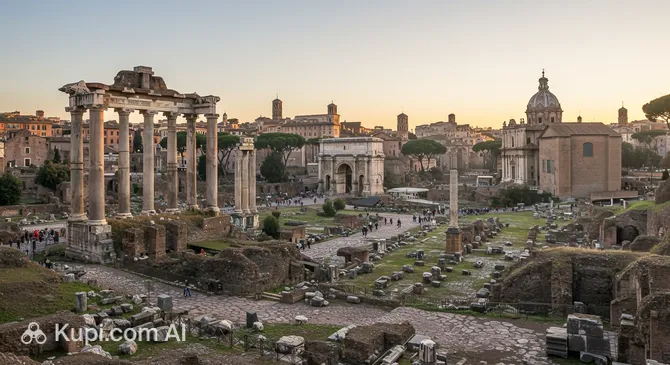
Roman Forum. Illustration.
Source: Kupi.com AI

Traveler photos:

Today, the Roman Forum is a grand open-air archaeological park and a UNESCO World Heritage site. Among the ruins of ancient columns, arches, and building foundations, it is easy to imagine the vibrant life of the ancient city. Visiting this unique site in Italy is not just about sightseeing; it is a true immersion into history, allowing you to touch the legacy of one of humanity's greatest civilizations.

Contacts

To plan your visit to the Roman Forum, which is part of the extensive Colosseum Archaeological Park, it is recommended to check the latest information in advance. Key details for visitors, including the address and the official website where you can find current opening hours and ticket prices, are provided below. Please note that the ticket price of 12 euros is subject to change and is often part of a combined ticket that includes access to the Colosseum and the Palatine Hill.

How to contactContact
Address00186 Rome, Metropolitan City of Rome Capital, Italy
Phone number+39 06 2111 5843
Websitecolosseo.it

What to Do

A visit to the Roman Forum is an opportunity to literally walk through the pages of history and feel the atmosphere of the ancient center of a great empire. The main activity here is a leisurely stroll through the ruins, which allows you to imagine how social, political, and religious life bustled here thousands of years ago. The main route follows the Sacred Way (Via Sacra) — the main street that led to the Capitoline Hill and was used for triumphal processions. Along the way, you will see the remains of grand basilicas where justice was administered and admire impressive triumphal arches, such as the Arch of Titus and the Arch of Septimius Severus.

The Forum is filled with unique monuments and iconic spots. Be sure to find the "Navel of the City" (Umbilicus urbis) — the symbolic center of Rome, and the mysterious "Black Stone" (Lapis Niger), which, according to legend, marks the burial site of the city's founder, Romulus. You can also see the ruins of numerous temples on the grounds, each of which played an important role in Roman life. Highlights include the remains of the Temple of Saturn, where the state treasury was once kept, and the circular Temple of Vesta, next to which stood the House of the Vestals. Walking among these ancient stones allows you to touch the daily lives and beliefs of the people who lived here centuries ago.

Beyond exploring individual structures, visitors can immerse themselves in the ancient atmosphere by imagining orators speaking from the Rostra or the lively trade that once took place in the square. You can even find three sacred plants that have grown here since ancient times: a fig tree, an olive tree, and a grapevine. To better understand the history and significance of each site, you might consider the services of a guide. A visit to the Roman Forum is not just a tour of ruins, but a true exploration of the heart of the ancient world that will leave an unforgettable impression.

Getting There

Getting to the Roman Forum is quite simple, as it is located in the heart of the historic center of Rome, right next to the Colosseum. The most convenient and fastest way is by metro. Take Line B (the blue line) to the Colosseo station. Upon exiting the metro, you will be just a few steps away from the entrance to the grand archaeological site, with the famous ruins right before your eyes.

In addition to the metro, the Roman Forum is easily accessible by public transport. Many city buses stop nearby, particularly on Via dei Fori Imperiali or Piazza Venezia. Popular routes include buses No. 51, 75, 85, 87, and 118. There is also a tram stop near the Colosseum within walking distance of the Forum, served by routes No. 3 and No. 8, which is especially convenient for those traveling from the Trastevere district.

If you prefer comfort, you can take a taxi; the ride from most central areas will be short. However, keep in mind that traffic in the city center can often be heavy. Furthermore, thanks to its excellent location, the Roman Forum is a pleasant walk from other iconic landmarks such as the Capitoline Hill, the Pantheon, or the Trevi Fountain, turning your journey into a captivating stroll through the Eternal City.

Nearest city: Rome

History & Facts

The history of the Roman Forum is a fascinating example of how an uninhabitable area can be transformed into the heart of a great civilization. Until the middle of the 8th century BC, the valley between the hills was a marshy and desolate place used exclusively for burials. Everything changed in the 7th century BC during the reign of King Tarquinius Priscus. Under his orders, large-scale engineering works were carried out: the marsh was drained using a system of canals, the central element of which was the Cloaca Maxima — a grand sewage system for its time. This laid the foundation for the future center of public life.

After the drainage, the valley transformed rapidly. Initially, a bustling marketplace appeared, but the space soon acquired political significance as well. The Forum was divided into two parts: one was dedicated to commercial stalls, while the other became the arena for the city's most important events. It hosted public assemblies, elections of magistrates, and religious ceremonies, and served as a stage for famous orators. It was on the Forum that the first pagan altars and even the residence of the Roman king — the Regia — were built, solidifying its status as a political and sacred center.

Over the centuries, the Roman Forum witnessed not only triumphs but also somber events. Justice was administered on its grounds: until the end of the 1st century AD, public executions were held here, and the bodies of the executed were displayed on the Gemonian Stairs. Simultaneously, the Forum continued to be developed with majestic structures: temples were erected, basilicas were built for court sessions, and numerous statues and monuments were raised in honor of distinguished citizens and Rome's victories. Thus, for centuries, this place was a living reflection of the multifaceted history of the Eternal City — from its birth to the fall of the empire.

Time Needed

When planning a visit to the Roman Forum, you should allow enough time for exploration, as it is an extensive open-air archaeological complex. For a quick look at the main ruins and a walk along the ancient Sacred Way (Via Sacra), you will need at least 1.5–2 hours. This is enough to get a general idea of the scale and grandeur of the former center of the Roman Empire, but it won't be sufficient for a more in-depth tour.

For a deeper immersion into the history and atmosphere of this unique place, it is worth setting aside about 3–4 hours. It is important to remember that the Roman Forum and the Palatine Hill, where the ruins of imperial palaces are located, form a single archaeological area, and it is convenient to visit them together. Climbing the Palatine Hill will not only allow you to see more historical sites but also offer magnificent panoramic views of the Forum itself and the city. For true history buffs, especially if using a guide or a detailed audio guide, exploring every corner of the Forum and the Palatine can take half a day.

Working Hours

The Roman Forum is open to visitors year-round, but its operating hours may change depending on the season. As a rule, the archaeological complex is open daily, starting at 8:30 or 9:00 AM. Closing times vary: in summer, it may stay open until 7:00–7:15 PM, while in autumn and winter, hours are reduced to 4:30–6:30 PM. It is important to remember that the last entry is usually allowed one hour before closing.

Given the immense popularity of the attraction, it is highly recommended to book tickets online in advance. This will help you avoid long queues, especially during the peak tourist season. A ticket to the Roman Forum is most often a combined ticket that also includes access to the Colosseum and the Palatine Hill. Before planning your visit to this iconic Italy landmark, be sure to check the official website for the most up-to-date information on hours, prices, and rules, as the schedule can change and the Forum may be closed on certain days (such as January 1 and December 25).

9:00 – 16:30

Nearby

After immersing yourself in the history of the Roman Forum, exploring its surroundings is a logical and exciting continuation of your journey through the Eternal City. Located in the heart of ancient Rome, the Forum is surrounded by many other iconic sites, each adding new details to the grand picture of Italy's imperial past. A stroll through the nearby streets and squares will help you better appreciate the scale and majesty of the ancient world's capital.

World-famous monuments, museums, and archaeological sites that harmoniously complement the experience of visiting the Forum are just a few minutes' walk away. Below is a list of some nearby attractions, along with the distance to each.

NameDistance
Capitoline Museums0.3 km
Ice Club Roma0.3 km
La Nuova Piazzetta0.3 km
Altare della Patria0.4 km
Colosseum0.5 km
Piazza Venezia0.6 km
Circus Maximus0.7 km

Have you reached the end of the page?

So the route has been studied inside and out