Support

Circus Maximus

About

The Circus Maximus (Circus Maximus) is the grandest stadium of antiquity and one of the largest hippodromes in history, located in the heart of Rome. Situated in a picturesque valley between the Palatine and Aventine hills, it served as the main arena for one of the Romans' favorite pastimes — chariot racing. It was a place where exciting spectacles unfolded, gathering tens and sometimes hundreds of thousands of spectators.
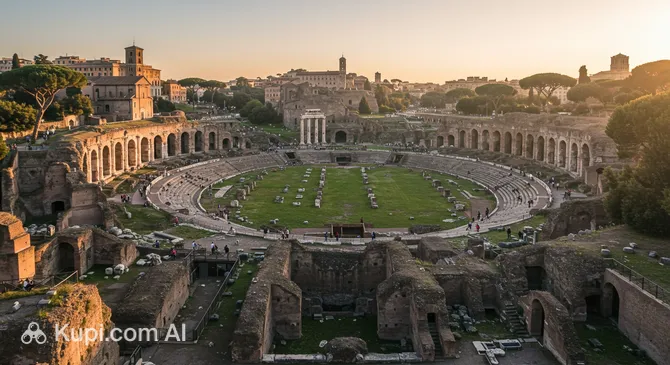
Circus Maximus. Illustration.
Source: Kupi.com AI

Traveler photos:

The scale of the Circus Maximus captures the imagination even today. The length of its arena reached 600 meters, and its width was about 150 meters. At its peak, the stadium could accommodate, by various estimates, between 150,000 and 250,000 people, making it the most capacious structure in the entire Roman Empire. Not only races were held here, but also public games, triumphal processions, and religious festivals, turning the circus into the epicenter of the social life of the powerful Italy's capital.

Today, in place of the once majestic arena, there is a vast elongated field that has preserved the outlines of the ancient hippodrome. Although only small fragments of the structure itself remain, its colossal size is easily recognizable. This area is open to the public and has become a popular recreation spot for both locals and tourists. Large-scale city events, concerts by world stars, and festivals are often held here, allowing this historical site to continue its life as a center of attraction for people.

Contacts

Since the Circus Maximus is an open-air public space today, it does not have specific contact details such as a phone number or email address. Entry to the grounds is free. Reaching this historical site is very easy: the nearest metro station is appropriately named Circo Massimo (Line B), and it is located right across from the ancient hippodrome. Numerous city buses also stop nearby. To get information about concerts and other public events often held at the Circus Maximus, it is recommended to contact Rome's tourist centers or follow announcements on official city portals.

How to contactContact
Address00186 Rome, Metropolitan City of Rome Capital, Italy
Phone number+39 06 0608
Websitewww.turismoroma.it

What to Do

A visit to the Circus Maximus is a unique opportunity to touch history and feel the atmosphere of Ancient Rome. The main activity here is walking through the vast territory of the former hippodrome, where you can imagine the scale of ancient competitions. To dive deeper into the past, information boards and multimedia displays are installed on the grounds, telling the story of the legendary chariot races. Of particular interest is the Circo Maximo Experience project, which uses virtual and augmented reality technologies to let you see the stadium in all its former glory, including a reconstruction of the Arch of Titus.

In addition to the historical component, the Circus Maximus is a popular place for rest and leisure. From its grounds, picturesque views of the Palatine and Aventine hills open up, making it an ideal spot for a leisurely walk or a picnic on the grass. Today, this large open space often becomes a venue for modern cultural events: from large-scale concerts by world stars to city festivals and holidays. Thanks to its central location, the Circus Maximus is easy to include in a walking itinerary of the Eternal City's main attractions.

Getting There

Thanks to its location in the heart of ancient Rome, the Circus Maximus is ideal for exploring on foot. It makes an excellent stop on your itinerary if you are visiting the Colosseum or the Roman Forum. A leisurely walk from these iconic landmarks takes no more than 10–15 minutes and allows you to enjoy views of the Palatine Hill. You can also easily walk to the hippodrome from the famous Mouth of Truth (Bocca della Verità), which is just a few steps away.

If you prefer public transport or are coming from more distant parts of the city, several convenient routes are available. In addition to the metro, buses 75, 81, and 160 stop right at the Circo Massimo/Roseto Comunale or Aventino/Circo Massimo stops. Another great option is to take tram 3, which also stops in the immediate vicinity of the ancient arena.

For lovers of longer and more scenic routes, a walk from the colorful Trastevere district is highly recommended. After crossing the Tiber via one of the bridges, such as the Palatino Bridge, you will find yourself at the foot of the Aventine Hill and can enjoy beautiful views before reaching the Circus Maximus. This route allows you to better feel the atmosphere of the Eternal City and see how modern life intertwines with its great past.

Nearest city: Rome

History & Facts

The history of the Circus Maximus is rooted in antiquity and is closely intertwined with the legends of the founding of Rome. According to legend, it was on this site, in the valley between the Aventine and Palatine hills, that the city's legendary founder, Romulus, organized the first public games, which led to the famous abduction of the Sabine women. However, the first actual structures appeared later, in the 6th century BC, under the fifth Roman king, Lucius Tarquinius Priscus. It was he who ordered the construction of wooden stands for spectators, laying the foundation for the future grand hippodrome.

Over the centuries, the arena was rebuilt and expanded many times, reflecting the growth and power of the Roman Republic. By the 4th century BC, the Circus Maximus established itself as the main venue for chariot racing — the most popular and thrilling spectacle in ancient Italy. Significant reconstruction took place after a fire in 31 BC under the leadership of Julius Caesar, when a central barrier known as the spina was added to the arena, complicating and decorating the race track.

During the Imperial era, the Circus Maximus continued to be at the center of attention. After the famous Great Fire of 64 AD, which devastated Rome, Emperor Nero not only restored the city but also rebuilt the hippodrome. Unfortunately, the majestic structure has not survived to this day in its original form, and the last races were held here in 549 AD. However, even today, looking at the vast elongated valley, one can easily imagine its former scale, and the preserved archaeological elements allow you to touch the great history of this legendary place.

Time Needed

The time you should allocate for a visit to the Circus Maximus directly depends on your interests and how deep you want to dive into history. For a quick self-guided tour of the vast territory where the hippodrome once stood and to take a few photos, 30 to 60 minutes is usually sufficient. During this time, you can walk the full length of the former arena, appreciate its impressive scale, and enjoy views of the Palatine Hill.

If you want to explore the site in more detail, you should plan for 1.5 to 2 hours. This time buffer allows you not only to take a leisurely stroll but also to visit the archaeological zone with its museum exhibition or take part in a guided tour. We especially recommend looking into the Circo Maximo Experience — an immersive walk using VR glasses that lasts about 40 minutes and allows you to see the Circus in all its ancient glory. It is a wonderful opportunity to literally transport yourself back to the days of chariot racing and feel the atmosphere of ancient Rome.

Working Hours

One of the main advantages of the Circus Maximus is its accessibility. The territory of the former hippodrome is a public space open for visits 24 hours a day, 7 days a week. Entry to this huge green area is absolutely free, allowing you to include it in your Rome itinerary at any convenient time, whether it's a morning jog or an evening stroll under the stars.

However, it is worth noting that specific archaeological zones may operate on the grounds or special events may be held, such as the popular Circo Maximo Experience project. Their operating hours may vary depending on the season and the event schedule. For example, the immersive show usually runs from 9:30 AM to 4:30 PM and is often closed on Mondays. Therefore, if you plan to visit the paid area specifically or participate in an interactive tour, it is highly recommended to check current information and schedules on official Rome tourism portals in advance. Pre-booking tickets for such events is often not only convenient but also necessary.

Nearby

The location of the Circus Maximus in the heart of historical Rome makes it an ideal starting point for exploring other great monuments of the Eternal City. A walk through the surrounding area will allow you to immerse yourself deeper into the atmosphere of antiquity, as many iconic sites are literally just a few steps from the ancient hippodrome. This is a unique opportunity to create a rich walking itinerary and see several gems of Italy in a single day.

Exploring nearby attractions will enrich your journey, complementing the impressions of the Circus Maximus's scale with views of legendary ruins, majestic squares, and famous museums. Below is a list of interesting places located very close by.

NameDistance
Colosseum0.7 km
Roman Forum0.7 km
Capitoline Museums0.8 km
La Nuova Piazzetta0.9 km
Altare della Patria1 km
Ice Club Roma1 km
Alcazar Live1.1 km

Have you reached the end of the page?

So the route has been studied inside and out