Support

Altare della Patria

About

In the heart of Rome, on Piazza Venezia, stands one of the most grandiose and recognizable structures in Italy — the Altar of the Fatherland. This monumental complex, also known as the Vittoriano, was built in honor of the first king of the unified country, Victor Emmanuel II, and today serves as an important national symbol.
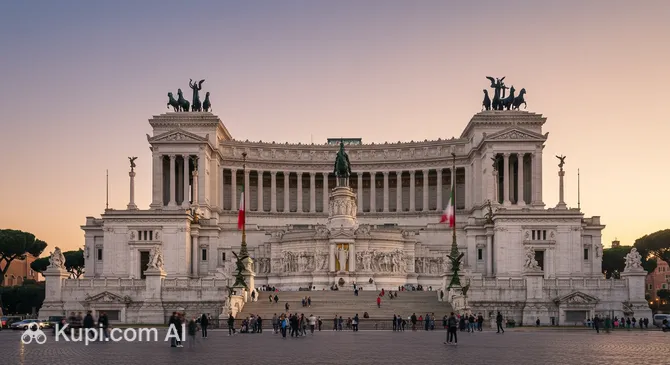
Altare della Patria. Illustration.
Source: Kupi.com AI

Traveler photos:

The structure is striking in its scale and splendor. Built from dazzling white Botticino marble in a Neoclassical style with Eclectic elements, the monument is visible from many points in the city. The center of the composition is occupied by a twelve-meter bronze equestrian statue of the king, symbolizing the unity and power of the nation.

At the foot of the statue lies another significant element of the complex — the Tomb of the Unknown Soldier, where an eternal flame burns in memory of those who fell in World War I. The Altar of the Fatherland itself, created by sculptor Angelo Zanelli, is a relief composition. In its center, against a backdrop of gold mosaic, the goddess Roma majestically sits, personifying the city, surrounded by other allegorical figures.

Contacts

The Altar of the Fatherland is an iconic monument located in the very heart of Rome, so getting there is quite easy. It is situated on Piazza Venezia, which can be reached by numerous buses or on foot from the Colosseo metro station via Via dei Fori Imperiali. To check the latest information regarding museum opening hours within the complex, special exhibitions, and potential changes in access, it is best to consult official sources.

How to contactContact
AddressPiazza Venezia, 00186 Roma RM, Italy
Phone number+39 06 6999 4211
Websitevive.cultura.gov.it

What to Do

A visit to the Altar of the Fatherland offers tourists several highlights. One of the main attractions is, undoubtedly, the ascent to the Vittoriano panoramic deck. From the observation terrace, you get a truly breathtaking 360-degree view of Rome, allowing you to see the Colosseum, the Roman Forum, and the domes of numerous cathedrals from a bird's-eye view. This is the perfect spot for taking impressive photos of the Eternal City.

In addition to admiring the panorama, visitors can spend time exploring the architectural complex in detail. You can closely examine the majestic twelve-meter bronze equestrian statue of King Victor Emmanuel II, as well as numerous sculptures, columns, and bas-reliefs reflecting important moments in the history of Italy. A special place at the foot of the monument is held by the Tomb of the Unknown Soldier, where the Eternal Flame burns. Here, you can stop for a moment of silence to pay tribute to the soldiers who fell in World War I. Furthermore, inside the complex, there are two museums: the Museum of the Risorgimento, dedicated to the era of national unification, and the Museum of the Flags of the Navy.

Getting There

Getting to the Altar of the Fatherland in Rome is very easy, as the monument is located in the heart of the city at Piazza Venezia. This is one of the main transport hubs in Italy's capital, with many roads and public transport routes leading to it. If you are already in the historic center—for example, exploring the Colosseum or the Roman Forum—the monument is a 10–15 minute walk away, allowing you to enjoy views of ancient ruins along the way.

The most direct way to reach the Altar of the Fatherland is to take one of the many city buses. Piazza Venezia serves as a terminus or transit stop for dozens of routes, making it easy to reach from anywhere in the city. Some of the most popular routes passing through the square include `40, 64, 70, 87, 170` and many others. This is the most convenient option if you want to arrive right at the foot of the monument.

Another convenient option is the Rome Metro. The nearest station is `Colosseo` (Line B), located about a 12-minute walk from the square. The walk from the metro to the Altar of the Fatherland is a mini-tour in itself, as your path will take you along the famous Via dei Fori Imperiali past the Roman Forum. Additionally, the terminus for tram `№8` is located near Piazza Venezia, making it a convenient option for those traveling from the Trastevere district.

For those who prefer maximum comfort, taxis or ride-hailing services are always available. A trip from the city's central districts will be quick, though it's worth noting that traffic around Piazza Venezia can be heavy, especially during peak hours. Using a taxi can be a good choice if you are traveling with small children or have limited time for sightseeing.

Nearest city: Rome

History & Facts

The idea to create a monument to commemorate the first king of a unified Italy, Victor Emmanuel II, belonged to his son, King Umberto I. Construction began in 1885 after Giuseppe Sacconi's design won an architectural competition. However, building such a massive structure in the historic center of Rome required difficult decisions: an entire medieval quarter had to be demolished to clear the site on the northern slope of the Capitoline Hill.

Unfortunately, the designer, Giuseppe Sacconi, did not live to see its completion, passing away in 1905. The work on this grand structure was continued by architects Gaetano Koch, Manfredo Manfredi, and Pio Piacentini. The monument's official inauguration took place in 1911 to coincide with the 50th anniversary of Italian unification, although all work was only finally completed in 1935. An interesting fact: the project's initial budget was 9,000 lire, but the final construction cost rose to an impressive 30 million lire.

When creating the Altar of the Fatherland, Giuseppe Sacconi drew inspiration from majestic ancient ensembles such as the Pergamon Altar and the Temple of Fortuna in Praeneste. The architecture of the Vittoriano combines features of Neoclassicism and Eclecticism, part of a search for a new style capable of expressing Italian national pride after the country's unification. Thus, the monument became more than just a tribute to a king; it was a powerful architectural statement symbolizing a new era in Italian history known as the Risorgimento.

Time Needed

When planning a visit to the Altar of the Fatherland, you should allow for 1 to 2 hours. This time is usually sufficient for a standard tour, which includes climbing the grand staircase, visiting the Tomb of the Unknown Soldier with the Eternal Flame, and, of course, heading up to the panoramic terrace. Most of this time is spent taking the glass elevator to the roof and enjoying breathtaking views of Rome, which offers a magnificent overlook of the Colosseum and the Roman Forum.

The length of your visit can easily change depending on your interests. If you only want a quick look at the monument's exterior and to pay your respects at the Eternal Flame, 30-45 minutes might be enough. However, if you are a history buff, you should plan for more time. Inside the complex, you will find the Museum of the Risorgimento, dedicated to the unification of Italy, and the Museum of the Flags of the Navy. Exploring these museums will add at least another 1-1.5 hours to your visit, turning it into a full half-day excursion.

Therefore, for most tourists, it is optimal to set aside about an hour and a half to enjoy the architecture and city panorama without rushing. If you want to delve deeper into history and visit the internal museum exhibitions, it is recommended to allocate at least 3 hours for the Altar of the Fatherland. To avoid long lines for the elevators to the observation deck, it is best to plan your visit for the morning hours on a weekday.

Working Hours

The Altar of the Fatherland in Rome is open to visitors year-round, except for January 1 and December 25. Standard opening hours for both the monument itself and the panoramic elevator are daily from 9:30 AM to 7:30 PM, with the last entry at 6:45 PM. Access to the monument grounds and the Tomb of the Unknown Soldier is free. However, a ticket is required to ascend to the panoramic terrace via the glass elevator and to visit the museums located within the complex.

Advance booking is generally not mandatory for weekday visits but may be recommended for weekends to avoid queues. During the summer months, from June to September, opening hours may be extended until late evening on Fridays. Given possible schedule changes, especially due to official events, it is highly recommended to check the current opening hours and ticket prices on the official monument website (vive.cultura.gov.it) before visiting.

9:30 – 19:30

Nearby

Visiting the Altar of the Fatherland is a wonderful opportunity to experience the heart of Rome, but you shouldn't stop at just one monument. Its central location makes it an ideal starting point for further exploration of the city. A walk around the neighborhood will allow you to dive deeper into the centuries-old history of Italy's capital and see how different eras intertwine at every turn.

Exploring nearby attractions will enrich your experience and help you form a more complete picture of the Eternal City. Within a few minutes' walk of the majestic Vittoriano, you'll find world-famous ancient ruins and museums as well as charming squares and churches, each holding its own secrets and legends. This is a unique chance to travel through time, moving from the Roman Empire era to Baroque masterpieces.

NameDistance
Piazza Venezia0.2 km
Capitoline Museums0.2 km
Scholars Lounge0.3 km
Roman Forum0.4 km
Ice Club Roma0.5 km
La Nuova Piazzetta0.5 km
Trevi Fountain0.7 km

Have you reached the end of the page?

So the route has been studied inside and out