Support

Piazza Venezia

About

Piazza Venezia is one of the most famous and significant squares in Rome, located in the heart of the Eternal City at the foot of the Capitoline Hill. It is not just a historical site, but a vital transport hub for the capital of Italy, where five central streets converge, including the Via dei Fori Imperiali leading to the Colosseum. Due to its location and monumentality, the square serves as a starting point for many excursion routes.
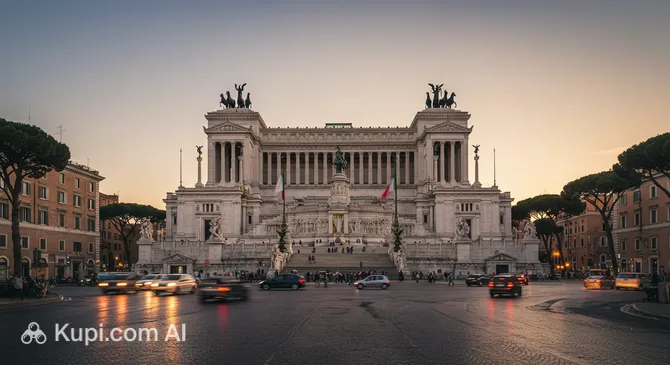
Piazza Venezia. Illustration.
Source: Kupi.com AI

Traveler photos:

The square owes its name to the majestic Palazzo Venezia, built in the 15th century by the Venetian Cardinal Pietro Barbo, who later became Pope Paul II. This building, which gave its name to the entire square, remains its primary architectural landmark today. Nowadays, the palace houses the National Museum.

In addition to Palazzo Venezia, the square's architectural ensemble is formed by two other notable buildings: Palazzo Bonaparte, famous as the place where Napoleon's mother spent her final years, and the Palazzo delle Assicurazioni Generali. Together with the square's dominant feature—the Vittoriano monument dedicated to the first king of unified Italy—these structures create an impressive and easily recognizable cityscape.

Piazza Venezia is considered one of the most photogenic and lively places in Rome, attracting tourists from all over the world. From here, paths lead to iconic landmarks such as the Roman Forum, the Colosseum, and the Capitoline Hill, making it a mandatory stop on any traveler's itinerary.

Contacts

Piazza Venezia is a public space, so it does not have individual contact details such as a phone number or email address. All necessary information for tourists, including details about tours and events in the area, can be found on the official tourism portal of Rome or at one of the city's Tourist Infopoints. Getting to the square is very easy: it serves as a major transport hub for numerous bus routes, and the nearest metro station—Colosseo (Line B)—is within easy walking distance.

How to contactContact
AddressPiazza Venezia, 00187 Roma RM, Italy
Phone number+39 06 0608
Websitewww.turismoroma.it

What to Do

At Piazza Venezia, travelers can immerse themselves in the grandeur of Roman architecture and history. The main activity here is contemplating the monumental Vittoriano complex, dedicated to the first king of unified Italy. This grand monument made of white marble, also known as the "Altar of the Fatherland," is striking in its scale. Be sure to climb to its upper terraces: they offer some of the best panoramic views of the Eternal City, perfect for taking unforgettable photos.

Beyond the Vittoriano, it is worth paying attention to other historical buildings surrounding the square. You can view Palazzo Venezia—an ancient palace that gave the square its name and now houses a museum. Nearby is the elegant Palazzo Bonaparte, interesting because Napoleon's mother spent her final years there. Although access to the interior of most buildings is limited, their facades are works of art in themselves that can be admired for hours.

Piazza Venezia is not only an open-air museum but also an excellent starting point for further exploration of Rome. From here, you can easily begin a walking tour of the most iconic landmarks. The ruins of the Roman Forum, the majestic Colosseum, and the ancient Pantheon are all just a few minutes' walk away. The square literally invites you to dive into the city's lively atmosphere and embark on a journey through its centuries-old history.

Getting There

Piazza Venezia is located in the very heart of Rome, making it one of the most accessible locations for tourists. The square is a vital transport hub where routes from all over the city converge, so reaching it is simple from any point in the capital. Whether you prefer public transport, a taxi, or walking, your journey to this iconic landmark will be straightforward and convenient.

The most convenient way to reach the square is by using public transport. Numerous bus routes pass through Piazza Venezia or its immediate vicinity, including popular lines 30, 40, 64, 70, and 170. You can also take tram No. 8 to the stop of the same name. If you prefer the metro, the nearest station is Colosseo (Line B), from which you can reach the square in a 10–15 minute walk along the scenic Via dei Fori Imperiali. Cavour station on the same line is also located nearby.

Thanks to its central location, Piazza Venezia is within walking distance of many other key attractions in Rome. A walk to the square can be part of a fascinating city route. For example, it is just a few minutes' walk from the Colosseum and the Roman Forum. Iconic sites like the Trevi Fountain and the Pantheon are also close by, making it easy to include a visit to the square in your daily itinerary for exploring the Eternal City.

Nearest city: Rome

History & Facts

The history of Piazza Venezia is rooted in antiquity, dating back to the times of Ancient Rome. Even then, this location was a strategically important crossroads where the famous Via Flaminia began. It was also the site of a gate in the Servian Wall—the city's first defensive fortification. Thus, the area of the future square played a key transport role long before it acquired its modern monumental appearance.

The square's modern layout began to take shape in the mid-15th century. A key event was the construction of Palazzo Venezia for the Venetian Cardinal Pietro Barbo, who later became Pope Paul II. After 1567, this majestic building housed the embassy of the Republic of Venice, which gave the square its current name. Later, in 1660, the architectural ensemble was complemented by Palazzo D'Aste, which was eventually renamed Palazzo Bonaparte after Napoleon's mother moved in.

Piazza Venezia underwent radical changes at the end of the 19th century. In 1885, the grand construction of the Vittoriano monument began in honor of the first king of a unified Italy, Victor Emmanuel II. To clear the space for the future "Altar of the Fatherland," many ancient buildings had to be demolished, forever altering the historical landscape of the area. Although the monument was officially opened in 1911, it was not fully completed until 1935.

In the 20th century, the square also witnessed significant historical events. During the period when Benito Mussolini chose Palazzo Venezia as his headquarters, Piazza Venezia was proclaimed the "Forum of Italy." This fact added another layer to the rich and multifaceted history of this iconic site, turning it into more than just an architectural monument, but a living witness to the changing fate of the Eternal City.

Time Needed

For a brief introduction to Piazza Venezia and its main monuments, 30 minutes to an hour and a half is usually sufficient. This is enough time to fully appreciate the grandeur of the square, take memorable photos against the backdrop of the monumental Vittoriano complex (known as the "Altar of the Fatherland"), and view the impressive facades of the historical palaces surrounding it. This is an ideal option for those who want a general overview of this iconic site before continuing their route through Rome.

If you plan a deeper immersion and want to explore the square in detail, it is worth setting aside half a day. This time allows you to unhurriedly visit the museums located on the square, such as the National Museum in Palazzo Venezia, and ascend to the panoramic terrace of the Vittoriano, which offers some of the best views of the capital of Italy. Such a leisurely approach provides the opportunity to truly feel the historical significance of this place.

Working Hours

Piazza Venezia is a public space, so the square itself is accessible for visiting 24 hours a day, year-round. You do not need tickets or an appointment to walk through it, admire the architecture, and take photos. This allows for flexible planning of your itinerary, letting you enjoy the atmosphere of this iconic location at any convenient time, whether early morning or late evening.

However, if you wish to visit the attractions located on the square, you should consider their operating hours. For example, the Vittoriano monument ("Altar of the Fatherland") is typically open to visitors from 9:30 AM to 7:30 PM, but hours may vary depending on the season, and operations are often extended on weekends. The National Museum in Palazzo Venezia operates on a similar schedule but is generally closed on Mondays. It is highly recommended to check the official websites of these museums for current information on opening hours and ticket requirements before your visit, as rules are subject to change.

Open 24 hours

Nearby

A visit to Piazza Venezia is just the beginning of your acquaintance with the historical heart of Rome. The neighborhoods surrounding the square are literally saturated with iconic sites, and a short walk will allow you to see even more treasures of the Eternal City. Exploring the surroundings will enrich your experience, as many of the greatest monuments in Italy are just a few steps away.

The square's strategic location makes it an ideal starting point for exploration. In just 5-15 minutes on foot, you can reach ancient ruins, majestic temples, and charming streets, each holding its own story. Below is a list of interesting places located in the immediate vicinity of Piazza Venezia.

NameDistance
Altare della Patria0.2 km
Scholars Lounge0.2 km
Capitoline Museums0.3 km
Pantheon0.5 km
Pane e Salame0.5 km
Trevi Fountain0.6 km
Roman Forum0.6 km

Have you reached the end of the page?

So the route has been studied inside and out