Support

Piazza Navona

About

Piazza Navona is one of the most famous and picturesque squares in Rome, a true heart of the city and a Baroque jewel of Italy. Its unique elongated shape is no accident, but a legacy of ancient times: the square was built on the site of the ancient Roman Stadium of Domitian, where athletic competitions were once held. Today, it is a space where history intertwines harmoniously with vibrant modern life.
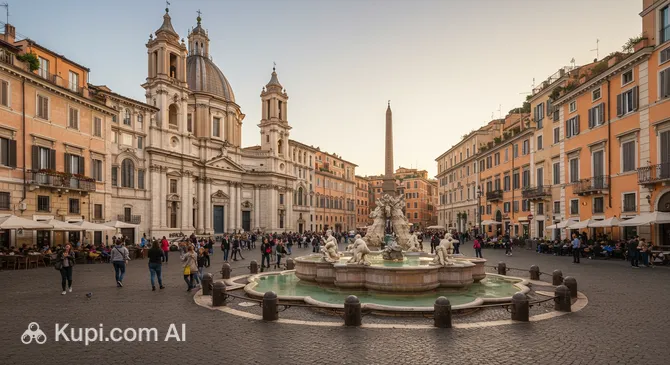
Piazza Navona. Illustration.
Source: Kupi.com AI

Traveler photos:

The architectural ensemble of the square is striking in its splendor. The central feature is the grand Fountain of the Four Rivers, a masterpiece by the great master Gian Lorenzo Bernini. The composition is complemented by two other fountains—the Moor Fountain and the Neptune Fountain. Surrounding the square are elegant 17th-century buildings, most notably the church of Sant'Agnese in Agone and the majestic Palazzo Pamphili, which together create a unique open-air theatrical stage.

Piazza Navona is not just an open-air museum, but also a magnet for locals and tourists alike. The square is always filled with a lively atmosphere: street artists and musicians perform here, and numerous cafes invite you to relax over a cup of coffee while enjoying the magnificent view. It is the perfect place to feel the spirit of the "Eternal City."

A visit to Piazza Navona offers a unique opportunity to simultaneously touch the great art of the Baroque era and plunge into the daily bustle of one of the most beautiful cities in the world. It is a place that leaves an unforgettable impression on everyone who visits.

Contacts

Piazza Navona is a public space accessible 24/7, so it does not have unified contact details such as a phone number or email address. The square is located in the historical center of Rome and is easily accessible by public transport or on foot. You can take one of the many buses (for example, routes 64, 70, 87, or 492) or walk from the Pantheon, which is just a few minutes away.

How to contactContact
AddressPiazza Navona, 00186 Roma RM, Italy
Websitewww.turismoroma.it

What to Do

The main reason people come to Piazza Navona is its magnificent fountains, each of which is a true work of art. In the center of the square stands the famous Fountain of the Four Rivers (Fontana dei Quattro Fiumi), created by the genius Bernini. It is flanked by the Moor Fountain (Fontana del Moro) and the Neptune Fountain (Fontana del Nettuno). Viewing these Baroque masterpieces, studying their details, and, of course, taking photos with them is a must for every visitor to Rome.

Piazza Navona is not just history frozen in stone, but a living open-air stage. You can almost always find street artists offering their work, musicians creating a unique atmosphere, and mimes entertaining the public. Depending on the season, the square hosts vibrant events: from Christmas markets that turn it into a winter wonderland to summer festivals and exhibitions. This is a place where something is always happening.

For a more relaxed experience, the square offers many opportunities. One of the greatest pleasures is choosing a table at one of the many cafes or restaurants surrounding the square. Here you can leisurely sip an espresso or enjoy authentic Italy cuisine while watching the bustling life around you. Piazza Navona is perfect for evening walks when the lights come on, giving the fountains and buildings an especially romantic look.

Getting There

Getting to Piazza Navona is easy, as it is located in the heart of Rome's historical center. Thanks to this prime location, the square is within walking distance of many other iconic sites, including the Pantheon and the colorful Campo de' Fiori square. This makes it a perfect stop on any walking route through the "Eternal City," allowing you to enjoy the atmosphere of ancient streets along the way.

The most convenient way to reach the square is by public transport. Numerous buses from different parts of the city stop nearby. If you are coming from the central Termini station, routes No. 40 or No. 64 are ideal. You should get off at the Corso Vittorio Emanuele II stop, from where the square is just a few minutes' walk. Also nearby are the Corso Rinascimento, Zanardelli, and Senato stops, served by buses 30, 70, 81, 87, and 492, giving travelers extra flexibility.

If you prefer to take the metro, the closest station to Piazza Navona is Spagna on Line A. From there, a pleasant walk through the picturesque streets of Rome will take approximately 15–20 minutes. During this time, you can see other attractions and fully immerse yourself in the unique atmosphere of Italy. Of course, taxi services are always available for maximum comfort and speed.

Nearest city: Rome

History & Facts

The history of Piazza Navona is a fascinating journey through the ages, beginning in the 1st century AD. Originally, the grand Stadium of Domitian stood on this site, built for athletic competitions and capable of holding up to 30,000 spectators. The square's modern name actually derives from the Greek word "agon" (competition): over time, "in agone" transformed into "Navona." Thus, the square's unique elongated shape is a direct legacy of the ancient arena, the contours of which can still be seen in the surrounding buildings.

In the Middle Ages, this space changed its purpose dramatically, becoming a bustling city market that remained until the end of the 19th century. However, the square's true flowering and transformation occurred in the 17th century, when Rome was experiencing the Baroque era. At the initiative of Pope Innocent X from the influential Pamphili family, Piazza Navona became a stage for the creativity of the greatest architects of the time—Gian Lorenzo Bernini, Francesco Borromini, and Carlo Rainaldi. They turned the former market square into one of the most outstanding architectural ensembles in Italy.

The central element of this Baroque splendor is the famous Fountain of the Four Rivers by Bernini. Opposite the fountain rises the church of Sant'Agnese in Agone, designed by his eternal rival, Borromini. The architectural ensemble was completed by the majestic Palazzo Pamphili, built for the Pope's family and decorated with magnificent frescoes by the artist Pietro da Cortona. These buildings not only formed the unique appearance of the square but also captured the spirit and artistic ambitions of that era in stone.

Time Needed

When planning a visit to Piazza Navona, you should allow for about 1-2 hours. This will be enough time to leisurely walk around the square, fully enjoy its Baroque architecture, and examine each of the three magnificent fountains in detail, including Bernini's central masterpiece—the Fountain of the Four Rivers. You will have time to take photos from different angles and feel the historical atmosphere of this unique place in Rome.

If you want a more complete experience, you can easily extend your stay to 2-3 hours. For example, it is worth stepping inside the church of Sant'Agnese in Agone to appreciate its rich interior, or visiting the museum dedicated to the ruins of the ancient Stadium of Domitian located beneath the square. You can also simply sit in one of the many cafes, watching street artists and musicians, which will allow you not just to see the landmark, but to dive into the everyday life of Italy.

Working Hours

One of the main advantages of Piazza Navona is its accessibility. Since it is an open city square in Rome, it can be visited at any time of day or night, 24/7 and free of charge. This makes it an ideal spot for both morning walks and romantic evening visits when the fountain lighting creates a special atmosphere. There is no need to book tickets or register to visit the square itself—it is open to everyone year-round.

However, keep in mind that the attractions located on the square, such as the church of Sant'Agnese in Agone or the museums, operate on their own schedules. Entry to them may be time-restricted and sometimes requires a fee. Therefore, if you plan to visit any of the buildings on Piazza Navona, it is recommended to check their current opening hours and entry conditions in advance on their official websites or at tourist information centers in Italy.

Open 24 hours

Nearby

Visiting one of Rome's main gems—Piazza Navona—is just the beginning of a fascinating journey through the city's historical center. The square's surroundings are equally rich in iconic sites, and a short walk will allow you to discover new facets of the "Eternal City" and see other masterpieces of architecture and art that are literally a stone's throw away.

Exploring nearby attractions will enrich your experience and help you gain a more complete picture of the grandeur and diversity of Italy's cultural heritage. Below is a list of interesting places located near Piazza Navona, along with the distance to each.

NameDistance
Pantheon0.3 km
Castel Sant'Angelo0.7 km
Scholars Lounge0.7 km
Pane e Salame0.7 km
Piazza Venezia0.8 km
Trevi Fountain0.9 km
Trapizzino Trastevere0.9 km

Have you reached the end of the page?

So the route has been studied inside and out