Support

Sistine Chapel

About

The Sistine Chapel (Italian: Cappella Sistina) is not just a former domestic church, but one of the most significant museums in the world and an outstanding monument of the Renaissance. Located in the Vatican, within the city of Rome, it is a true jewel of Italy's cultural heritage and a site that attracts millions of travelers every year.
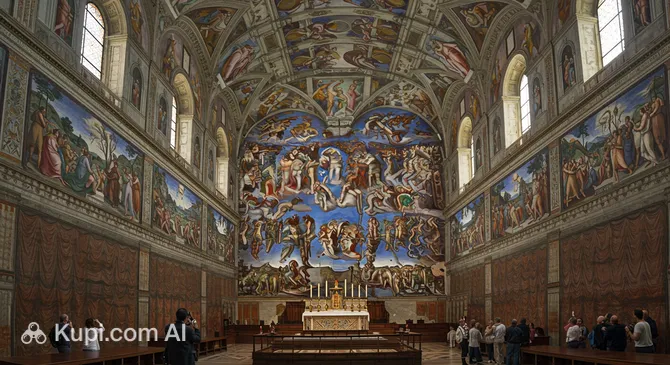
Sistine Chapel. Illustration.
Source: Kupi.com AI

Traveler photos:

From the outside, the chapel building looks quite austere and resembles a fortress, which was dictated by security concerns during its construction in the 15th century. However, behind these modest walls lie artistic treasures of incredible value. The chapel gained worldwide fame for its unique frescoes, created by the greatest masters of the Renaissance, such as Sandro Botticelli and Pietro Perugino.

The main magnet for visitors is undoubtedly the masterpieces of Michelangelo. Commissioned by Pope Julius II, he painted the chapel's vast ceiling, creating the famous cycle of frescoes with scenes from the Book of Genesis, including the legendary "Creation of Adam." Later, he returned to create the massive and dramatic "Last Judgment" fresco on the altar wall. These works truly take your breath away with their scale and the brilliance of their execution.

Beyond its artistic value, the Sistine Chapel still performs a vital religious function today. It is within these walls, away from the public eye, that conclaves take place—the meetings of cardinals to elect a new Pope. Thus, a visit to the chapel is not only an encounter with great art but also a touch of centuries-old history and living traditions.

Contacts

The Sistine Chapel is part of the Vatican Museums complex, so you should refer to their general contact details to plan your visit. It is highly recommended to check the official website in advance for all the latest information regarding opening hours, ticket purchases, and visitor regulations.

How to contactContact
Address00120, Vatican City
Phone number+39 06 6988 3145
Websitewww.museivaticani.va

What to Do

Upon entering the Sistine Chapel, visitors first direct their gaze upward to the main jewel of the site—the stunning ceiling frescoes. This monumental work of art, which has become one of the greatest masterpieces of the Renaissance, is considered the pinnacle of Michelangelo's creative genius. The vault of the chapel was painted at the request of Pope Julius II, who invited the great master to Rome specifically for this purpose. One can spend ages examining the numerous scenes from the Book of Genesis, including the legendary "Creation of Adam," while marveling at the scale and brilliance of the concept.

Another monumental work by Michelangelo also commands attention—the massive "Last Judgment" fresco on the altar wall. However, do not overlook the side walls of the chapel. They are decorated with paintings by other prominent Renaissance artists, such as Botticelli and Perugino, depicting the lives of Christ and Moses. It is worth noting that the interior decoration of the chapel itself, with the exception of these priceless frescoes, appears quite modest, which further emphasizes the magnificence of the paintings.

Visiting the chapel is, above all, a contemplative experience. It is customary to maintain silence so as not to disturb other visitors and to fully immerse oneself in the atmosphere of great art, as photography is strictly forbidden inside. The Sistine Chapel is famous not only for its painting but also for its music: it is home to one of the most significant and oldest choirs in the world. While hearing them sing during a regular visit is rare, knowing about this living tradition adds a special depth to any trip to Italy.

Getting There

Getting to the Sistine Chapel, which is part of the Vatican Museums, is quite straightforward from any point in Rome. This popular tourist destination is well-served by the city's public transport system. The most convenient and fastest way is to use the metro, which will take you almost to the very walls of the Vatican.

You will need Metro Line A (the orange line). The closest stations to the Vatican Museums entrance are Ottaviano and Cipro. From either station, it is a short walk of about 10 minutes to the entrance. You can simply follow the "Musei Vaticani" signs or the flow of other tourists—it is very hard to get lost.

In addition to the metro, numerous city buses run to the Vatican. For example, Bus No. 49 stops right in front of the museum entrance, which is very convenient. Buses No. 32, 81, and 982 will take you to Piazza del Risorgimento, from where the entrance is just a 5-minute walk. Of course, you can always take a taxi, which is more comfortable but significantly more expensive, especially during peak hours.

Nearest city: Rome

History & Facts

The history of the Sistine Chapel is inextricably linked with Pope Sixtus IV, after whom it was named. Construction took place between 1473 and 1481 on the site of the old "Cappella Magna," where the papal court gathered during the Middle Ages. Although the project was designed by architect Baccio Pontelli, the work was supervised by Giovannino de' Dolci. This is how Rome gained a building destined to become one of the greatest treasures of Italy.

One of the most fascinating facts is that the chapel was originally intended not only as a place of prayer but also as a formidable defensive structure. Pope Sixtus IV feared attacks from the Republic of Florence, ruled by the Medici, as well as threats from the Ottoman Empire. Therefore, the design included thick walls and even machicolations on the upper floor so that, in case of danger, the Pope could take refuge in the chapel as if it were a fortress.

There are other remarkable details as well. For instance, the dimensions of the chapel were intended to exactly replicate the proportions of the legendary Temple of Solomon as described in the Old Testament. Furthermore, before Michelangelo began his genius work, the chapel's ceiling looked completely different. It featured a deep blue vault scattered with golden stars, symbolizing the celestial sphere. It is hard to imagine that the "Creation of Adam" was once just a simple starry sky!

Time Needed

When planning your visit, it is worth distinguishing between the time spent directly inside the chapel and the total time required to reach it. Most visitors spend about 20–30 minutes admiring Michelangelo's brilliant frescoes inside the Sistine Chapel. This is usually enough time to get a general view of the famous ceiling with scenes from the Book of Genesis and the monumental "Last Judgment" fresco on the altar wall. However, it is important to understand that the stay here is often compressed due to the constant flow of tourists and the requirement to maintain silence.

The key point is that the Sistine Chapel is the culmination of a long route through the Vatican Museums, and it is impossible to enter it directly. The entire journey through the numerous halls and galleries preceding the chapel takes a significant amount of time. Therefore, for a full visit without rushing, it is recommended to set aside at least 3-4 hours. True art lovers who wish to explore the rich museum collections in detail on their way to the main masterpiece could easily spend half a day here.

Working Hours

The Sistine Chapel is part of the Vatican Museums, so its operating hours completely coincide with the schedule of the museum complex. Generally, the museums are open to visitors from Monday to Saturday. Standard opening hours are from 8:00 to 19:00, with the last entry at 17:00. Note that the chapel is usually closed on Sundays, except for the last Sunday of each month. On this day, admission is free, but visiting hours are reduced (usually from 9:00 to 14:00, with the last entry at 12:30), and the number of visitors can be enormous. The chapel is also closed on major religious holidays, such as Christmas and Easter.

It is crucial to plan your visit in advance. It is strongly recommended to buy tickets online several weeks or even months before your trip. This will allow you to avoid the hours-long queues that often form at the entrance to the Vatican Museums. Tickets purchased online usually have a fixed entry time. Since opening hours can change, especially due to events held at the Vatican, always check the most up-to-date information on the official Vatican Museums website immediately before your visit.

DayOpening hours
Monday8:00 – 20:00
Tuesday8:00 – 20:00
Wednesday8:00 – 20:00
Thursday8:00 – 20:00
Friday8:00 – 20:00
Saturday8:00 – 20:00
SundayClosed

Nearby

A visit to the Sistine Chapel is the highlight of any tour of the Vatican Museums, but the experience of this unique location doesn't end at its exit. The chapel is situated in the heart of the Vatican, surrounded by other great monuments of history, architecture, and culture, all within walking distance. Tourists from all over the world come to the Vatican to see the unique frescoes of the Sistine Chapel, visit St. Peter's Basilica, or explore the Vatican Gardens.

Exploring the surrounding area will allow you to dive deeper into the atmosphere of the Eternal City and gain a more complete understanding of its heritage. A walk from the Sistine Chapel to the nearby attractions of Rome will enrich your experience and make your trip to Italy even more unforgettable.

NameDistance
Vatican Obelisk0.2 km
Vatican Museums0.4 km
Castel Sant'Angelo1 km
Piazza Navona1.6 km
Trapizzino Trastevere1.8 km
Pantheon1.9 km
Tonnarello1.9 km

Have you reached the end of the page?

So the route has been studied inside and out