Support

Lupanar of Pompeii

About

The Lupanar of Pompeii is one of the most intriguing and visited attractions in the ancient city of Pompeii, located in Italy. It is not just ruins, but a well-preserved ancient Roman brothel that offers a unique glimpse into the daily life and customs of the ancient world, frozen in time after the eruption of Vesuvius.
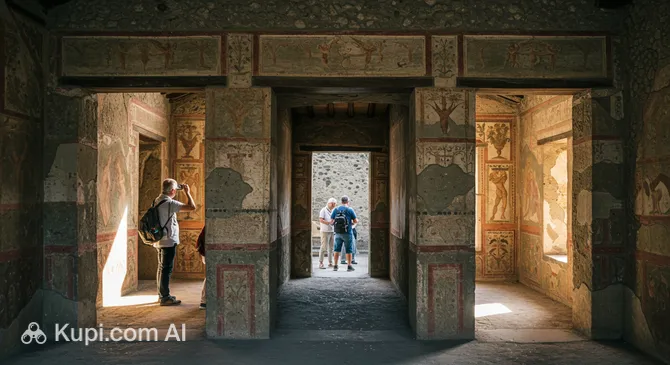
Lupanar of Pompeii. Illustration.
Source: Kupi.com AI

Traveler photos:

Its name, Lupanar, comes from the Latin word "lupa," meaning "she-wolf" – a slang term used for prostitutes in Ancient Rome. The building is a two-story structure with ten small rooms, known as cubicula, five on each floor. The walls of many rooms and corridors are decorated with erotic frescoes, which researchers believe may have served as a kind of "menu" of services or simply reflected the nature of the establishment.

This unique historical site was discovered by archaeologists in 1862 and has since undergone several stages of restoration. The last major restoration work was completed in 2006, with previous significant work carried out in 1949. Thanks to the efforts of restorers who carefully replaced decayed wooden structures with new ones, the original structure of the building has been preserved, allowing us today to touch such a provocative part of Pompeii's history.

Contacts

For the most up-to-date information on visiting the Lupanar of Pompeii, such as opening hours, ticket prices, and possible special events, it is recommended to contact the administration of the Pompeii Archaeological Park directly. This will help you plan your visit in the best possible way.

Here are some contact details that may be useful:

How to contactContact
AddressVia Villa dei Misteri, 2, 80045 Pompei NA, Italy
Phone number+39 081 536 9869
Websitepompeiisites.org

What to Do

Visiting the Lupanar of Pompeii is a unique opportunity to peek into the daily life of the ancient city of Pompeii and see how one of the most famous establishments of its kind was organized. Visitors can examine the preserved architecture and interior layout of the ancient Roman brothel in detail, imagining the atmosphere that prevailed here nearly two thousand years ago.

The main highlight to observe in the Lupanar is its famous frescoes. In the building's entrance hall, near the ceiling, you will see erotic frescoes. Even more remarkable are the small paintings above the door of each room: they depict various love scenes and, as historians believe, served as a kind of "catalog" or "menu" of the establishment's services.

On the lower floor, visitors can look into the cramped rooms, the so-called cubicula. Here, the stone beds have been preserved, which in ancient times were covered with mattresses. Note their size – they are quite short, even for the relatively small ancient Romans. The walls of the rooms are covered with numerous graffiti – inscriptions and drawings left by both clients and workers of the Lupanar, adding a special historical authenticity to the site.

Although the second floor, where larger rooms were located, is currently inaccessible to tourists, a visit to the lower floor of the Lupanar provides a vivid and memorable insight into this aspect of life in ancient Pompeii. This site is an important testament to the lifestyle and customs of Roman society.

Getting There

The Lupanar of Pompeii is located within the vast archaeological complex of the ancient city of Pompeii, situated in the Campania region near Naples, Italy. To reach this unique monument of antiquity, most tourists start their journey from Naples, which has convenient transport links to Pompeii.

The most popular way to get from Naples to the Pompeii archaeological site is by using the Circumvesuviana suburban train. Trains depart from Naples Central Station (Napoli Centrale / Piazza Garibaldi) on the Naples – Sorrento line. You need to get off at the Pompei Scavi - Villa dei Misteri station. The journey takes approximately 30-40 minutes, and the station is located practically at the entrance to the archaeological park. This is very convenient as it allows you to immediately immerse yourself in the atmosphere of the ancient city.

Once inside the Pompeii archaeological complex, finding the Lupanar itself is easy. It is located in the central part of the excavations, in the seventh region (Regio VII), Insula 12, House 18 (VII, 12, 18). At the park entrance, you can pick up a map showing all key sites, including the Lupanar. There are also signs posted throughout the complex to help you navigate and reach the desired attraction. It is recommended to allow enough time for exploration, as Pompeii is a massive open-air museum.

Nearest city: Pompeii

History & Facts

The Lupanar of Pompeii, also known as the Lupanarium, holds a special place in the history of ancient Pompeii. It was not just one of many, but the city's main brothel. While historians count at least two dozen locations in Pompeii where intimate services were provided, many of these were merely single rooms, often located above wine shops. The Lupanar, however, was a specialized establishment, highlighting its unique status in the city's social structure.

The staff of the Lupanar consisted mainly of slaves, often of Greek or Eastern origin, purchased by the establishment's owner. The cost of services in this ancient brothel typically varied from two to eight asses – the local currency unit. Interestingly, wealthy residents of Pompeii rarely visited such establishments. They generally had their own slaves or concubines, and if necessary, could summon a courtesan directly to their home, reflecting the social customs of the time.

One of the most curious details associated with the Lupanar is the way ancient residents found their way to it. The path to the brothel was indicated by carved phallic symbols on the pavement – a kind of ancient "signpost." The tragic eruption of Mount Vesuvius on August 24, 79 AD, which buried Pompeii under a thick layer of volcanic ash, "preserved" the Lupanar along with the rest of the city. Thanks to this unique set of circumstances, the building has survived to this day and was discovered by archaeologists, providing invaluable insight into the daily life and morals of the ancient world.

Time Needed

To explore the Lupanar of Pompeii, one of the iconic landmarks of the ancient city of Pompeii, it is usually recommended to set aside 30 to 45 minutes. This time is generally sufficient to walk through the small rooms of the ancient brothel, examine the preserved frescoes, and feel the atmosphere of this unique site.

It should be noted that the Lupanar is one of the most popular and visited sites within the Pompeii archaeological park. Because of this, especially during the peak tourist season, fairly long queues can form at the entrance. Therefore, when planning your visit, it is worth allowing extra time for a possible wait. To minimize time spent in line, it is best to arrive at the Lupanar in the morning hours, immediately after the complex opens, or towards the end of the day when the main flow of tourists has subsided.

Working Hours

The Lupanar of Pompeii, one of the ancient city's intriguing landmarks, is available to visit during the general opening hours of the Pompeii archaeological complex. Typically, the park is open to visitors daily. From April to October, opening hours are usually from 9:00 AM to 7:00 PM. From November to March, the complex generally operates from 9:00 AM to 5:00 PM. It is important to remember that the archaeological park is closed on certain holidays, namely January 1st, May 1st, and December 25th.

Since the Lupanar of Pompeii is part of the larger archaeological park, no separate booking is usually required for its visit if you already have an entrance ticket to Pompeii. However, it is strongly recommended to check the current schedule and visiting conditions on the official website of the Pompeii Archaeological Park before planning your visit. This will help avoid surprises and ensure that information about opening hours and closing days has not changed. The attraction is open year-round, except for the aforementioned official holidays.

9:00 – 15:30

Nearby

A visit to such an iconic landmark as the Lupanar of Pompeii certainly leaves a lasting impression. However, to truly immerse yourself in the atmosphere of the ancient city and gain a more complete picture of its life, it is worth paying attention to other interesting sites located nearby.

Exploring the surrounding areas will allow you to discover new facets of Pompeii's history, see a variety of architectural styles, and better understand the daily lives of its inhabitants. Every street and ruin here holds its own secrets, and visiting neighboring attractions will enrich your journey and help form a cohesive impression of this unique place.

NameDistance
Archaeological Park of Pompeii0.2 km
Forum of Pompeii0.2 km
House of the Faun0.2 km
Temple of Apollo0.2 km
Large Theatre of Pompeii0.2 km
House of the Vettii0.3 km
Pompeii Antiquarium0.4 km

Have you reached the end of the page?

So the route has been studied inside and out