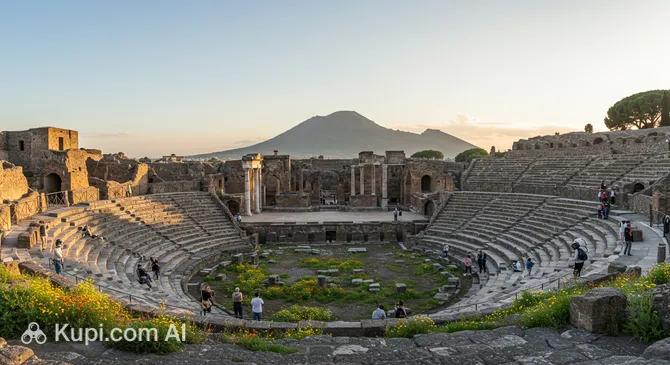
The Large Theatre of Pompeii is a majestic ancient Roman theatre located in the famous archaeological complex of the city of Pompeii in Italy. It is one of the earliest surviving stone theatrical structures of the ancient world, with its construction dating back to the 3rd–2nd centuries BCE. The theatre was not just a venue for performances, but an important center of cultural and social life in ancient Pompeii.
Traveler photos:
Originally, the architecture of the Large Theatre was close to Greek traditions, maintaining a close connection with the surrounding natural landscape. The seating area, known as the theatron, was skillfully carved directly into the hillside. The orchestra, the area in front of the stage, was shaped so that a circle could be inscribed within it, which is also characteristic of the Greek type of theatre. The theatre was strategically adjacent to the Triangular Forum, highlighting its significance in the urban structure.
The stage was a separate, impressive building. Behind it was an extensive four-sided portico, which originally served as a foyer for spectators during intermissions or bad weather. Interestingly, this space was later converted and used as the peristyle of the gladiators' barracks, adding another layer to the rich history of this unique ancient monument.