Support

Iki Airport

About the Airport

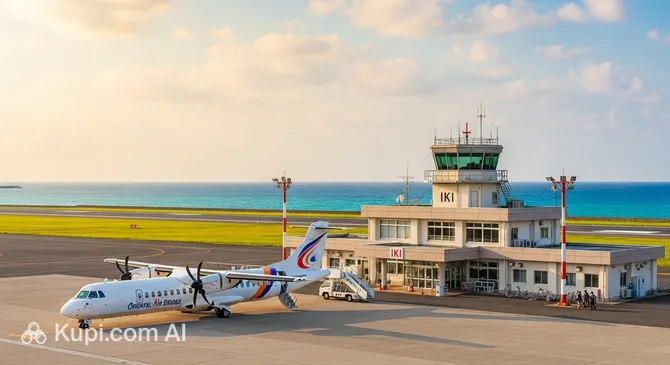
Iki Airport. Source: Kupi.com Binoculars

Iki Airport is not merely a transport hub, but a welcoming gateway opening up to the emerald waters of the Sea of Japan and the island's ancient shrines. Instead of endless corridors and the bustle of megacities, you will be greeted here by a refreshing sea breeze and an intimate atmosphere where every flight feels like a long-awaited event. Landing at this airport offers unforgettable views of the rugged coastline, turning the final minutes of your flight into a breathtaking aerial tour.

IATA Code IKI
ICAO Code RJDB
City Iki
Distance to Centre ~11 km (from Gonoura district)
Status Regional (Domestic)
Annual Passengers About 35,000 people
Schedule Recommended to check on the airline's website

Features and Advantages of the Airport

The main advantage of Iki Airport is its compactness and efficiency. Thanks to the small size of the terminal, all procedures — from check-in to boarding — take only a matter of minutes. This allows travellers to avoid the stress typical of large hubs and arrive at the airport shortly before departure, leaving more time for relaxation.

Another pleasant feature is its picturesque location. The runway is laid practically along the seashore, making take-offs and landings incredibly beautiful here. An open observation deck is equipped on the second floor of the terminal, where anyone can go up to enjoy the ocean panorama and take spectacular photos of aircraft against the backdrop of the seascape.

For tourists planning to rent a car, a significant advantage is the availability of spacious and, as a rule, free parking right in front of the terminal building. This makes the airport maximally convenient for independent travellers, allowing them to easily return a rental car immediately before departure without unnecessary costs or complex logistics.

Contact Information

There are several ways to contact representatives of Iki Airport (IKI). Below are the main contact details for passengers.

  • Official Website: Current information about the airport's operations can be found on the official page on the Nagasaki Prefecture website. It is best to check flight schedules on the airline's website, for example, Oriental Air Bridge (ORC).
  • Information Desk Phone: For questions related to terminal operations, you can contact the airport administration at: +81 920-44-5335.
  • Airport Address: 741-1 Sumiyoshihigashifure, Ashibe-cho, Iki-shi, Nagasaki 811-5323, Japan.
  • Email: A specific email address for general passenger inquiries is not publicly provided. It is recommended to use the telephone for communication.
  • Social Media: At present, Iki Airport does not have official pages on popular social networks.
  • Lost and Found Information: If your belongings were lost on board the aircraft or did not arrive with your flight, you should immediately contact your airline's baggage tracing service. For items left within the terminal building, please contact the airport administration at the phone number listed above.
  • Customer Support Contacts: For questions related to tickets, flight check-in, or special assistance, it is necessary to contact the airline you are flying with directly.

How to Get to the Airport

Getting to Iki Airport (IKI) is a fairly simple task, given the compact size of the island. The main transport hubs from where tourists usually start their journey are the ferry ports of Gonoura and Ashibe. You can reach the airport from the city centre and the ports in several ways.

Public Transport on the island is represented by Iki Kotsu Bus company buses. This is the most budget-friendly way to travel. Buses run according to a schedule, connecting key points of the island, including the ports and the airport. A trip from Gonoura Port, the main transport hub of Iki, will take approximately 20–25 minutes. The fare is low and usually amounts to a few hundred yen. It is recommended to check the schedule in advance, especially if your flight is early in the morning or late in the evening.

Taxi is a more comfortable and faster option. Cars can be found at taxi ranks near ferry terminals or ordered by phone. A taxi ride from Gonoura Port to the airport will take about 15 minutes. The cost will be significantly higher than the bus and may range from 2,500 to 3,500 yen depending on the exact departure location. This option is ideal for those travelling with heavy luggage or a small group. You may also consider booking a private transfer in advance.

Car Rental is a popular choice among tourists wishing to explore the island freely. Car rental offices are located mainly near the ports. In a rented car, you will not only get to the airport comfortably but also be able to see all the island's attractions at your own pace. The road to the airport is well signposted, and the journey itself does not take much time. The airport provides parking, which for small regional airports in Japan is often free or very inexpensive, making this method even more attractive.

Terminals and Map

Iki Airport (IKI) is a small regional air station, typical of many small islands in Japan. Its main feature is simplicity and convenience, due to the presence of just one compact terminal that serves both departing and arriving flights. Thanks to this, passengers do not need to worry about complex transfers or long transits between different buildings — everything is located in one place.

The structure of the terminal is intuitive. The first floor is the main zone where key services are concentrated. Located here are the airline check-in counters, the arrival area with the baggage claim belt, an information desk, as well as car rental company offices. The second floor is dedicated to the departure zone. After passing through security, passengers enter a small waiting lounge before boarding. Also on the second floor, there is usually an observation deck from where one can watch aircraft take-offs and landings.

Procedures at Iki Airport are very quick. Flight check-in and security screening rarely take much time due to the low passenger flow. As a rule, it is sufficient to arrive at the airport 45-60 minutes before the departure of a domestic flight. The departure and arrival zones are just a few steps away from each other, making navigation as simple as possible. All information is duplicated in English, and staff are always ready to help.

No special knowledge is required to navigate the airport. Signs clearly lead from the entrance to the check-in counters, then to the security checkpoint and into the waiting lounge. Due to the small size of the building, getting lost here is practically impossible. The main advice for travellers is to enjoy the calm and unhurried atmosphere that favourably distinguishes Iki Airport from major international hubs. The entire journey from the terminal entrance to the boarding gate can be completed in literally a few minutes.

Airport History

The history of Iki Airport (IKI) is inextricably linked with the development of the island of the same name. The air harbour was opened in July 1964 with the aim of ensuring stable transport connections with the main part of Japan and reducing reliance on maritime transport, which is highly dependent on weather conditions. Since its foundation, the airport has become a key element of the island's infrastructure.

Initially, the airport was built with a single runway 1,200 metres in length. This characteristic has been preserved to this day, allowing it to accommodate small turboprop aircraft, which are ideally suited for short regional flights. The main stages of the airport's development were associated not so much with expansion, but with the modernisation of equipment and the terminal to maintain modern standards of safety and passenger comfort.

The main historical achievement of Iki Airport is its many years of uninterrupted operation, which gave a powerful impetus to the development of tourism on the island. Thanks to air connections, travellers from all over Japan and abroad gained fast and convenient access to the unique natural and cultural attractions of Iki. The airport is under the administration of Nagasaki Prefecture, which underscores its important regional status.

An interesting fact: Iki Airport is an example of how even a small air harbour can radically change the life of an entire region. It does not break records for passenger numbers on a national scale, but for the residents and economy of the island, its importance is hard to overestimate. Today, it continues to fulfil its main mission — to be a reliable "gateway to the sky", connecting this picturesque corner with the wider world.

Services and Amenities

Iki Airport (IKI) is a small regional airport serving the island. The range of services here corresponds to its size and is focused on ensuring basic comfort for passengers travelling on domestic routes within Japan.

In the terminal, you will find a small shop where you can buy souvenirs, local delicacies, and travel goods, as well as a café or vending machine with snacks and beverages for a light bite before departure. The choice of dining establishments is limited, so one should not expect full-service restaurants. There are no specialised premium lounges or VIP lounges at the airport; all passengers use the general waiting hall.

For the convenience of travellers, free Wi-Fi is available within the terminal. There are also power outlets for charging electronic devices, although their number may be limited. Regarding financial services, the airport typically has an ATM, but full-service bank branches or currency exchange points are absent. It is recommended to exchange currency in advance.

The airport is equipped to receive passengers with special needs: there are ramps and accessible toilets. If necessary, assistance can be requested from airline staff. For travellers with small children, a nursing room (mother and child room) is provided. Medical assistance is limited to a first aid station. There are no hotels directly on the airport grounds, however, various accommodation options can be found in nearby settlements on the island. Dedicated business centres or conference rooms are not provided at Iki Airport.

Where to Eat

Iki Airport (IKI) is a small regional airport, so the choice of dining establishments here is limited. Nevertheless, passengers can find a place to have a snack or a proper lunch before departure while getting acquainted with local cuisine.

The main and only place for dining at the airport is the "Airport Inn" restaurant, located on the second floor of the terminal. This establishment is situated in the public area, before passing through security control, so plan your visit in advance. A calm atmosphere reigns here, and the windows offer a view of the runway. The restaurant is combined with a souvenir shop where you can purchase local delicacies.

The menu at "Airport Inn" features classic Japanese dishes such as udon and curry, as well as local specialities. Iki Island is famous for its seafood, especially sea urchin (uni), and "Iki-gyu" beef. If you are lucky, you will be able to try dishes with these delicacies, which will be a great conclusion to your trip to Iki. Prices here are average for Japan: a full lunch will cost approximately 1,500-2,500 yen. The restaurant's operating hours are usually tied to the flight schedule: it opens in the morning and closes after the departure of the last aircraft.

For those in a hurry, the best option will be the vending machines located in the terminal building. You can buy various beverages, both hot and cold, as well as light snacks. Regarding special dietary requirements (vegetarian, gluten-free, or Halal), in such a small airport, finding certified dishes will be practically impossible. It is recommended to bring suitable food with you if you have strict dietary restrictions.

Travel Tips

Travelling through Iki Airport can be quick and comfortable if you familiarise yourself with its features in advance. This small regional airport mainly serves domestic flights, making it convenient for exploring the island and other parts of Japan. Here are a few tips to help you plan your trip.

Arrival time at the airport. Since Iki Airport is small and serves domestic destinations, there are no long queues here. It is recommended to arrive 1-1.5 hours before departure. This time will be sufficient to calmly check in luggage, complete registration, and pass security control.

Check-in and Security. Procedures at Iki Airport are quite fast. To save time, use online check-in if your airline provides such an option. Security control is standard, but due to low passenger flow, it usually takes just a few minutes.

Seat selection on the plane. Flights from Iki or to Iki offer picturesque views of the island and the sea. To enjoy them, choose a window seat. If the ability to leave the cabin quickly after landing is more important to you, it is better to choose an aisle seat.

Hand luggage rules. Standard aviation rules apply. Liquids can be carried in containers up to 100 ml, packed in a transparent bag. Sharp objects, weapons, and flammable substances are prohibited in hand luggage. Always check baggage and hand luggage allowances with your airline to avoid extra charges.

Connecting passengers and Customs. Iki Airport is not a transit hub. Most passengers start or end their journey here. Since the airport serves only domestic flights, there is no customs or passport control here. You will go through all these procedures at your first international arrival airport in Japan.

Saving time and money.

  • Book flight tickets in advance, especially during peak season.
  • Travel light with only hand luggage to avoid paying for baggage and waiting for its retrieval.
  • Bring an empty water bottle with you, which can be filled after passing security control.

In case of flight delay. Iki Airport has limited infrastructure. In the event of a flight delay, contact your airline representative for information on the new departure time and possible options (e.g., rebooking). Since the waiting lounges are small, it is recommended to have a book, a charged power bank, or downloaded films with you to pass the time.

Reached the end of the page?

That means the route is fully explored