Support

Jeju International Airport

About the Airport

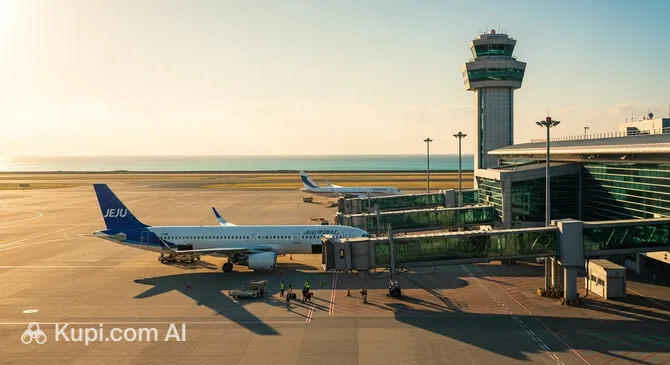
Jeju International Airport. Source: Kupi.com Binoculars

Welcome to Jeju International Airport (CJU) — the main aerial gateway to the "Hawaii of Korea"! This airport serves as the starting point for millions of travellers eager to experience the unique nature and culture of Jeju Island in South Korea. Despite its relatively compact size, it consistently ranks among the top three busiest airports in the country. It is the origin of the Jeju–Seoul route, which has held the status of the world's busiest air route by passenger numbers for many years.

Below is the essential information about the airport in a convenient format:

IATA Code CJU
ICAO Code RKPC
City Jeju City
Distance to Centre Approx. 3–4 km
Status International
Annual Passengers ~29.1 million (2023)
Popular Airlines Korean Air, Asiana Airlines, Jeju Air
Schedule Online Flight Board "Jeju International Airport"

Despite the colossal passenger traffic, Jeju Airport is distinguished by its thoughtful organisation and modern infrastructure. Both domestic and international flights are serviced in a single terminal, making transfers very convenient. For the comfort of travellers, everything necessary is available here: numerous cafes and restaurants featuring Korean cuisine, Duty Free shops, currency exchange counters, bank branches, and a tourist information centre where staff can help you plan your route around the island. Thanks to its close proximity to the island's capital, you can reach the city centre by bus or taxi in just 10-20 minutes, allowing you to quickly begin your unforgettable adventure on Jeju.

Contact Information

  • Official Website: You can find flight schedules, terminal maps, and other up-to-date information on the airport's official website: www.airport.co.kr/jeju (the site is available in Korean, English, Chinese, and Japanese).
  • Information Service Phone: For calls within South Korea, the Korea Airports Corporation (KAC) unified number is 1661-2626. For international calls: +82-1661-2626.
  • Airport Address: 2 Gonghang-ro, Jeju-si, Jeju-do, Republic of Korea.
  • Email: A direct email address for general inquiries is typically not provided. It is recommended to use the "Voice of Customer" form on the official airport website for communication.
  • Social Media: Links to the official pages of the Korea Airports Corporation (KAC), which manages the airport, can be found on their main website.
  • Lost and Found Information:
    • If you have lost items within the terminal area, please contact the Lost and Found office at: +82-64-797-2521.
    • If the issue concerns checked baggage (suitcases handed over at check-in), you must contact your airline's representative office directly.
  • Passenger Support Contacts: Information desks are located in the arrival and departure halls. You can also use the general information service phone for assistance.

How to Get to the Airport

Getting to Jeju International Airport (CJU) is quite simple from any point on the island. Thanks to a developed transport infrastructure, travellers can choose the method most convenient for them, whether it be budget-friendly public transport or a comfortable taxi. The airport is located very close to Jeju City, making the journey quick and tireless.

Public Transport: Buses. This is the most economical and popular way to get to the airport. The island operates an extensive network of city and intercity buses, many of which stop right at the passenger terminal. For example, Limousine Bus No. 600 connects the airport with major hotels and the Jungmun Tourist Complex in Seogwipo city. Regular city buses also run frequently between the airport and various districts of Jeju City. The trip from the city centre will take approximately 15-25 minutes, and the cost is very affordable.

Taxi and Private Transfer. Taking a taxi is a fast and convenient option, especially if you have a lot of luggage. Taxis are easy to find anywhere on the island. Travel time from the centre of Jeju City is about 10-15 minutes, depending on traffic conditions. The cost will be higher than the bus but remains reasonable. For maximum convenience, especially for families or groups, you can book a private transfer in advance, which will meet you at your hotel and deliver you directly to the departure terminal.

Car Rental. Many tourists prefer to explore the island's beauty in a rental car, as road trips are a hallmark of tourism in South Korea. The process of returning the car before departure is very simple. Most rental companies are located near the airport and provide free shuttles that will take you from the parking lot to the terminal in 5-10 minutes. Simply follow the "Car Rental Return" signs upon arrival in the airport area.

Airport Parking. For those arriving by private vehicle, a large parking zone is provided on the airport grounds. There are options for both short-term and long-term parking. The cost depends on the duration of parking. This is a convenient option if someone is seeing you off at the airport or if you are leaving your car for a short trip.

Terminals and Map

International Airport Jeju City (CJU) serves as the main air gateway to the island of the same name in South Korea. Despite high passenger traffic, its structure is straightforward and intuitive. The airport consists of one large passenger terminal that handles both domestic and international flights. This significantly simplifies navigation, as you do not need to move between different buildings.

The terminal is divided into two main sections: Domestic and International. Although they are in the same building, they have separate check-in areas, security controls, and boarding gates. The terminal layout is logical and organised by floors:

  • 1st Floor: Arrival Area. Here you will find baggage claim belts, car rental counters, tourist information centres, and exits to bus stops and taxis. International passengers pass through passport and customs control here.
  • 2nd Floor: Airline offices and several cafes.
  • 3rd Floor: Departure Hall. Here are the flight check-in counters, followed by security checkpoints and passport control (for international flights). After clearing all formalities, you enter the airside area with shops and boarding gates.
  • 4th Floor: Restaurant court, where you can have a meal before your flight while enjoying a view of the runway.

Transitions between zones are made on foot inside the building. Signs are in multiple languages (Korean, English, Chinese), which helps in orienting yourself easily. It is recommended to arrive at the airport 1.5-2 hours before a domestic flight and 2.5-3 hours before an international one. During peak tourist seasons and holidays, queues for check-in and security may be longer, so it is worth allowing extra time. The main tip for navigation is to check in advance which part of the terminal (Domestic or International) your flight departs from, and follow the corresponding signs.

Airport History

The history of Jeju International Airport is inextricably linked with the development of the island itself as the premier resort of South Korea. Its story began in 1942, when a Japanese military airfield was built on this site. After the end of World War II, the airfield came under civilian control and began to play a key role in connecting the island with the mainland. It was officially opened for civilian flights in 1958, receiving the name "Jeju Airport".

An important milestone in the development of the air harbour was 1968, when the airport received international status. This event served as a powerful impetus for the development of tourism on the island. As the popularity of Jeju City as a tourist destination grew, so did the load on the airport. In 1983, a large-scale reconstruction was completed, including the extension of the runway and the expansion of the passenger terminal, which allowed for the reception of larger aircraft.

The real boom in development occurred in the late 20th and early 21st centuries. To cope with the constantly growing passenger flow, the construction of a new, modern passenger terminal was completed in 2007, and the old one was converted for domestic flights. Further modernisations continued in the 2010s, allowing the airport to meet the highest international standards of service and safety.

One of the most impressive facts in the history of Jeju Airport is its records. For many years, the Seoul-Jeju air route has been the busiest in the world in terms of the number of flights and passengers carried, which speaks eloquently of the island's incredible popularity. Today, Jeju International Airport is not just a transport hub, but a vital artery feeding the economy and tourism industry of the entire island, and the gateway to the "Korean Hawaii" for millions of travellers from around the world.

Services and Amenities

Jeju International Airport (CJU) offers passengers a wide range of services to make waiting for a flight as comfortable and productive as possible. Within the terminal, you will find numerous restaurants and cafes where you can try both authentic Korean dishes and familiar international snacks. For shopping enthusiasts, various stores are open, including a Duty Free zone with a large selection of cosmetics, souvenirs, electronics, and famous local delicacies.

For those who prefer to wait for their flight in a calmer atmosphere, the airport operates premium lounges and VIP halls. Here you can relax in comfortable armchairs, enjoy complimentary drinks and snacks, and work in silence. Free Wi-Fi is available throughout the airport, and numerous public charging stations are provided to keep your gadgets ready for use.

Jeju Airport also addresses all practical matters. For financial transactions, bank branches, ATMs, and currency exchange counters are available. In case of illness, passengers can visit the medical centre for first aid. For travellers with small children, convenient baby care rooms are equipped where you can feed and change your baby in a quiet environment.

The airport is fully adapted for passengers with reduced mobility: ramps, special elevators, adapted restrooms, and escort services are provided, which are recommended to be booked in advance through the airline. Although there are no hotels directly inside the terminal building, many hotels to suit any taste and budget are located in the immediate vicinity of the airport. For business travellers, business lounges usually provide basic services such as workspaces and access to office equipment, allowing for effective use of time before departure.

Where to Eat

International Airport Jeju City (CJU) offers passengers diverse dining options, from a quick coffee to a hearty meal featuring local cuisine. Most establishments are concentrated in the public area before security control, so if time permits, it is better to eat there.

Public Area (Landside)

The main gastronomic space of the airport is located on the 4th floor — here lies a large food court with a wide selection of restaurants. This is the ideal place for a full lunch or dinner. Here you can try authentic Korean dishes and, in particular, local specialties of Jeju Island. Look out for:

  • Black Pork dishes (Heuk-dwaeji) — the island's signature specialty.
  • Bibimbap — rice with vegetables, meat, and egg.
  • Various Korean soups, such as Kimchi-jjigae (spicy stew with kimchi) or Doenjang-jjigae (soybean paste stew).

On the 1st floor (Arrivals) and 3rd floor (Departures), you can also find chain coffee shops, bakeries (e.g., Paris Baguette), and fast-food restaurants (Lotteria), which are excellent for a quick snack.

Secure Area (Airside)

After passing passport control and security, the choice of establishments becomes smaller, but you won't go hungry. In the departure zones (for both domestic and international flights), there are coffee shops where you can grab drinks and sandwiches, as well as several small eateries and shops offering ready-made food and snacks.

Special Dietary Preferences

Finding options for strict diets can be challenging.

  • Vegetarians will find it easiest to order vegetable bibimbap (Yachae Bibimbap), asking for it to be prepared without meat and egg. However, keep in mind that many Korean sauces may contain fish ingredients.
  • There are generally no certified Halal or gluten-free establishments in the airport. Travellers with specific requirements are advised to choose rice and vegetable dishes, carefully studying the ingredients, or to carry suitable snacks with them.

Prices and Opening Hours

Prices at the airport are expectedly higher than in the city. The cost of a full meal at the food court ranges on average from 12,000 to 25,000 won. Most restaurants and cafes open early in the morning (around 6:00–7:00) and operate until the last evening flight (approximately until 21:00–22:00).

Recommendations:

  • For a quick snack and coffee, coffee shops on the 1st and 3rd floors or in the departure area are ideal.
  • For a complete and leisurely lunch immersing yourself in local cuisine, head to the food court on the 4th floor in the public area. This is the best way to enjoy the flavours of South Korea before your flight.

Tips for Travellers

Travelling through Jeju International Airport can be an easy and pleasant start or finish to your adventure on the island. To ensure everything goes smoothly, use our tips which will help save time, stress, and money.

Arrival time at the airport. Jeju is one of the busiest destinations in South Korea, especially for domestic flights. We recommend arriving at the airport 2-3 hours before international flights and 1.5-2 hours before domestic ones. During peak seasons (summer, national holidays), it is better to allow extra time.

Check-in and Security Control. To save time in queues, complete online check-in for your flight if your airline provides this option. Security checkpoints at Jeju Airport operate efficiently, but be prepared in advance: keep your boarding pass and passport handy, pack liquids up to 100 ml in a transparent bag, and be ready to remove laptops and other large electronics from your hand luggage.

Seat Selection. If you want to enjoy stunning views of Jeju Island and its coastline during takeoff or landing, choose a window seat. An aisle seat is suitable for those who appreciate the ability to stand up freely and stretch their legs during the flight.

Hand Luggage. Standard security rules prohibit carrying sharp objects, flammable substances, and liquids in containers larger than 100 ml. All liquids must be packed in a single transparent bag. Be sure to check with your airline for exact weight and size limits for hand luggage to avoid extra charges at the airport.

Transfer Passengers. Jeju Airport mainly serves direct flights. If you have a complex itinerary with a transfer, for example, from a domestic flight to an international one, you will likely need to collect your luggage, pass through customs and passport control, and then check in again for the next flight. Carefully check transit information with your airline.

Customs Control. When entering South Korea, you will need to fill out an immigration card and a customs declaration. Honestly declare all goods subject to declaration. A Tax-Free refund system is available for tourists at the airport, so keep receipts for major purchases to process the refund before departure.

Saving Time and Money. Use public transport — numerous buses run from the airport to any point in Jeju City and to the island's main resorts. This is significantly cheaper than a taxi. Buy souvenirs and have snacks in the city rather than at the airport, where prices are generally higher.

Flight Delays. In case of a flight delay or cancellation, first contact your airline's counter for information and instructions. Jeju Airport has plenty of shops, cafes, and restaurants, as well as free Wi-Fi, to pass the waiting time. Check with the airline representative if you are entitled to meals or hotel accommodation in the event of a long delay.

Reached the end of the page?

That means the route is fully explored