Support

Arashiyama Monkey Park Iwatayama

About

Iwatayama Monkey Park is a wonderful nature park located on the slopes of Mount Iwatayama in the picturesque Arashiyama district, a suburb of Kyoto, Japan. This unique destination provides visitors with a rare opportunity to observe wild Japanese macaques, also known as "snow monkeys," in their natural habitat.
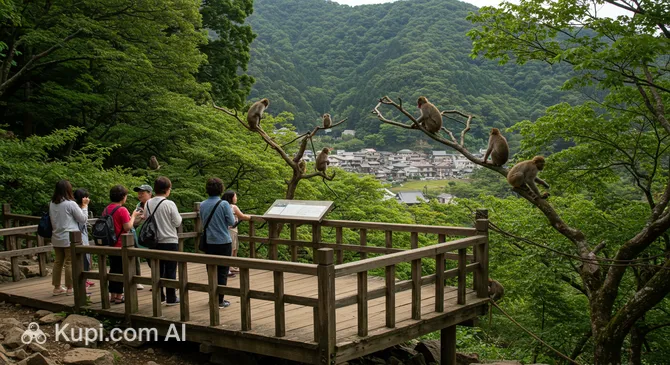
Arashiyama Monkey Park Iwatayama. Illustration.
Source: Kupi.com AI

Traveler photos:

Iwatayama Park is home to a troop of approximately 120 Japanese macaques (Macaca fuscata, or Nihonzaru). These primates are an endemic species found exclusively in Japan. Japanese macaques are known for their unique adaptation to cold climates and behaviors, including the famous hot spring bathing in some regions of the country. At Iwatayama Park, you can see these charming creatures in their natural mountain environment.

Besides meeting the playful macaques, the climb to the top of Mount Iwatayama, where the park is located, rewards you with a magnificent panoramic view of Kyoto, the Arashiyama district, and the surrounding scenic hills. It is a great spot not only for animal lovers but also for those who appreciate beautiful landscapes and want to take unforgettable photos.

Contacts

When planning your visit to the Iwatayama Monkey Park in Arashiyama, keep in mind that the entrance fee is 500 yen. It is best to check official Kyoto tourism resources or verify details just before your visit for up-to-date information on opening hours and specific contact details, such as phone numbers or the official website address, as these are subject to change.

How to contactContact
AddressJapan, 〒616-0004 京都府京都市西京区嵐山中尾下町61
Phone number+81 75-872-0950
Websitewww.monkeypark.jp

What to Do

The main reason visitors come to Iwatayama Monkey Park is, of course, the chance to observe wild Japanese macaques. Here, you will see these funny animals going about their daily lives in their natural environment. It is important to remember that these are wild animals, so certain safety rules must be followed: do not look the monkeys directly in the eye and do not get too close to them. Park staff monitor compliance with these rules to ensure the visit is pleasant and safe for both humans and primates.

One of the most interesting activities in the park is feeding the monkeys. However, this can only be done from inside a special hut with wire-mesh windows. Inside this hut, visitors can purchase small portions of sliced sweet potatoes or peanuts to offer the macaques through the mesh. This approach ensures safety and prevents undesirable begging behavior from the animals.

In addition to interacting with the monkeys, the climb up Mount Iwatayama itself is a bit of an adventure. From the summit, stunning panoramic views of Kyoto, the scenic Arashiyama district, and its surrounding hills unfold. It is especially beautiful in autumn, when the maple leaves turn vibrant shades of crimson and gold, creating unforgettable scenery. This is a perfect place for photography and peaceful contemplation of nature.

Getting There

Iwatayama Monkey Park is located in the scenic Arashiyama district, which is considered a suburb of Kyoto. Therefore, your first step is to get to the Arashiyama area. Fortunately, transportation between central Kyoto and Arashiyama is well-developed. You can take the JR Sagano (Sanin) Line to Saga-Arashiyama Station, or the private Hankyu Arashiyama Line to Arashiyama Station. City buses also run to Arashiyama.

After arriving in Arashiyama, you will need to hike up Mount Iwatayama, where the park is situated. The park entrance and the start of the trail are located near the famous Togetsukyo Bridge. The climb takes approximately 20-30 minutes along a scenic, though occasionally steep, forest trail. It is recommended to wear comfortable shoes, as the path can be uneven.

Since the park is at the top of a hill, the ascent requires some physical effort. However, your reward will be not only a meeting with the monkeys but also magnificent panoramic views of Kyoto and the surrounding area from above. If you prefer a more comfortable way to reach Arashiyama, you can always take a taxi from the city center, but keep in mind that you will still need to complete the hike to the park itself on foot.

Nearest city: Kyoto

History & Facts

Iwatayama Monkey Park in Arashiyama is not just a popular tourist spot, but also an important scientific center. It is home to about 150 Japanese macaques, which have become the focus of attention for many researchers and students. Scientists from all over the world come here to track their behavior and study complex social interactions and unique adaptation mechanisms, turning the park into a kind of living open-air laboratory.

The Japanese macaques living here are a unique species of primate, famous for their striking adaptation to the relatively cold climate of Japan. Their ability to survive in snowy conditions and their specific behavioral traits are of particular interest to zoologists and primatologists who visit for research. These animals are endemic to the Japanese islands, making them even more valuable to the scientific community.

While monkeys might not be the first thing that comes to mind when thinking about a trip to Japan, the creators of the Iwatayama Monkey Park in Arashiyama have successfully turned the presence of these animals into a truly attractive tourist experience. Most importantly, this was done with great respect for nature: the park strives to preserve the macaques' natural habitat, allowing visitors to observe them in conditions as close to the wild as possible and learn more about these amazing creatures.

Time Needed

To fully experience the Iwatayama Monkey Park in Arashiyama and its charming inhabitants, as well as to enjoy the views from the summit, most visitors will need about 2-3 hours. This time allows you to take part in all the main activities the park offers without rushing.

This timeframe usually includes the climb up the mountain to the main park area, which is a short hike in itself. You will have enough time to observe the Japanese macaques in their natural habitat, feed them from the special hut (if you wish), and, of course, admire the breathtaking panoramic views of Kyoto and its surrounding scenic landscapes. If you plan to take many photos or simply want to linger longer to soak up the atmosphere, you might want to allow a bit more time.

Working Hours

Iwatayama Monkey Park in Arashiyama is open to visitors year-round, so you can plan your visit for any season. According to available information, the park is open daily, giving tourists the chance to enjoy interacting with Japanese macaques in their natural habitat.

Unfortunately, the exact opening hours are not specified in the provided data. Therefore, to find out the current schedule and whether tickets need to be booked in advance, it is highly recommended to check the park's official website or consult local tourist information centers in Kyoto just before your visit. This will help you plan your trip effectively and avoid any potential inconvenience.

9:00 – 16:00

Nearby

A visit to the Iwatayama Monkey Park in Arashiyama will undoubtedly be a highlight of your trip to Kyoto. However, to make your journey even more enriching and complete, it is worth exploring other attractions nearby. Discovering the surrounding area will allow you to dive deeper into the atmosphere of this wonderful region of Japan and discover new facets of its culture and beauty.

The Arashiyama district, where the monkey park is located, is a treasure trove of interesting sites in its own right. By expanding your itinerary, you can gain a fuller understanding of the diversity of Kyoto, famous for its temples, gardens, and unique atmosphere. Below is a list of some attractions located near the Iwatayama Monkey Park in Arashiyama, along with their approximate distances.

NameDistance
Pug Cafe Living Room Kyoto3.9 km
Nijō Castle6.5 km
Kyoto Railway Museum6.5 km
Kyoto Aquarium6.9 km
IMU Bar Kyoto7.4 km
Shinpuhkan7.6 km
Kyoto Samurai and Ninja Museum7.9 km

Have you reached the end of the page?

So the route has been studied inside and out