Support

Fushimi Inari Shrine

About

Fushimi Inari Shrine (Fushimi Inari Taisha) is one of the most iconic and impressive Shinto temple complexes, located in the southern part of the city of Kyoto. As the head shrine dedicated to Inari, the goddess of rice, business, and prosperity, it attracts millions of visitors and pilgrims from across Japan and the world. The complex is situated at the foot of the sacred Mount Inari, the territory of which belongs entirely to the temple.
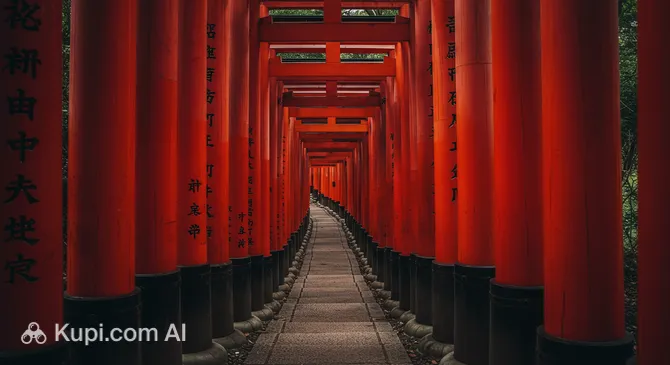
Fushimi Inari Shrine. Illustration.
Source: Kupi.com AI

Traveler photos:

The main feature that made Fushimi Inari world-famous is the thousands of bright red torii gates. These gates, donated by devotees and companies as a sign of gratitude or a request for success, form picturesque tunnels that stretch along trails through the forest to the mountain peak. Walking through these torii corridors is not just sightseeing, but a true immersion into a unique, mystical atmosphere.

Throughout the complex, you will also encounter numerous statues of foxes (kitsune), which in Shinto are considered the sacred messengers of the goddess Inari. They often hold symbolic items in their mouths, such as the key to a rice granary, highlighting the deity's role as a protector of the harvest and well-being. A visit to Fushimi Inari offers not only stunning views but also a deep introduction to Japanese traditions and beliefs.

Contacts

To contact the Fushimi Inari administration or inquire about rituals and events, you can use the official channels. Visitors should note that the shrine grounds are open 24/7. Below are the primary contact details for planning your visit.

How to contactContact
Address68 Fukakusa Yabunouchichō, Fushimi Ward, Kyoto, 612-0882, Japan
Phone number+81 75-641-7331
Websiteinari.jp

What to Do

The main activity for visitors to Fushimi Inari Shrine is, without a doubt, walking through the famous tunnels made of thousands of bright red torii gates. These trails lead through a picturesque forest up the sacred Mount Inari, which is part of the temple grounds. The entire route to the summit and back takes about 2–3 hours, but shorter paths are also available. The climb is not just physical activity, but a meditative journey that allows you to enjoy the silence of nature and take stunning photographs in the mystical gate corridors.

As you ascend the mountain trails, you will come across many small shrines, altars, and stone mounds (tsuka) intended for personal prayers and offerings to the deities. This is a great opportunity to see how locals and pilgrims express their respect. Look out for the many fox statues (kitsune), which are considered messengers of the goddess Inari. They are often depicted with a key in their mouths—the symbol of the key to the rice granary, emphasizing the deity's role in ensuring prosperity.

After your walk along the trails, it is worth spending time in the streets at the foot of the mountain. Here, you will find many shops and stalls where you can try local delicacies and buy souvenirs. Particularly popular are traditional Japanese sweets and the famous fortune cookies, which are believed to have originated in this area. Visiting these shops will be a pleasant conclusion to your visit, allowing you to take home not only spiritual impressions but also tasty memories of Kyoto.

Getting There

Getting to Fushimi Inari Shrine is quite simple, as it is conveniently located in the southern part of Kyoto. The most popular and fastest way is by train. You will need the JR Nara Line, which departs from the central station. The journey to Inari Station takes only about 5 minutes, and the station is located right across from the main entrance to the temple complex, making this option exceptionally convenient.

Another handy public transport option is the Keihan Line. You will need to travel to Fushimi-Inari Station, which is just a few minutes' walk from the shrine. This method may be particularly convenient if you are traveling from areas of the city served by this specific metro line.

If you prefer more comfort or are traveling in a group, you can take a taxi. The ride from central Kyoto to Fushimi Inari takes approximately 15–20 minutes, though time and cost may vary depending on traffic conditions. For those staying nearby, a pleasant walk or bike ride to the temple is also possible.

Nearest city: Kyoto

History & Facts

The history of Fushimi Inari Shrine is rooted in deep antiquity, making it one of the oldest and most significant Shinto sites in Japan. Its founding predates even the move of the capital to Kyoto in 794, with the very first structures on this site dating back to 711. A century later, in 816, the famous monk Kukai initiated the shrine's reconstruction, significantly strengthening its status. This site has always played a vital role in the country's spiritual life, long before it became a world-renowned tourist attraction.

The shrine gained special fame and prestige during the Heian period when it became a pilgrimage site for the Emperor in 1072. Since then, it has enjoyed imperial patronage and was included in the elite list of temples receiving direct government support. However, like many historical monuments, Fushimi Inari did not escape tragic events. During the destructive Onin War (1467–1477), the entire temple complex was completely destroyed by fire.

It took about thirty years to restore the shrine after the fire, and the new main building was consecrated in 1499. Most of the structures visitors see today were built around 1500, preserving the spirit of that era. An interesting fact is that during the reconstruction, the architectural concept changed: while in the old shrine, three different deities (kami) were dedicated separate buildings, in the new complex, all five revered kami were united under one roof.

Time Needed

When planning a visit to Fushimi Inari Shrine, you should allow for 2 to 3 hours for a basic tour. This is usually enough time to get to know the main part of the complex: see the impressive main gate, visit the primary shrine at the foot of the mountain, and, of course, walk through the most famous and dense sections of the vermilion torii gate tunnels. Such a route allows you to experience the unique atmosphere of the place without committing to a long climb.

If you want to get a more complete impression and explore the entire area, prepare to spend more time. A full ascent to the summit of the sacred Mount Inari and the descent back down can take an additional 2–3 hours. Thus, a full journey through all the shrine's trails can take about half a day. However, the beauty of Fushimi Inari is that you can decide for yourself how far to go and turn back at any time, making a visit convenient for any schedule.

Working Hours

One of the main advantages of Fushimi Inari Shrine is its exceptional accessibility. The temple complex is open to visitors 24 hours a day, year-round, 7 days a week, allowing guests to enjoy its unique atmosphere at any time of day or night. It is important to note that entry to the entire grounds is free, and no prior registration or ticket purchase is required for a visit.

Despite the 24-hour access to the trails, it should be kept in mind that the main shrine buildings, as well as souvenir shops and offices on its territory, operate on a more limited schedule, usually from 9:00 AM to 5:00 PM. If you want to do more than just walk and wish to purchase amulets or souvenirs, plan your visit for the daytime. For those who prefer solitude and wish to take photos without the crowds of tourists, the early morning hours are the best time to visit.

Open 24 hours

Nearby

Visiting Fushimi Inari Shrine is just the beginning of discovering the treasures that Kyoto holds. To truly experience the spirit of this ancient city, it's worth taking time to explore the surrounding areas. Every nearby street and temple can tell its own unique story and offer new impressions, completing the picture of Japan's cultural richness.

A walk through nearby attractions will allow you to see other facets of Japanese architecture and religious traditions, from Buddhist temples to picturesque gardens. Iconic sites located a few kilometers from Fushimi Inari will make your journey even more fulfilling and memorable. Below is a list of some of them, along with their distances.

NameDistance
Kyoto Resort Hotel2.6 km
Kiyomizu-dera3 km
The Hotel Seiryu Kyoto Kiyomizu3.3 km
Ninenzaka Yasaka Chaya3.4 km
Kyoto Aquarium3.6 km
Kyoto Railway Museum4 km
Kyoto Yakiniku Enen Shijo Kawaramachi4.1 km

Have you reached the end of the page?

So the route has been studied inside and out