Support

Gwanghwamun Gate

About

A majestic structure greeting guests in the heart of the Korean capital, Gwanghwamun Gate is the main southern entrance to the grand Gyeongbokgung Palace complex in Seoul. This architectural monument serves not only as the gateway to the royal residence but also as one of the most recognizable symbols representing South Korea on the global tourism stage.
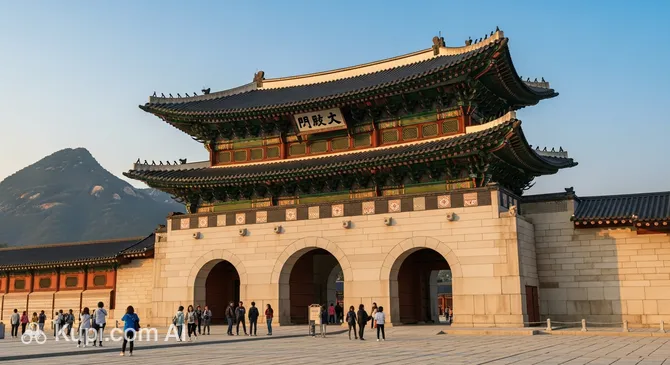
Gwanghwamun Gate
Gwanghwamun Gate. Иллюстрация. Источник: Kupi.com AI

Originally erected in 1395 under the founder of the Joseon Dynasty, the gate embodies the high ideals of the past: its name translates as "let the light of enlightenment cover the world." A massive granite base with an arched passage is topped by an elegant wooden tower, while statues of mythical Haetae creatures stand eternal watch on either side, protecting the site from misfortune. The gate's modern appearance is the result of a meticulous 2010 reconstruction, during which craftsmen restored its historical look with maximum precision.

Today, Gwanghwamun Gate stands at the center of the bustling square of the same name, where ancient architecture contrasts strikingly with modern skyscrapers and views of the rugged Bukhansan mountain. This is a place where history literally meets modernity, creating a unique atmosphere that every traveler seeks to experience.

Contacts

For more information or inquiries regarding your visit, you can use the following contact details:

How to contactContact
Address161 Sajik-ro, Jongno District, Seoul, Южная Корея
Phone+82 2-3700-3900

What to Do

One of the most vivid highlights of your visit will be the ceremonial Changing of the Guard. This ceremony, featuring guards in vibrant historical costumes from the Joseon Dynasty, takes place daily every hour from 10:00 to 15:00. It is a wonderful opportunity to see history come to life and take stunning photos against the massive walls. In fact, many tourists come here wearing rented hanbok (national costumes) specifically for a themed photo shoot.

After exploring the gate itself, be sure to stroll through the spacious Gwanghwamun Square. Here you can see the majestic Statue of King Sejong the Great, which hides an interesting underground museum dedicated to the creation of the Korean alphabet. Nearby is the monument to Admiral Yi Sun-sin and the famous "12-23" fountain, which creates a mesmerizing light show in the evening resembling fireworks.

For those interested in history in detail, the "Waterway of History" runs along the square—a shallow canal with key dates and events from the country's annals engraved on its floor. This area is perfect for leisurely walks, with numerous benches and rest areas allowing you to comfortably observe the rhythm of Seoul life surrounded by flowers and fountains.

Getting There

Getting to this iconic landmark in the city center is quite easy. The fastest and most convenient way is by metro. You can take Gwanghwamun Station (Line 5, Exits 3–5) or the station of the same name on Line 1 (Exit 1). From either of these exits, the walk to the gate takes no more than 5–10 minutes. Stations on Line 3 are also within walking distance.

For those who prefer ground transport, numerous bus routes run along Sejong-daero avenue, with stops located right by the square. If you are coming directly from Incheon Airport, you can take airport limousine buses AE501 and AE500, or take the AREX express train with a subsequent transfer to the metro; the journey takes about an hour and a half.

If you are already in the historical center, the gate is an easy walk from Gyeongbokgung Palace, the colorful Insadong district, or Bukchon Hanok Village. A taxi ride from central Seoul is also quick, taking about 10–15 minutes depending on traffic conditions.

Ближайший город: Seoul

History & Facts

The history of these majestic gates began in 1395, when they were built as the main entrance to the Gyeongbokgung Palace complex. As the southern gate of the capital, they served not just as a passage, but as an important symbol of the power of the new Joseon Dynasty. The name chosen by the first king carried deep meaning: "let the light of enlightenment cover the world," reflecting the ideals of governance at that time.

The structure has faced a challenging past: in 1592, during the Imjin War, the gates were destroyed and remained in ruins for nearly three centuries. It wasn't until 1867, under Emperor Gojong, that they were restored to their original form. However, the 20th century brought further damage, first due to colonial-era construction and later during the conflicts of the mid-century. A post-war reconstruction in 1968 used concrete, which for a long time was considered a compromise.

The gates regained their authentic appearance in 2010 after a massive restoration project that replaced the concrete structures with traditional granite and wood, returning the gate to its historically accurate location. A notable feature is the mythical Haetae creatures—lion-unicorns placed on either side. According to feng shui principles, these guardians are meant to protect the palace and the city from fires, which legend says could be brought on by Gwanaksan Mountain.

Time Needed

To view the gate itself, walk across Gwanghwamun Square, and take commemorative photos, most tourists need about 1 to 2 hours. This is usually enough time to catch the Changing of the Guard and explore the monuments to King Sejong and Admiral Yi Sun-sin.

If you plan to go beyond a basic viewing and want to enter Gyeongbokgung Palace or visit the underground museum exhibits beneath the square, you should set aside 3–4 hours. This will allow you to enjoy the atmosphere of the historical center without rushing and examine all the architectural elements of the complex in detail.

Working Hours

Gwanghwamun Gate itself and the adjacent square are accessible 24/7. You can walk here and enjoy the night lighting of the complex at any time. However, keep in mind that entry to the Gyeongbokgung Palace grounds beyond the gate has specific hours and is closed on Tuesdays.

The Changing of the Guard ceremony is held daily from 10:00 to 15:00 at the start of every hour. Please note that performances may be canceled in the event of heavy rain or extreme weather conditions. For up-to-date information on special events, it is recommended to check the city's official tourism portal.

Круглосуточно

Nearby

Exploring the area around Gwanghwamun Square allows you to dive deeper into both the modern life and history of the Korean capital. Numerous cultural and entertainment sites are concentrated nearby, making them excellent additions to your excursion.

NameDistance
National Palace Museum of Korea0.2 km
Charles H0.6 km
Four Seasons Hotel Seoul0.6 km
Bar Cham0.7 km
Deoksugung Palace1.1 km
Myeongdong Korean BBQ1.3 km
Changgyeonggung Palace1.6 km

Reached the end of the page?

That means the route is fully explored