Support

Swedish Gate

About

The Swedish Gate (Latvian: Zviedru vārti) is a unique architectural monument and one of the most iconic landmarks of Riga, the capital of Latvia. It is the only one of the eight city gates remaining today from the ancient fortifications that once surrounded the city. Located at 11 Torņa Street, the gate is part of a larger architectural ensemble that includes the medieval Jurgen's Tower, the first mention of which dates back to 1350.
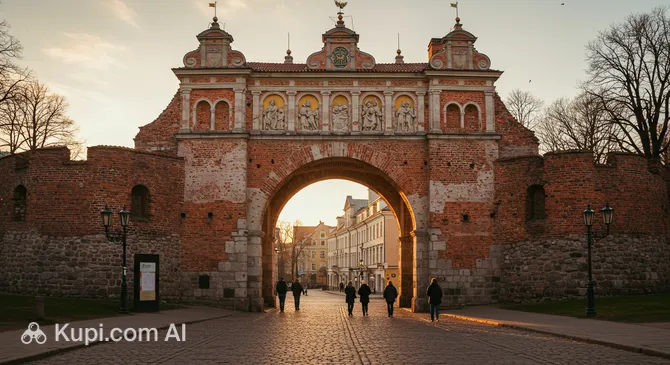
Swedish Gate. Illustration.
Source: Kupi.com AI

Traveler photos:

Despite its modest size — only 3.75 meters wide — the Swedish Gate impresses with its elegant cylindrical arch, finished with Saaremaa dolomite. The keystones, decorated with images of lions and the construction date "1698," hold special artistic value. An interesting detail: the lion facing the city holds a ring in its mouth, while the lion facing the former barracks is depicted with a fierce snarl, which has given rise to many legends and interpretations.

Its name — the Swedish Gate, or sometimes the Lion's Gate — comes from these stone lions, as the lion is one of the symbols of Sweden. The gate was built during the period of Swedish rule in Riga, which also explains its name. Today, the Swedish Gate is not just a historical structure but a must-visit for tourists wishing to touch the medieval history of the city and take memorable photos against the backdrop of this ancient building.

Contacts

The Swedish Gate is a significant architectural monument in Riga and is open for viewing 24/7, as it is an open-air site. Since the gate has no dedicated administration, it is recommended to contact Riga tourist information centers or the city's official tourism websites for additional information or to plan a guided tour. You can find the gate in the Old Town while strolling through its narrow streets.

How to contactContact
AddressTorņa iela 4-1a, Centra rajons, Rīga, LV-1050, Latvia

What to Do

A visit to the Swedish Gate in Riga is a unique opportunity to touch history and feel the medieval atmosphere. Walking through this arch, the only part of the city wall preserved in its original form, allows you to imagine the bustling life of the Old Town centuries ago. You can examine the ancient stonework, imagine the guards who once protected the city entrance, and feel like part of Latvia's centuries-old history.

The main draw of the Swedish Gate, besides its historical value, is the legends that surround it. One of the most famous stories is related to the gate's name: according to one version, it was named after Swedish soldiers who showed heroism during the Northern War and left the city through this gate. Another, more romantic and tragic legend, tells of a young Riga girl in love with a Swedish warrior. Forbidden love led to the girl being, as legend has it, walled into the gate's structure.

This legend adds a special mystical flair to the attraction. They say that if you listen very closely at midnight at the gate, especially if you have known true love, you can hear the girl's faint whisper: "But I still love him!" Thus, a walk to the Swedish Gate becomes more than just sightseeing; it’s a true immersion into city lore that evokes emotions and leaves a lasting impression.

Getting There

The Swedish Gate is located in the heart of the historic center of Riga, at 11 Torņa Street. If you are already walking through the streets of the Old Town (Vecrīga), reaching this attraction will be easy — it is part of many popular walking routes. This is a great opportunity to combine visiting the gate with exploring other iconic sites of ancient Riga.

For those coming from other parts of the city, public transport is a convenient option. The nearest tram and bus stops are located around the perimeter of the Old Town. From there, you can reach the Swedish Gate on foot in about 10-15 minutes, enjoying the atmosphere of the medieval streets. Please note that public transport access directly into the Old Town is limited.

Another way to get to the Swedish Gate is by taxi. A driver can drop you off as close as possible to the destination, as allowed by traffic rules in the historic part of Riga. Given that the streets of the Old Town are quite narrow and winding, it is recommended to use a map or a navigation app to avoid getting lost and easily find this unique architectural monument.

Nearest city: Riga

History & Facts

The Swedish Gate in Riga is not just an architectural monument, but a real page of history embodied in stone. Its appearance dates back to the end of the 17th century, specifically to 1698, when Riga was under Swedish rule, which gave them their name. Originally, a defensive wall appeared in this area much earlier, after 1210, but the gate itself was cut through much later. Its main purpose was to provide convenient passage from the inner city to the barracks and residential buildings located outside the city fortifications of that time.

Interestingly, the creation process of the Swedish Gate was carefully documented. In April 1697, city engineer Christian Purgold inspected house number 11 on Trokšņu Street, which belonged to a certain Gerd Heidemann. It turned out that to build the passage, it was necessary to demolish a chimney and a staircase in the building. The homeowner agreed to these changes, provided that the city authorities would restore the dismantled parts of his home elsewhere at their own expense. All work was successfully completed by 1698.

After construction, the Swedish Gate, like other city gates in Riga, functioned according to a strict schedule: they were opened with the first rays of the sun at dawn and securely locked at sunset. The uniqueness of this gate lies in the fact that out of the eight entrance gates that once existed in Riga's fortifications, only the Swedish Gate has survived to this day in its practically original form. This makes it an especially valuable witness to the city's centuries-old history.

Later, in 1926, the Swedish Gate and the adjacent house were leased by the Society of Architects of Latvia. The building was reconstructed for the society's needs, but the gate itself was carefully preserved. Today, it remains one of the most recognizable and atmospheric sights of Old Riga, attracting tourists with its authenticity and rich history.

Time Needed

When planning a visit to the Swedish Gate in Riga, keep in mind that for a brief look at the arch itself and the adjacent part of the ancient city wall, you will need very little time — literally 15-20 minutes. This will be enough to take a few photos and feel the medieval atmosphere.

However, if you want to explore this historical site in more detail, learn about the legends and stories associated with it, and enjoy the views of the surrounding ancient buildings, it is recommended to set aside about 30-45 minutes. During this time, you can take a leisurely walk, examine the architectural details, and perhaps look into the nearby souvenir shops or cafes.

It is important to note that the Swedish Gate is an integral part of many walking tours of Old Riga. Therefore, if you are planning such a tour, the time spent at the gate will be seamlessly integrated into the overall sightseeing itinerary of the historic center of the capital of Latvia.

Working Hours

The Swedish Gate in Riga is a unique architectural monument accessible for viewing at any time. As it is essentially a passageway between streets, it is open to the public 24/7, year-round, without any visiting restrictions. You do not need to book tickets or make an appointment to see this historic landmark.

Although the gate is accessible 24/7, for the best experience and high-quality photos, it is recommended to plan your visit during daylight hours. Daylight will allow you to fully appreciate the architectural details and the atmosphere of this iconic Riga site.

Open 24 hours

Nearby

The area around the Swedish Gate beckons explorers of Old Riga with the chance to make even more discoveries. While strolling through the ancient streets, you will not only feel the spirit of history but also find many other remarkable places located very nearby.

Exploring these nearby attractions will allow you to gain a deeper understanding of Riga's cultural and historical richness. Expand your tourist itinerary, as interesting sites are literally within walking distance and waiting for their visitors.

NameDistance
Latvian War Museum0.1 km
Dome Square0.2 km
Three Brothers0.2 km
Cat House0.2 km
Riga Castle0.3 km
Riga Black Magic Bar0.3 km
Freedom Monument0.4 km

Have you reached the end of the page?

So the route has been studied inside and out