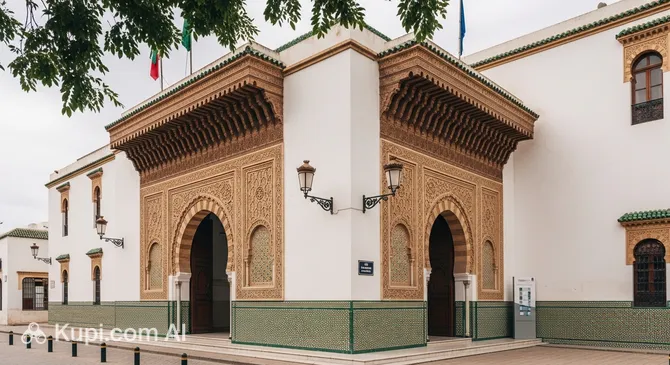
A visit to the Archaeological Museum of Tetouan is a fascinating journey back through the centuries, allowing you to touch the ancient secrets of northern Morocco. Located in the Ville Nouvelle district, this institution is considered one of the city's most important cultural centers, offering guests a unique opportunity to see artifacts spanning more than a million years of human history.
Archaeological Museum of Tetouan. Illustration.
Source: Kupi.com AI
Traveler photos:
Officially opened in 1940, the museum occupies a building specifically designed in a medieval style. This architecture immediately sets the mood, preparing visitors to encounter treasures from the prehistoric, Roman, and Islamic eras. The museum serves not just as a repository of antiquities but as a living testament to how great civilizations succeeded one another on this land.
The museum's exhibitions are curated so that even a casual tourist can trace the evolution of the region. From the simple tools of early humans to exquisite works of art, each hall tells its part of the grand story of Africa's northern coast.
Contacts
To check for the latest information before your visit or when planning a group tour, you can use the institution's official contact details.
Below is the basic contact information for reaching the museum administration:
Within the museum's halls, a wonderful world of antiquity unfolds before you. One of the most striking parts of the collection is the ancient Roman mosaics, which are impressive for their preservation and complex patterns. Finds from Lixus and Volubilis are equally interesting: bronze figurines, ceramics, and rare coins that once circulated in the markets of the great empire.
Archaeology enthusiasts should definitely pay attention to the section dedicated to the Phoenician period. Here, you'll find exquisite figurines of goddesses and a unique mosaic, testifying to the high level of craftsmanship of ancient seafarers. The museum also displays artifacts found in the caves of Martil and Sidi Abderrahmane, which shed light on human life in prehistoric times.
Special attention should be given to the 3D model of Mzoura—a mysterious megalithic structure often called the Moroccan Stonehenge. If you are interested in books, be sure to visit the local library, whose collections are dedicated to the preservation of valuable African literature. This place is perfect for slowing down for a moment and feeling the depth of the region's cultural layers.
Getting There
The museum is located at 2 Av. Ben Hssain, in the lively Ville Nouvelle district. This central location makes the site easily accessible for most travelers. Avenue Mohamed V—one of the city's main arteries leading to Al-Jalae Square—leads directly toward the museum building.
If you are staying in the historical part of the city (the Medina), you can reach the museum on foot, enjoying the transition from traditional architecture to more modern quarters. For those arriving from outlying areas, it is most convenient to use local taxis (Petit Taxi), which are abundant on the streets and relatively inexpensive.
Public transport in the city is also available, and many bus routes pass through the center; however, for tourists, a taxi remains the simplest and fastest way to get right to the doors of this cultural center.
Nearest city: Tetouan
History & Facts
The history of the area where the city stands today dates back to deep antiquity. As early as the 3rd century BC, a Mauretanian settlement called Tamuda existed here. Later, the Carthaginians and Romans came to these lands, each leaving their mark, which is now carefully preserved within the museum walls.
The modern history of the city began to be written actively in the late 15th century, when Tetouan became a refuge for Andalusian refugees—Moors and Jews who fled Spain. This event defined the unique character of the region, where Arabic traditions are closely intertwined with Spanish ones. From 1913 to 1956, the city served as the capital of Spanish Morocco.
The Archaeological Museum itself was officially opened on July 19, 1940. The building was designed specifically for museum needs and styled after medieval architecture to harmonize with the historical context. Today, it is a key institution for understanding how civilization developed in the northern part of the country over hundreds of centuries.
Time Needed
To leisurely explore all the halls and delve into the details of the exhibition, a typical visitor will need 1 to 2 hours. This is quite enough time to get acquainted with the key mosaics and coin collections.
If you are a passionate history lover or plan to use the museum library to study African literature, you should set aside a bit more time. The museum is compact, but its exhibits have a high historical density, so there is no need to rush.
Working Hours
The Archaeological Museum of Tetouan usually welcomes guests from Tuesday to Sunday. Doors are open from 10:00 AM to 6:00 PM, making it easy to fit a visit into your daily schedule. Please note that Monday is a day off, when the museum is closed to visitors.
Operating hours may change on holidays or during Ramadan, so it is recommended to check the latest information on the institution's official website or inquire at the city's tourist information center before your visit.
Day
Working hours
Monday
10:00–18:00
Tuesday
Закрыто
Wednesday
10:00–18:00
Thursday
10:00–18:00
Friday
10:00–18:00
Saturday
10:00–18:00
Sunday
10:00–18:00
Nearby
A visit to the museum is just one part of exploring the region's rich heritage. Tetouan is famous for its architecture and atmosphere, so exploring the immediate surroundings will help you form a complete impression of this unique "White City."
Within walking distance of the museum, you will find government buildings as well as the famous gates (Babs) leading into the old Medina. Here is a list of sites worth visiting nearby: