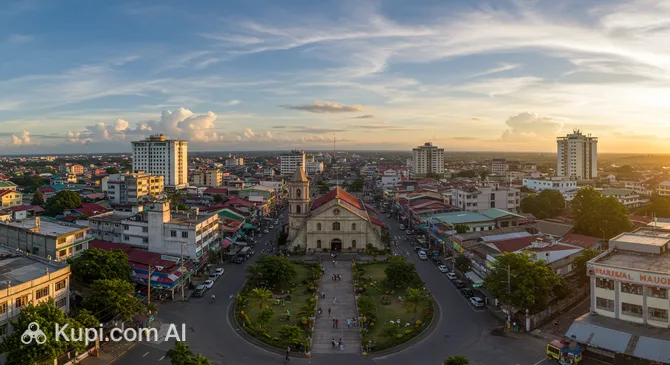
Marilao is a dynamically developing municipality in the province of Bulacan, located just a few kilometers north of Manila. The city is often called the "Northern Gateway" from the capital of the Philippines due to its advantageous geographical location along the busy MacArthur Highway. With a population of over 250,000, Marilao is a typical suburban hub where modern shopping malls stand alongside rice fields and industrial zones.
Marilao. Illustration.
Source: Kupi.com AI
For travelers, the city is primarily interesting as a point of contact with the authentic daily life of the region. The rich history of Marilao, which gained full independence in 1913, is reflected in its ancient churches and traditional neighborhoods. Despite its industrial character, it maintains an atmosphere of Filipino hospitality, which is especially noticeable during local holidays and fiestas.
The city's main landmarks are the National Shrine of the Divine Mercy and the historic St. Michael the Archangel Parish Church. Marilao is an ideal destination for those who want to see the Philippines' transition from an agrarian past to an urban future without straying far from the country's main metropolis. We invite you to explore this vibrant and ever-changing corner of Bulacan.
Weather Overview
Marilao is dominated by a typical tropical climate characteristic of Central Luzon. It is warm or hot all year round, with average temperatures ranging from 25°C to 33°C. The hottest months are considered to be April and May, when the thermometer can rise to 35°C, creating high humidity conditions that may be unfamiliar to tourists.
The city is characterized by a clear division into two seasons. The dry period lasts from December to May—this is the best time to visit, when rainfall is minimal and days are sunny and clear. From June to November, the monsoon season arrives. During this time, heavy downpours and thunderstorms are frequent, especially intense in July and August. If you are interested in a detailed weather forecast for Marilao, keep in mind that due to the low-lying terrain, some areas of the city may experience flooding after prolonged rains.
Travelers are recommended to plan their visit between January and March, when the most comfortable and dry city climate sets in. During this time, humidity is slightly lower, and evenings bring a pleasant coolness with a light breeze. Regardless of the season, it is always worth carrying sunscreen and light clothing, as UV radiation is very high here even on cloudy days.
Average monthly temperature
Average monthly precipitation
Interesting Facts
The municipality of Marilao achieved the status of a fully independent administrative unit only in 1913, although its history as a settlement dates back to the Spanish colonial period.
The city has experienced a phenomenal demographic surge: from 1975 to 2015, its population grew by over 640%, making it one of the fastest-growing suburbs in the region.
Despite dense development, Marilao still preserves patches of active rice fields that serve as a reminder of the area's agricultural past.
The municipality is divided into 16 barangays (neighborhoods), and its total area is only about 33 square kilometers, resulting in very high population density.
The city's first church was built on a site historically named "tauiran," which translates from the local dialect as "crossing place."
How to Get There
Marilao boasts excellent transport accessibility, acting as a link between Manila and the northern provinces of Luzon. The main transport artery is MacArthur Highway, through which hundreds of buses and jeepneys arrive in the city daily. If you are planning a trip, be sure to check current information on how to get to the city to choose the optimal route and avoid traffic jams.
The nearest major aviation hub is Ninoy Aquino International Airport (NAIA) in Manila, located approximately 35–40 kilometers to the south. The journey from the airport by taxi or via the Grab service will take one to two hours depending on traffic conditions. Also, from the capital's northern terminals, such as Cubao or Monumento, buses regularly depart toward Bulacan, passing through the center of Marilao.
There is currently no railway service within the municipality itself. The nearest light rail stations (MRT and LRT) are located in the northern part of Manila and Malabon, from where you can transfer to a jeepney or bus. It is important to note that during the rainy season, low-lying areas of Marilao can flood, which sometimes makes transport movement along main highways difficult.
Station
Passenger traffic
Distance
Balagtas station
4
9 km
Monumento station
7
13 km
Balintawak station
7
14 km
Fernando Poe Jr. station
7
14 km
5th Avenue LRT Station
7
14 km
Main Attractions
Although Marilao is primarily considered an industrial and residential suburb, it has several iconic sites that attract pilgrims and curious tourists. One of the most famous landmarks is the National Shrine of the Divine Mercy. Completed in 1992, this majestic complex serves as an important spiritual center, drawing believers from all over the region. Its modern architecture and tranquil atmosphere create a sharp contrast with the municipality's bustling streets.
History buffs should visit the St. Michael the Archangel Parish Church. This parish has deep roots: the Baroque building was constructed back in 1868. Although the original structure was heavily damaged during the events of the late 19th century, the restored temple retains its grandeur and is the main point of attraction in the Poblacion area. Walking around the church, you can feel the spirit of the old town, which was once a small settlement on the riverbank.
For those who prefer modern leisure, the SM City Marilao shopping complex is the place to be. Located right on MacArthur Highway, it is more than just a place for shopping; it is a true social hub where the city's best restaurants and entertainment are concentrated. While Marilao lacks classic museums or natural parks, the combination of spiritual shrines and modern infrastructure makes it an interesting stop on the way to the northern provinces of Luzon island.
Local Cuisine
The culinary face of Marilao is a vibrant mix of traditional Filipino flavors and modern street food. The city is famous for its baked goods: local bakeries fill the streets every morning with the aroma of fresh pan de sal bread. Be sure to try the signature sweets and rice cakes produced by local food enterprises—they are considered some of the best in Bulacan province.
Among the main dishes popular with locals are the classic adobo, the sour soup sinigang, and the more specific lunarya—a dish made with pork blood and rice that has a rich flavor. The city's gastronomic scene is concentrated around the markets in the barangays, where street stalls offer freshly grilled seafood and traditional snacks at very affordable prices (ranging from 100 to 300 Philippine pesos).
If you prefer a more familiar setting, head to the food courts at SM City Marilao. Popular Filipino fast-food chains such as Jollibee and Mang Inasal are represented there, where you can try the famous grilled chicken with unlimited rice. For drinks, opt for refreshing young coconut juice (buko) or local San Miguel beer, which perfectly complements spicy and savory Filipino dishes.
Travel Tips
A trip to Marilao will allow you to see the real life of a Filipino suburb. To make your journey as comfortable and safe as possible, use our practical tips.
Clothing and Essentials: Choose light cotton clothing, as the region experiences high humidity and heat. When visiting churches like the Shrine of the Divine Mercy, observe the dress code: shoulders and knees should be covered. Be sure to bring an umbrella—it will save you from both tropical downpours and the scorching sun.
Transport: Use jeepneys or tricycles to get around the city. If you value comfort, install the Grab app—it is the most reliable way to call an air-conditioned car. Keep in mind that there can be serious congestion on MacArthur Highway during peak hours.
Finances: The official currency is the Philippine Peso (PHP). ATMs and exchange offices operate in the SM City Marilao mall, but tricycles and markets only accept cash in small denominations.
Health and Safety: Drink only bottled water. Use mosquito repellent during the rainy season. The city is generally safe, but keep a close eye on your bags and wallets in crowded places like markets and malls.
Communication: The primary language is Tagalog, but most residents understand and speak English quite well. You can buy a local SIM card (Globe or Smart) at any telecommunications shop in the mall.
Local Etiquette: Filipinos are very friendly. Greet people with a smile. Respect your elders: it is customary here to show them special reverence.
What to Avoid: Try not to plan trips at the height of the typhoon season (August to October), as low-lying areas of Marilao are prone to flooding. Avoid displaying expensive jewelry or large sums of money in poorer neighborhoods.
Extra Tip: If you plan a trip to Manila, leave either very early in the morning or after the morning rush hour to avoid spending several hours in traffic.
Enjoy the hospitality of Bulacan and discover new facets of life in the Philippines. Have a pleasant trip!
Entertainment & Nightlife
Nightlife in Marilao is quiet and suburban, and you won't find massive discotheques or noisy club districts here. The main form of evening relaxation for locals remains karaoke bars (KTV) scattered along the main roads. This is a great opportunity to immerse yourself in the local culture: Filipinos love to sing, and such establishments are always full of friendly groups. Most bars stay open until midnight, offering refreshing drinks and light snacks in a relaxed setting.
The primary center for entertainment during daylight hours and early evenings is SM City Marilao. It features a modern cinema showing both global blockbusters and local films. The mall also houses game zones for children and food courts that become meeting places for families and youth. If you are looking for a more vibrant nightlife with cocktail bars and concerts, it is best to head to neighboring Quezon City, which is about an hour's drive away.
A special time to visit the city is September, when the annual fiesta in honor of St. Michael the Archangel takes place. During this period, the streets of Marilao are transformed: colorful parades are held, street musicians perform, and fairs stay open until late at night. In terms of safety, the city is quite suitable for evening walks in central areas; however, tourists are advised to use taxi services or Grab for travel after dark to avoid trips to poorly lit peripheral zones.
Parks & Museums
There are virtually no specialized museums in Marilao, as the city developed as an industrial center rather than a cultural capital. Nevertheless, religious buildings fulfill the role of historical guardians here. The St. Michael the Archangel Parish Church is essentially an open-air museum: its architecture and decor tell the story of the region's colonial past and the resilience of the locals who restored the temple after various destructions.
Park areas in the municipality are mainly represented by small public spaces and squares in front of churches. The most significant place for walking and reflection is the area around the National Shrine of the Divine Mercy. This well-maintained space with greenery offers the peace and quiet often lacking on the noisy suburban streets. Many residents also use the open areas near major shopping centers as places for relaxation and meeting.
An interesting feature of the Marilao landscape remains the rice fields, which still occupy significant areas on the outskirts of the barangays. While these are not parks in the classical sense, they provide a necessary "green respite" within the municipality's dense development. If you are looking for large-scale natural areas or art galleries, locals usually recommend heading to Quezon City or Manila, where the choice of cultural sites is much wider.
Getting Around
The transport system in Marilao is typical for a densely populated Filipino suburb, where the main burden falls on jeepneys and tricycles. Jeepneys are colorful public utility vehicles that ply MacArthur Highway, connecting the city with neighboring municipalities and northern districts of Manila. The fare is inexpensive (ranging from 20 to 50 pesos), but during peak hours—7 to 9 AM and 5 to 8 PM—transport can be very crowded, and movement slows down due to traffic jams.
For moving within residential neighborhoods (barangays), it is most convenient to use tricycles—motorcycles with a covered sidecar. This is the most common form of local transport, which will take you directly to the door of your house or hotel. A short-distance trip costs about 10–20 pesos. Additionally, the Grab service is active in Marilao, providing an excellent alternative to regular taxis for those who value comfort and fixed pricing.
There are no special transit cards in the city; payment for public transport is made in cash to the driver or conductor. Tourists should remember that pedestrian infrastructure in Marilao is poorly developed: sidewalks are often missing or occupied by market stalls, and the tropical heat makes long walks exhausting. During the rainy season, it is important to monitor the weather forecast, as heavy downpours can temporarily paralyze traffic in low-lying sections of the roads near SM City.
Accommodation
The hotel infrastructure in Marilao is primarily geared toward business travelers and those looking for budget accommodation in the suburbs of Manila. While you won't find luxury five-star hotels here, the city offers decent mid-range and economy options. Popular choices include budget chain hotels like RedDoorz, which provide essential comfort, cleanliness, and internet access at very attractive prices.
The most convenient area to stay is along MacArthur Highway, especially in close proximity to the SM City Marilao shopping mall. This offers the advantage of easy access to transport, restaurants, and shops. For those planning a longer stay in the city, apartments or housing in modern condominiums like SMDC Cheer Residences are available, offering more home-like conditions and security.
Accommodation prices in Marilao are significantly lower than in central Manila, making it attractive for budget-conscious tourists. It is recommended to book accommodation in advance through international services, especially if your trip coincides with the fiesta celebrations in September. At other times of the year, rooms are usually available, but pre-selection will help you find the most conveniently located option.
Nearby Cities
Marilao is a convenient starting point for exploring other interesting places in the Bulacan province and the capital region. Literally a ten-minute drive away is the city of Meycauayan, known for its industrial heritage and jewelry traditions. This dynamic place allows you to see another important economic center of the region.
For those seeking cultural experiences, a trip to Bocaue is an excellent option. This city is famous for its vibrant "Pagoda" river festival and the massive Philippine Arena. It is also worth visiting Obando, where nationally famous dance rituals are performed during local festivals. Lovers of a quiet suburban atmosphere can visit Bignay or Punturin, which are located very close by.
Exploring the surroundings of Marilao provides an opportunity to gain a deeper understanding of the diversity of Filipino culture. Thanks to the developed network of jeepneys and tricycles, traveling between these cities doesn't take much time and allows you to see many interesting details—from ancient churches to modern industrial landscapes.
Shopping & Souvenirs
Shopping in Marilao is centered around the region's largest shopping mall—SM City Marilao. This massive modern building on MacArthur Highway offers almost everything: from branded clothing and electronics to a huge supermarket and pharmacies. For tourists, this is the most comfortable place for shopping, where both international brands and products from famous Filipino manufacturers can be found in air-conditioned comfort.
For a more authentic experience, head to the local markets in the Poblacion or Nagbalon areas. Here, the atmosphere of genuine Filipino trade reigns: rows of fresh tropical fruits, seafood, and spices stand alongside stalls offering affordable clothing and household goods. Markets are the best place to witness the daily life of the city and practice your bargaining skills.
Popular souvenirs from Marilao often include handicrafts by local artisans, particularly wooden items for which Bulacan province is famous. Local pastries and long-lasting sweets sold in bakeries at shopping centers also make excellent gifts. Most shops operate from 10:00 AM to 9:00 PM; cards are accepted in large malls, but you will definitely need cash in pesos for markets and tricycles.