Support

Arch of Triumph

About

In the northern part of Bucharest, the capital of Romania, stands one of the city's most recognizable symbols — the Triumphal Arch (Romanian: Arcul de Triumf). This majestic monument is located between Kiseleff Highway and King Michael I Boulevard, serving as both an important part of the urban landscape and a key element of the country's culture and history. The arch is dedicated to Romania's participation in the First World War and the unification of Romanian lands.
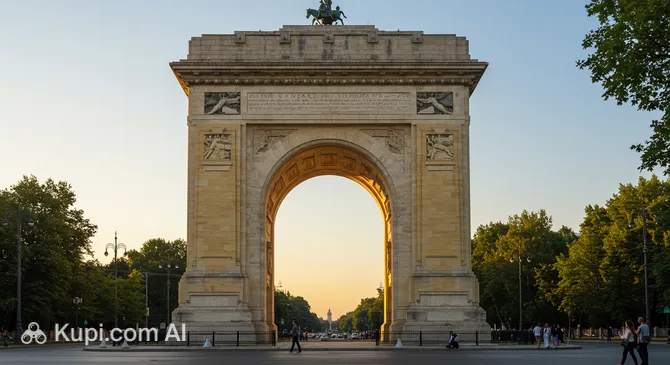
Arch of Triumph. Illustration.
Source: Kupi.com AI

Traveler photos:

The modern structure, opened on December 1, 1936, is a magnificent example of the Neoclassical style. It was designed by the famous Romanian architect Petre Antonescu. The world-renowned Arc de Triomphe in Paris served as a model, emphasizing the historic friendship between Romania and France. At the same time, the Bucharest arch has its own unique appearance thanks to sculptural compositions created by prominent Romanian masters.

The monument is impressive in size: it stands 27 meters tall, with a rectangular base measuring 25 by 11.5 meters. Inside the arch, there is a staircase leading to an observation terrace and a small museum that can be visited on certain days. Every year on December 1, Romania's National Day, military parades pass under the vaults of the Triumphal Arch, making it the center of national celebrations.

Contacts

The Triumphal Arch is primarily a monument and an observation deck, so it doesn't have traditional contact details like a phone number or email address. It is important to note that the viewing terrace at the top is not open to the public at all times, but only on specific days. Typically, this occurs during national holidays and special city events. To plan your visit and ensure you don't miss the chance to go up, it is highly recommended to check the current schedule on Bucharest's official tourist websites before your trip.

How to contactContact
AddressPiața Arcul de Triumf, București 011453, Romania
Websitewww.monumentfor.ro

What to Do

A visit to the Triumphal Arch is an opportunity to touch history and enjoy magnificent views. While walking around the monument, you can closely examine its architecture and sculptural compositions created by famous Romanian masters. This is a favorite spot for photo shoots, particularly popular among newlyweds, which gives it a special romantic atmosphere. Try to spend some time studying the bas-reliefs that tell the story of key moments in Romania's history.

The highlight for many visitors is the ascent to the observation deck. Inside the arch are stairs leading to the upper terrace, which offers an impressive panoramic view of the city. From here, you can see wide boulevards, the green expanse of King Michael I Park, and urban landscapes. This opportunity is not always available, mainly during national holidays, so such a chance is truly worth appreciating.

In addition to visual impressions, the Triumphal Arch offers food for thought. Famous Romanian historian Nicolae Iorga’s texts are carved into its walls, along with the names of locations where important battles took place. This transforms the arch from a mere architectural monument into a kind of stone chronicle that helps one gain a deeper understanding of the historical significance of this structure for the entire country.

Getting There

Getting to the Triumphal Arch, located in the northern part of Bucharest, is quite simple thanks to a well-developed public transport system. The monument is situated in Triumphal Arch Square (Piața Arcul de Triumf), at the intersection of busy city thoroughfares, making it easily accessible from anywhere in the capital. The most convenient ways to reach this iconic landmark are by metro, bus, or taxi.

The fastest and most popular option is the metro. The nearest station is Aviatorilor, which is on the M2 line. From the metro exit, a pleasant 10–15 minute walk leads you to the monument. Additionally, you can reach the arch by numerous buses that stop at "Arcul de Triumf" or "Cașin." Among the most frequent routes are buses 205, 331, and 335. Tram 41 also runs in this area and can be a convenient way to travel.

If you prefer comfort, you can always call a taxi. A ride from the city center is quick, taking about 8–10 minutes depending on traffic. For those who enjoy long walks, it's possible to reach the Triumphal Arch on foot; however, keep in mind that the distance from the historic center is about 5 kilometers, and such a route will take at least an hour. This option is perfectly suited for those who want to get a closer look at the architecture and atmosphere of Bucharest's elegant northern districts.

Nearest city: Bucharest

History & Facts

The history of the modern Triumphal Arch is essentially the story of three different monuments, each appearing at a key moment for the country. The first, made of wood, was hastily built in 1878 to celebrate a major event — Romania gaining its independence. It was under its vaults that victorious troops marched, symbolizing the dawn of a new era in the nation's history.

The idea became relevant again after the First World War and the unification of Romanian lands into a single state. In 1922, a second arch was built on the same spot, more substantial with a reinforced concrete frame, but the facade and decorative elements were made of plaster due to the rush for the celebrations. This was intended as a temporary solution, but the monument stood for over ten years before weather conditions began to take their toll.

Finally, on December 1, 1936, the current and third Triumphal Arch was officially inaugurated. Designed by architect Petre Antonescu, it was constructed from durable stone and granite, replacing its short-lived predecessor. Today, this majestic monument is not just an architectural masterpiece but a powerful symbol of the national unity of the Romanian people.

Time Needed

When planning a visit to the Triumphal Arch in Bucharest, keep in mind that the time spent can vary significantly. For a simple look at the monument, walking around it, and taking souvenir photos, 30–45 minutes will be enough for most tourists. This is sufficient to appreciate the grandeur of the architecture, examine the bas-reliefs, and feel the historical atmosphere of this iconic site for Romania. The arch is located at the center of a busy traffic junction, so many see it as part of a longer route, such as during a walk through King Michael I Park.

If your goal is not just an external viewing but also ascending to the observation deck, you should set aside more time — about 1.5–2 hours. Inside the arch, a staircase leads to the terrace offering panoramic city views, as well as a small museum. It's important to remember that access to the top is not always open, but only on certain days, such as weekends in summer and autumn months or during national holidays. Therefore, to get the most out of your visit, it is highly recommended to check the current observation deck schedule in advance.

Working Hours

Since the Triumphal Arch is an open-air monument, it can be viewed from the outside at any time of day. However, access to the observation terrace and the small museum inside is not open year-round, but only during specific periods. Typically, you can go up during the warmer months — from June to October — on weekends. The arch also traditionally opens on national holidays, such as December 1st.

Specific opening hours can change from year to year, so before planning your visit, it is highly recommended to check the latest information on Bucharest's official tourist portals. Usually, advance ticket booking is not required, and entry on the days the arch is open may be free. Given the popularity of this site, it's best to arrive early on open days to avoid long queues.

DayOpening hours
MondayClosed
Tuesday10:00 – 18:00
Wednesday10:00 – 18:00
Thursday10:00 – 18:00
Friday10:00 – 18:00
Saturday10:00 – 18:00
Sunday10:00 – 18:00

Nearby

Visiting the Triumphal Arch in Bucharest is just the beginning of exploring one of the city's most elegant neighborhoods. The monument's strategic location makes it an ideal starting point for further exploration of the northern part of Romania's capital. A stroll through the surroundings will allow you not only to enjoy beautiful architecture but also to discover green oases and other important cultural sites within walking distance.

Once at the arch, you'll notice it serves as a gateway to the vast and picturesque King Michael I Park (formerly known as Herastrau). This is a wonderful opportunity to combine viewing a historic monument with a leisurely walk in nature. Additionally, there are other noteworthy spots nearby that will enrich your experience of the city.

NameDistance
Ceaușescu Mansion1.2 km
18Lounge1.2 km
Grigore Antipa National Museum of Natural History1.6 km
Miramagica Ferris Wheel1.7 km
La Mița Biciclista2.8 km
Bucharest Blu Hotel3.1 km
Park Inn Bucharest Hotel & Residence3.1 km

Have you reached the end of the page?

So the route has been studied inside and out