Support

Natural History Museum

About

Located in the historic center of Sibiu, the Natural History Museum invites its guests on a fascinating journey through the history of life on our planet. Opened in the late 19th century, today it is an important part of the Brukenthal National Museum and one of the most interesting scientific and educational sites offered to tourists by hospitable Romania.
Natural History Museum
Natural History Museum. Иллюстрация. Источник: Kupi.com AI

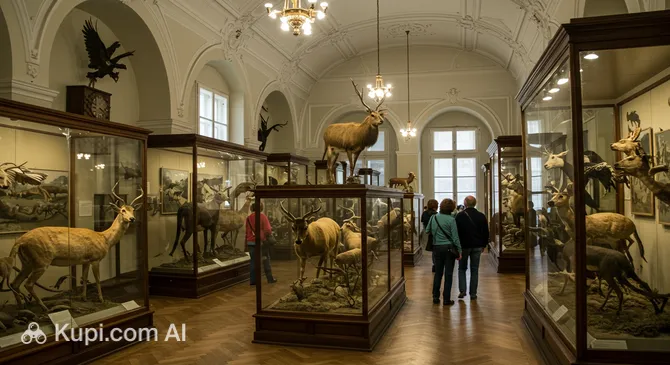
The museum's foundation is an impressive collection of approximately one million exhibits. Under one roof, you will find paleontological discoveries, rare minerals, and an extensive zoological exhibition. The museum is very popular with families, thanks in large part to its realistic dioramas and unusual entrance, where visitors are greeted by imposing dinosaur figures.

The special atmosphere of the place comes not only from the richness of its collections but also from the attention to detail: even the entry ticket here is often designed as an original postcard that you can keep as a souvenir. Small but cozy halls with high-quality lighting allow you to examine every representative of the fauna, from Arctic bears to exotic kangaroos, in their nearly natural habitats.

Contacts

When planning your visit to this scientific center, it is a good idea to check its exact location and contact details in advance. Below is all the necessary information to help you find your way and contact the museum administration if needed.

How to contactContact
AddressStrada Cetății 1, Sibiu 550160, Romania
Phone+40 269 436 545
Websitebrukenthalmuseum.ro

What to Do

The museum experience begins before you even cross the threshold: a small dinosaur park is located in the inner courtyard, where you can take great photos with prehistoric giants. Inside the building, several themed zones await visitors, including halls for mineralogy and paleontology, which display unique fossils and rare stones.

The main magnet for tourists is the "Living World" exhibition. Thanks to skillfully crafted taxidermy and thoughtful lighting, the animals look remarkably realistic. Here you will encounter bears, wolves, and foxes, as well as more exotic inhabitants of the planet—crocodiles, ostriches, and kangaroos. A walk through the halls allows you to visually explore various ecosystems and their inhabitants.

This place is ideal for quiet contemplation and educational leisure. Because the museum is compact, the tour will not be tiring even for the youngest visitors, while the variety of species presented provides a great opportunity to discuss the richness of nature and the importance of its conservation.

Getting There

The Natural History Museum is located in the very heart of Sibiu at Strada Cetății 1. Thanks to its central location, it is just a few minutes' walk from the city's main square, making it a convenient stop on any walking tour of the historic center.

If you are staying in more distant areas, it is most convenient to use a taxi or public transport, which is well-developed in the city. Most tourist routes converge in the center, so the Large Square can serve as your landmark; from there, you can reach the museum with a leisurely stroll while enjoying the ancient architecture.

Ближайший город: Sibiu

History & Facts

The museum owes its existence to the activities of the Transylvanian Society of Natural Sciences, which founded it in 1895. For over a century, the collections have been expanded and organized, becoming one of the largest in the region. The museum is an integral part of the rich heritage of the Brukenthal National Museum, named after the Governor of Transylvania, Samuel von Brukenthal.

Interestingly, the history of the museum complex is closely intertwined with the architectural landscape of Sibiu itself. While the exhibits are housed in dedicated halls, they are complemented by the city's historical context. The museum's holdings are impressive in scale, containing about one million exhibits covering diverse fields—from mineralogy to zoology.

The building that houses parts of the museum complex is also noteworthy. For instance, the neighboring History Museum occupies the famous Altemberger House—a magnificent monument of 16th-century Gothic architecture. This proximity emphasizes the deep connection between natural sciences and the general history of Transylvania's development, making the museum an important cultural and scientific bridge between the past and the present.

Time Needed

For a quick overview of the museum's main exhibits, 20 to 30 minutes is usually sufficient. This is enough time to see the dinosaur figures in the courtyard and walk through the main halls featuring animals and minerals.

If you plan to study the paleontological collection in detail or carefully examine the rare minerals, we recommend allowing about one hour for your visit. The museum is compact, making it an ideal educational stop during a long walk through the city.

Working Hours

The museum follows a standard schedule for most cultural institutions in the region. You can visit the exhibitions from Wednesday to Sunday, 09:00 to 17:00. Please note that Monday and Tuesday are days off when the museum is closed to the public.

DayWorking hours
ПонедельникЗакрыто
ВторникЗакрыто
Среда9:00 – 17:00
Четверг9:00 – 17:00
Пятница9:00 – 17:00
Суббота9:00 – 17:00
Воскресенье9:00 – 17:00

Nearby

The museum's location in the historic center allows tourists to combine a visit to the natural history exhibits with exploring many other iconic sites. A walk through the surrounding streets will lead you to magnificent Gothic architecture, cozy squares, and famous landmarks located just a few hundred meters from each other.

NameDistance
Carpenters' Tower0.1 km
Citadel Park0.2 km
Potters' Tower0.2 km
Great Square0.3 km
Brukenthal National Museum0.3 km
Holy Trinity Roman Catholic Church0.3 km
Brukenthal National Museum0.4 km

Reached the end of the page?

That means the route is fully explored