Support

The Palace of Culture in Târgu Mureș

About

Imagine a building that embodies all the elegance of the early 20th century. The Palace of Culture is not just an architectural monument, but a true gem of Hungarian Art Nouveau (Secession) located in the heart of Târgu Mureș. This majestic site is a signature landmark that all of Romania is rightfully proud of.
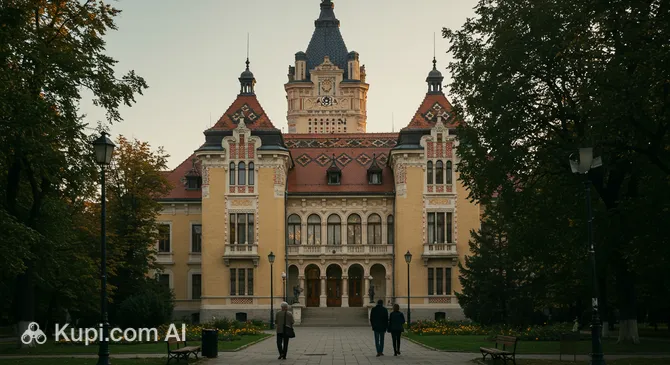
Palace of Culture
Palace of Culture. Иллюстрация. Источник: Kupi.com AI

The building captures the imagination with its luxurious finishes: the facades are adorned with exquisite mosaics and reliefs, while inside, visitors are greeted by unique stained-glass windows and interiors that have preserved the atmosphere of the imperial era. The palace is recognized as one of the most significant cultural centers in the region, bringing together art, history, and music.

Today, the State Philharmonic, the Museum of History and Archaeology, an extensive library, and an art gallery coexist harmoniously under one roof. It is a living space where exhibitions are held and classical music resonates, attracting thousands of travelers with its unique energy.

Contacts

For the latest information on events or group tours, you can use the following contact details for the organization.

How to contactContact
AddressStr. Enescu, fostă Ferenc, Strada Dr. Czakó József 2, Târgu Mureș, Romania
Phone+40 365 451 034
Websitepalatul-culturii.ro

What to Do

The first thing to do when visiting is to take a leisurely stroll around the building to admire the facade decorations. Look for the magnificent bas-relief above the main entrance depicting the coronation of Franz Joseph, and the detailed composition based on the opera "Bánk Bán," which is a masterpiece of decorative art.

Once inside, be sure to visit the famous Mirror Hall, where sunlight plays across elegant stained-glass windows illustrating scenes from folk legends. Art lovers should stop by the art gallery, while those interested in the region's past should explore the halls of the archaeology and history museum. The palace interiors, with their bronze bas-reliefs and fine carvings, are world-class exhibits in their own right.

If you're lucky with your travel dates, be sure to buy a ticket for a concert in the Philharmonic Hall. The superb acoustics and solemn atmosphere of the hall make listening to music an unforgettable experience. For those who appreciate aesthetic details, every corridor and staircase in the palace offers plenty of opportunities for atmospheric photos.

Getting There

The landmark holds a place of honor right in the city center at Roses Square (Piața Trandafirilor). Thanks to this prime location, the building is within walking distance of almost any point in the historic district, allowing you to enjoy the city's architecture along the way.

If you arrive in the city by train or intercity bus, the walk from the railway station or bus terminal takes about 15–20 minutes at a leisurely pace. You can also take a local taxi, which will bring you to the main entrance in just a few minutes.

For those who prefer public transport, many bus routes pass through the central part of the city, with a stop located in the immediate vicinity of the site. Drivers can leave their cars in paid parking lots on the adjacent streets, though these areas can be quite busy during the day.

Ближайший город: Targu Mures

History & Facts

The construction of this architectural masterpiece took place between 1911 and 1913. The project was designed by the talented Hungarian architects Marcell Komor and Dezső Jakab. They were followers of the famous Ödön Lechner, whose style largely defined the appearance of Central European Art Nouveau at that time.

Interestingly, the original plan called for only a two-story building. However, during the process, the project was revised, and the city received a magnificent three-story structure that became a true triumph of the Secession style. The palace's creation was closely linked to the 40th anniversary of Emperor Franz Joseph's coronation, an event that sparked the construction of iconic cultural sites throughout Austria-Hungary.

Over its century-long history, the building's walls have hosted many different organizations. At various times, it has housed the Academy of Music, the city library, the Academy of Fine Arts, and even a cinema. Despite the changing eras, the site has consistently maintained its status as the region's primary intellectual and creative hub.

Time Needed

To fully appreciate the beauty of the interiors and examine the rich decor in detail, the average tourist will need about 1.5 to 3 hours. This is sufficient time to explore the art galleries and the museum's historical exhibitions.

If your goal is not just a walk-through but attending an evening concert by the State Philharmonic, plan to spend the entire evening here. In any case, there is no need to rush; every stained-glass window and every bas-relief deserves careful study.

Working Hours

When planning your visit, please note that Monday is a day off. During the rest of the week, the visiting schedule is quite convenient for tourists, although the palace closes a bit earlier on weekends.

Current opening hours: Tuesday to Friday, the doors are open from 9:00 AM to 4:00 PM. On Saturday and Sunday, you can explore the exhibits from 9:00 AM to 2:30 PM.

DayWorking hours
ПонедельникЗакрыто
Вторник9:00 – 16:00
Среда9:00 – 16:00
Четверг9:00 – 16:00
Пятница9:00 – 16:00
Суббота9:00 – 14:30
Воскресенье9:00 – 14:30

Nearby

Târgu Mureș is a city with a rich historical heritage, so a visit to the palace can easily be combined with other interesting sights. Exploring the area around Roses Square will allow you to dive deeper into the atmosphere of this Transylvanian region.

NameDistance
Luxor0.3 km
Ascension Cathedral0.5 km
Fortress Church0.7 km
Târgu Mureș Fortress0.9 km
Privo Restaurant0.9 km
Hookah Trio1 km
Jazz & Blues Club1 km

Reached the end of the page?

That means the route is fully explored