Support

"The First Romanian School" Museum

About

Exploring the historic Șchei district, you will discover the First Romanian School Museum—a unique cultural landmark that Brașov is rightfully proud of. It is more than just an educational institution; it is a true national literary center where the foundations of the modern Romanian language and printing were laid.

The building, erected in 1495 and renovated in the 18th century, sits snugly next to the majestic St. Nicholas Church. For Romania, this site holds sacred importance: it was here in the 16th century that Deacon Coresi printed the first books in the Romanian language, opening a new chapter in the history of Eastern European enlightenment.
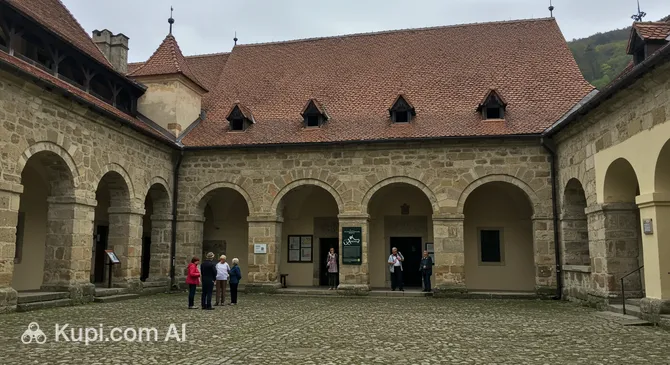
The First Romanian School Museum
The First Romanian School Museum. Иллюстрация. Источник: Kupi.com AI

Today, the museum houses an impressive collection of 4,000 ancient books and over 30,000 valuable historical documents. Visitors can see rare masterpieces in Church Slavonic and Latin script that have shaped the region's cultural code over centuries. The atmosphere of the ancient classrooms and the scent of old paper transport guests back to a time when every printed word was worth its weight in gold.

Contacts

For visit details or to book a group tour, you can use the following contact information:

How to contactContact
AddressPiața Unirii 2-3, Brașov 500123, Romania
Phone+40 740 028 678
Websitewww.primascoalaromaneasca.ro

What to Do

The main reason to visit this museum is the chance to see an authentic 16th-century printing press. Visitors can examine in detail the old press used by Deacon Coresi to create the first Romanian books. Feeling a sense of connection to the birth of national literature is an unforgettable experience.

The museum halls display unique documents, such as the first Romanian grammar from 1757 and ancient textbooks. You can step into an old schoolroom, which still has wooden benches and school supplies from past centuries. It’s an excellent place to imagine how lessons were conducted hundreds of years ago and the complex paths through which knowledge spread.

Be sure to combine your school visit with a tour of the neighboring St. Nicholas Church, built in the Gothic style. After immersing yourself in the history of printing, it's pleasant to stroll through the winding streets of the Șchei district, which have preserved the spirit of a medieval settlement. Attentive tourists will notice interesting architectural details and can capture great shots against the backdrop of the rugged Carpathian Mountains.

Getting There

Reaching this cultural landmark is quite simple, as it is located in the picturesque historic district of Șchei. If you are already in the center of Brașov, the walk from Piața Sfatului (Council Square) takes only 15–20 minutes. The route leads through ancient streets past Catherine's Gate, which is a pleasant tourist route in itself.

For those who prefer public transport, buses run to the Șchei district. The nearest stop is right at the entrance to the St. Nicholas Church complex, just a few dozen meters from the school building. You can also always use a local taxi; the ride from the city center takes no more than 5-10 minutes.

If you are planning a visit from Bucharest, it is most convenient to take a train or car. The distance is about 180 km, and the road through the Carpathians offers many beautiful views before you even arrive in the city.

Ближайший город: Brașov

History & Facts

The official construction date of the current building is 1495, though historical evidence suggests a church school existed on this site as early as the 14th century. Some even suggest that educational activities were conducted here in the 11th century, making it one of the region's oldest centers of enlightenment.

A true revolution occurred here in the mid-16th century when Deacon Coresi established a printing house. Between 1556 and 1583, the first books in the Romanian language using the Latin alphabet were printed within these walls. Before this time, religious and secular literature were primarily written in Church Slavonic.

In the 18th century, the school remained a center for linguistic innovation. In 1724, Protopope Flora Baran compiled the first Romanian Latin alphabet here, and in 1757, Dimitrie Eustatievici published the first complete Romanian grammar. These works laid the foundation for the modern Romanian language.

The building began operating as a museum in 1961. Despite several reorganizations, it has maintained its authentic spirit and unique collection, becoming a national literary center that carefully preserves the heritage of Transylvanian enlightenment.

Time Needed

To explore all the museum halls, study the collection of ancient books, and listen to the guide's story, it usually takes 1 to 2 hours. The exhibition is quite compact but very rich in important historical details.

If you plan to combine your visit with a tour of the neighboring St. Nicholas Church and a walk through the narrow streets of the Șchei district, we recommend setting aside about 3 hours. This will allow you to enjoy the architecture without rushing and take memorable photos in one of the city's most atmospheric spots.

Working Hours

Please note the museum's opening hours, as it is closed at the beginning of the week:

  • Monday and Tuesday: Closed
  • Wednesday – Friday: 10:00 – 17:00
  • Saturday: 11:00 – 17:00
  • Sunday: 12:00 – 17:00
DayWorking hours
ПонедельникЗакрыто
ВторникЗакрыто
Среда10:00 – 17:00
Четверг10:00 – 17:00
Пятница10:00 – 17:00
Суббота11:00 – 17:00
Воскресенье12:00 – 17:00

Nearby

The Șchei district, where the museum is located, is rich in historical monuments, and exploring it will be an excellent addition to your main itinerary. Walking through these ancient quarters allows you to feel the atmosphere of an old Transylvanian town more deeply.

NameDistance
St. Nicholas Church0 km
Union Square0.1 km
Weavers' Bastion0.6 km
Beth Israel Synagogue0.6 km
Black Tower0.7 km
Rope Street0.7 km
Mustață Beerhouse0.8 km

Reached the end of the page?

That means the route is fully explored