Support

The Fortress-on-Straja

About

Perched on the scenic Straja Hill, the White Tower (also known as the Citadel on Straja Hill) is an outstanding example of medieval fortification in the city of Brașov. This formidable defensive structure was erected by Saxons in the 16th century to protect the settlement's borders. All of Romania is famous for its castles, but this fortress is unique for its location, which offers an incredible view of the historic city center.
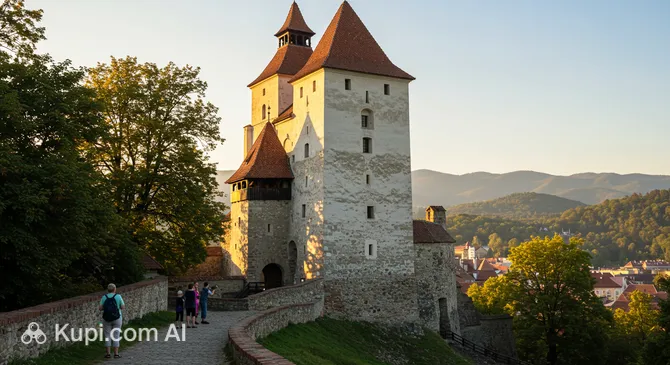
The White Tower
The White Tower. Иллюстрация. Источник: Kupi.com AI

The site's architectural ensemble includes a characteristic horseshoe-shaped tower and a system of walls surrounded by a deep moat. For a long time, the fortress served not only as the city's shield but also as a prison; today, it has been transformed into a popular tourist space with a unique atmosphere of the past.

The main highlight of this location is the panoramic observation deck. From here, guests can see Brașov in all its diversity: the tiled roofs of medieval houses and ancient bastions spread out on one side, while dynamic modern neighborhoods stretch out on the other. This spot is considered a must-visit for all history buffs and fans of beautiful photography.

Contacts

To confirm up-to-date information for your visit, you can use the following contact details:

How to contactContact
AddressStrada Cetățuia 7, Brașov, Romania
Websiteturism.brasovcity.ro

What to Do

The main draw for visitors is the viewpoint in front of the fortress entrance. It offers what is arguably the best view of Brașov, where the old town with its narrow streets meets the modern districts. It is the perfect place to take panoramic photos and spot details like the Black Church or the City Hall from above.

Exploring the outer fortifications allows you to appreciate the prowess of medieval engineering. You can walk along the massive walls, study the design of the horseshoe-shaped tower, and see the remains of the defensive moat. While the interior spaces may sometimes be closed for restoration, a walk around the perimeter and the trails of Straja Hill provides a sense of peace and seclusion.

For those who wish to extend their stay, there is a restaurant located within the fortress grounds. Here, you can enjoy a snack while soaking in the historical setting and the cool shade of the ancient walls. A visit to the tower is often combined with other fortifications, such as the Graft Bastion, creating a complete route along the old town's defensive line.

Getting There

Reaching this historic site is quite simple if you are in the city center. The most pleasant way is a walk from the Council Square (Piața Sfatului). Simply follow Strada Cetății as it gradually winds up the hill. The walk takes about 15–20 minutes and rewards you with picturesque views of the old quarters.

If you prefer more comfort, you can take a taxi or use a private car to reach the address Strada Cetățuia 7. There are parking spaces available at the foot of the hill, though the final stretch must still be covered on foot. For precise navigation, use the coordinates 45.6492779, 25.5916897.

For tourists arriving from other regions, the most convenient way is to first reach the Brașov Gara Bartolomeu railway station. From there, the historic hill is accessible by bus or taxi (a distance of about 2–3 km). Keep in mind that the climb is quite steep, so comfortable shoes will come in handy.

Ближайший город: Brașov

History & Facts

The history of this fortification began in the 16th century when the Saxon settlers of Transylvania decided to strengthen the city's defenses. The construction of the stone fortress started in 1552 on the site of an older wooden fort. The project is attributed to the talented Italian architect Alessandro da Urbino, who designed the powerful horseshoe-shaped tower and the deep moat surrounding it.

The Citadel on Straja Hill was a strategically vital site: it prevented enemy artillery from being positioned on the hill during sieges. In 1690, the garrison successfully withstood a siege by Kuruc forces led by Imre Thököly. Interestingly, at the end of the 17th century, there were discussions about demolishing the fortifications, but fortunately for modern tourists, the structure was preserved.

In the 18th century, under Emperor Joseph II, the fortress underwent modernization, but over time it lost its military significance. For the past three centuries, its walls were used as a prison. Today, it stands as an architectural monument reflecting the rugged and majestic style of Saxon defensive architecture characteristic of medieval Transylvania.

Time Needed

A leisurely visit to the attraction and its surroundings usually takes 1 to 2 hours. This is plenty of time to complete the climb up the hill, explore the outer defensive walls, and enjoy the city panorama.

If you plan to take professional photos during sunset or decide to relax at the local restaurant, you should budget a bit more time. The walking trails around Straja Hill also invite you to enjoy a peaceful break in the fresh air, away from the hustle and bustle of the city.

Working Hours

Currently, the site is temporarily closed due to ongoing restoration works. This may limit access to the interior rooms and the fortress courtyard; however, the outer grounds and the observation deck in front of the entrance typically remain accessible to tourists during daylight hours.

Before planning your visit, it is highly recommended to check for current updates on the city's official website or confirm the status with local guides, as the work schedule is subject to change.

Nearby

Brașov is a city with a high concentration of historical monuments, so a walk to the fortress should be combined with a visit to nearby locations. This will allow you to fully immerse yourself in the atmosphere of a medieval Saxon town and see the contrast between its historic core and modern districts.

NameDistance
Nicolae Titulescu Park0.4 km
Brașov Art Museum0.5 km
Museum of Communism0.5 km
Vibe Restaurant & Cocktail Bar0.6 km
Hukka Lounge0.7 km
Kronstadt Shisha0.7 km
Dei Frati0.7 km

Reached the end of the page?

That means the route is fully explored