Support

Șirul Canonicilor

About

Strolling through the historic streets that Oradea is famous for, it’s impossible to miss one of the city's most impressive architectural ensembles — the Canonical Row. This unique Baroque monument consists of a chain of 10 interconnected residential buildings forming a single majestic facade. The complex's main feature is a covered corridor over 250 meters long, adorned with 57 arches in an elegant Italian style.
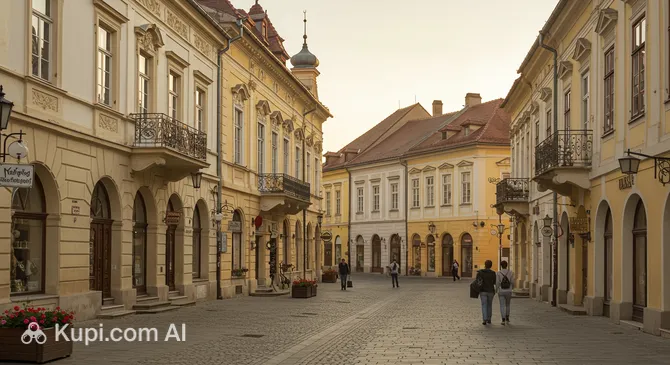
Canon
Canon's Row. Иллюстрация. Источник: Kupi.com AI

This site in Romania was built as a residence for canons — high-ranking clergymen who made up the city's spiritual and intellectual elite. The complex's architecture skillfully blends elements of Italian Baroque and Viennese Classicism, reflecting the aesthetic preferences of 18th-century Central Europe. Thanks to the rhythmic alternation of supporting pilasters, it creates a mesmerizing visual effect of an endless tunnel.

Canonical Row is an integral part of the city's main Catholic complex, which also includes the Bishop’s Palace and the Roman Catholic Cathedral. It is recognized as one of the city's most iconic symbols, drawing history and art lovers from around the world with its austere yet solemn appearance.

Contacts

For those who want to clarify details before visiting this architectural monument, basic contact information is provided below.

How to contactContact
AddressStrada Șirul Canonicilor, Oradea, Румыния
Websitelexikon.adatbank.ro

What to Do

The main pleasure when visiting the Canonical Row is, of course, a walk along its legendary covered corridor. Passing through the endless arcade of 57 arches, you can feel the 18th-century atmosphere and appreciate the scale of the engineering of that time. It is an ideal spot for those seeking solitude and tranquility while admiring the play of light and shadow between the massive columns.

For photography enthusiasts, this place offers truly unique opportunities. Thanks to the corridor's great length, you can capture the perfect perspective, creating the illusion of an infinite architectural tunnel. Each of the ten buildings has its own subtle features, so it is worth examining the decorative details, which show the touch of Italian and Austrian masters.

Be sure to include the neighboring sites in your itinerary — the Roman Catholic Cathedral and the Bishop’s Palace. Together, they form a grand Baroque ensemble that allows you to fully immerse yourself in the history of the region's religious and cultural life. This site will be particularly interesting for those fond of Central European history who want to see how the prominent scholars and clergymen of the past lived and worked.

Getting There

Finding the Canonical Row is easy, as it is located in the central part of the city at Strada Șirul Canonicilor. Due to its convenient location, most tourists prefer to get here on foot from the city's main squares, using the majestic spires of the nearby Catholic Cathedral as a landmark.

If you are coming from outlying districts, you can use public transport — buses and trams run regularly through the center, stopping within a few minutes' walk of the architectural ensemble. Taxis are also always available, allowing you to travel in comfort directly to the start of the famous corridor.

For travelers with their own or rented cars, parking spaces are available in the vicinity of the complex. A visit to the Canonical Row is easily combined with a tour of the Bishop’s Palace, as they are located in immediate proximity to each other.

Ближайший город: Oradea

History & Facts

The history of this remarkable structure began in 1757–1758. The project was designed by the prominent Baroque architect Johann Lucas von Hildebrandt. Despite an ambitious start, the construction of the ensemble spanned more than a century. The first seven buildings were completed by 1780, two more were added in 1863, and the final, tenth house was finished only in 1875.

The primary purpose of the complex was to house the canons — influential clergymen who served on the bishopric's administrative council. These walls remember many prominent figures of their time: the historian György Pray lived here, as did the famous academics Flóris Rómer and Vilmos Fraknói. For a long time, the complex was not just a residence but a true intellectual center of the region.

The architectural appearance of Canonical Row is interesting because it clearly shows the transition from the lush Italian Baroque to the more restrained Viennese Classicism. This "frozen time" makes the site an invaluable lesson in the history of 18th-19th century European urban development. Interestingly, the plan originally included a theological seminary building, but that part of the project was never implemented at this location.

Time Needed

For a leisurely stroll under the vaults of the Canonical Row and for taking some striking photos, you will need about 30–45 minutes. The corridor is quite long, and it's worth taking time to appreciate the details of the arches and pilasters.

However, considering that the site is part of a large-scale architectural ensemble, we recommend allowing 2–3 hours for a full visit. During this time, you will be able to explore the neighboring Roman Catholic Cathedral and the majestic Bishop’s Palace, making your immersion into the Baroque era as complete as possible.

Working Hours

The covered corridor of the Canonical Row itself is an open architectural space accessible for viewing at any time. Nevertheless, for the most comfortable walk and to take the best photos, it is recommended to visit during daylight hours.

Since the official opening hours of the building complex may vary depending on church events or the operation of internal institutions, we advise checking the official website or inquiring on-site before your visit, especially if you plan to combine your stroll with a visit to the cathedral or the Bishop’s Palace.

Nearby

A walk along the Canonical Row is just the beginning of your acquaintance with the region's rich heritage. The surroundings of this place are literally saturated with historic buildings and cultural monuments that allow you to feel the city's atmosphere more deeply.

Exploring the nearby streets and palaces will help you get a complete picture of the architectural diversity, from austere fortress walls to elegant Art Nouveau facades.

NameDistance
Roman Catholic Cathedral of Oradea0.1 km
Children's City1.2 km
Moskovits Palace1.2 km
La Cuptor1.5 km
Darvas-La Roche House1.5 km
Oradea City Hall Tower1.5 km
Liberty Park1.5 km

Reached the end of the page?

That means the route is fully explored