Support

Claustros de Santo Domingo

About

In the heart of the Andalusian city of Jerez de la Frontera lies a true architectural gem — the Cloisters of Santo Domingo. This majestic ensemble of covered galleries was once part of an ancient Dominican monastery founded in the 13th century on the site of a Moorish fortress. Today, the complex is recognized as one of the most significant Gothic monuments in Spain.
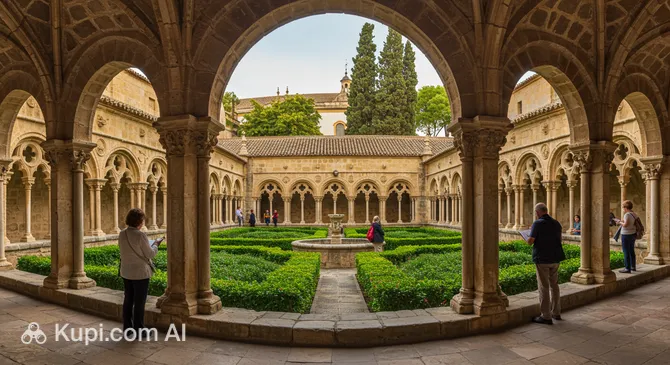
Cloisters of Santo Domingo
Cloisters of Santo Domingo. Иллюстрация. Источник: Kupi.com AI

The modern-day Claustros de Santo Domingo serve as a vast cultural space spanning approximately 7,000 square meters. After years of meticulous restoration, these historic walls have been transformed into a vibrant arts center where ancient stones harmoniously coexist with contemporary exhibitions and concerts. Visitors are struck by the remarkable blend of styles, from austere Islamic foundations to ornate Gothic and Renaissance elements.

The significance of this site lies not only in its age but also in its scale — it is one of the largest enclosed Gothic spaces in Andalusia. Walking beneath its vaults, you embark on a journey through time, feeling the breath of history created here over seven centuries.

Contacts

To check for current information on exhibitions and special events, you can use the official resources. The cloisters are managed by the local municipal authorities.

How to contactContact
AddressMarqués de Casa-Domecq, 4, 11402 Jerez de la Frontera, Cádiz, Spain
Websitewww.jerez.es

What to Do

The main highlight for visitors is the Great Cloister (Claustro Grande). Its galleries, adorned with ribbed vaults and elegant 16th-century tracery screens, create a play of light and shadow perfect for photography. Be sure to head up to the Upper Cloister, which preserves fragments of the old library and offers a different perspective on the courtyard.

While exploring the interior, don't miss the Lower Dormitory — a long hall where monks once rested — and the Refectory (dining hall). The latter impresses with its Renaissance barrel vault decorated with medallions; at one time, more than 300 people could dine here simultaneously. It is also worth visiting the Oratory of Diego de Ribadeneyra, which features a unique wrought-iron screen from 1572.

For history buffs, the Almohad Portal is of particular interest — the only visible element of the original Muslim building that survived the reconstruction. While exploring the Chapter House and the old confessionals, look out for the Gate of Grace (Puerta de Gracias), where traces of frescoes depicting the Passion of Christ are still visible.

Getting There

The historic complex is located in the very heart of the city, right next to the ancient Seville Gate. It is easy to find using the address Marqués de Casa-Domecq, 4. If you are traveling by car, it is most convenient to use the GPS coordinates: 36.6860969, -6.1364983. There are parking zones available in the vicinity of the attraction.

For those who prefer public transport, the city offers a well-developed network of bus routes. If you arrive at the main Jerez railway station, the walk to the cloisters takes about 15–20 minutes (a distance of approximately 1.5 km), allowing you to see the architecture of the old quarters along the way. Licensed taxis are also always available at the station.

Thanks to its convenient location in Andalusia, the city is easily accessible by train or bus from major centers such as Seville, Cadiz, and Malaga. Within the historic center itself, the best way to get around is on foot, enjoying the atmosphere of the ancient streets leading to the walls of the old monastery.

Ближайший город: Jerez de la Frontera

History & Facts

The history of this site began in 1264, when King Alfonso X the Wise reclaimed the city from the Muslims. As a sign of gratitude to the Dominican Order, he granted them the ancient Islamic fortress. The first decades of the monastery's existence were harsh, as the monks had to constantly fend off raids from the Nasrid Kingdom of Granada.

The construction of the complex we see today spanned several centuries. In 1434, the Dominicans petitioned the city council for assistance in building the church and the main galleries. The Great Cloister, which became a pinnacle of Andalusian Gothic, was created between 1460 and 1500. Later, in the 16th century, exquisite stone tracery was added to the windows, crafted by masters invited from the surroundings of Burgos.

Following the famous Ecclesiastical Confiscations of Mendizábal in 1835, when church property was seized by the state, the cloisters were separated from the monastery church and passed into civil administration. For a long time, they were used for various city needs until a major restoration lasting over 12 years transformed them into a modern cultural center.

Interestingly, during excavations on the site, archaeologists discovered about 5,000 ancient ceramic vessels. These finds are still being studied by experts, revealing new chapters in the daily life of medieval Spain.

Time Needed

To leisurely explore both floors of the galleries and visit the historic halls, it is recommended to set aside 1.5 to 2 hours for your visit. This is plenty of time to study the architectural details, read the explanatory materials, and soak in the tranquility of the ancient walls.

If you plan to visit the temporary exhibitions or cultural events often held on the premises, you should allow an extra hour. The site invites thoughtful contemplation, so don't rush through the halls — every vault and portal deserves separate attention.

Working Hours

When planning your visit, please note that the complex is closed on Mondays and Sundays. On other days, the following schedule applies:

  • Tuesday – Friday: from 10:30 AM to 1:30 PM and an evening session from 6:00 PM to 9:00 PM.
  • Saturday: from 10:00 AM to 1:45 PM (no evening session).

Note the afternoon break on weekdays — this is the traditional siesta time when many of the city's cultural sites close for a few hours.

DayWorking hours
ПонедельникЗакрыто
Вторник10:30 – 13:30, 6:00 – 21:00
Среда10:30 – 13:30, 6:00 – 21:00
Четверг10:30 – 13:30, 6:00 – 21:00
Пятница10:30 – 13:30, 6:00 – 21:00
Суббота10:00 – 13:45
ВоскресеньеЗакрыто

Nearby

The location of the complex in the city's historic core makes it easy to combine your visit with other iconic sites. A stroll through the nearby squares and palaces will help you dive deeper into the region's unique atmosphere, where Christian and Moorish traditions intertwine.

NameDistance
Royal Convent of Santo Domingo0.1 km
Plaza del Mamelón0.3 km
Plaza del Arenal0.5 km
Palace of the Viceroy Laserna0.5 km
Lola Flores Cultural Center0.5 km
Las Banderillas0.6 km
Tabanco San Pablo0.6 km

Reached the end of the page?

That means the route is fully explored