Support

Pamplona Cathedral

About

Pamplona Cathedral, also known as the Cathedral of Santa María la Real, is the primary religious and architectural treasure of the city of Pamplona, the capital of the Navarre region in Spain. It is not just a church, but a whole monumental complex that holds a central place in the historic heart of the city and serves as the seat of the local archbishop.
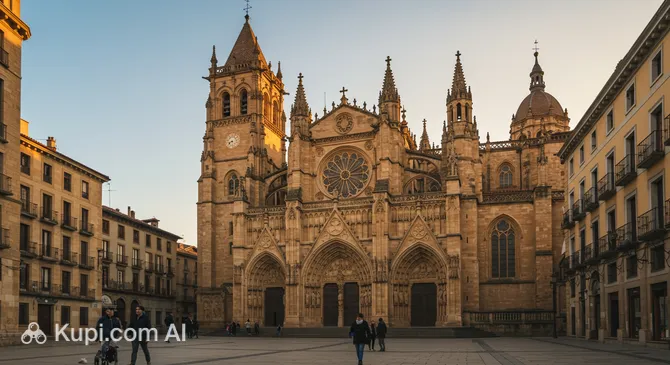
Pamplona Cathedral. Illustration.
Source: Kupi.com AI

Traveler photos:

The main feature of the cathedral is its amazing blend of architectural styles accumulated over centuries. Its austere Neoclassical facade, built in the 18th century, hides a magnificent Gothic interior. Inside, visitors will find one of the most exquisite Gothic cloisters in Europe, which impresses with its lightness and the elegance of its carved stone. In addition, elements of Romanesque, Renaissance, and Baroque styles can be found in the architecture of the complex.

Over the centuries, the cathedral has witnessed major historical events, including the coronations of the kings of Navarre. One of the cathedral's main gems is the alabaster mausoleum of King Charles III the Noble and his wife, Eleanor, which is considered a masterpiece of Gothic sculpture. Visiting this site is an opportunity to touch the rich history and culture of one of Spain's most distinctive regions.

Contacts

To plan your visit to Pamplona Cathedral, including current opening hours and ticket prices, we recommend consulting official sources. All necessary information is usually available on the attraction's website.

How to contactContact
AddressC. Dormitalería, 1, 31001 Pamplona, Navarra, Spain
Phone number+34 948 22 56 79
Websitewww.catedraldepamplona.com

What to Do

Visiting Pamplona Cathedral is an immersion into centuries of history and architecture. The first thing that greets guests is the majestic Neoclassical facade designed by the famous architect Ventura Rodríguez in the 18th century. However, upon stepping inside, you will be transported to a completely different era. A spacious Gothic space with three naves will open up before you, where an atmosphere of peace and reverence prevails. The main gem of the interior is the magnificent alabaster mausoleum of King Charles III the Noble and his wife, Eleanor, considered a masterpiece of Gothic sculpture.

A walk through the cathedral will allow you to explore the numerous chapels in detail, each representing its own architectural style and housing unique relics and works of art. Don't miss the opportunity to visit the 14th-century cloister—an inner courtyard considered one of the most beautiful examples of Gothic architecture in Spain. It is an ideal place for a solitary stroll and contemplation, where temporary exhibitions and cultural events are often held.

For a deeper look into the history of the Navarre region, it's worth visiting the Diocesan Cathedral Museum, located in the buildings adjacent to the cathedral. Its collection includes valuable artifacts, religious painting, and sculpture. A tour of the cathedral complex can be perfectly combined with a walk through the old town of Pamplona, as other iconic sites, such as the Church of San Saturnino and the Royal and General Archive of Navarre, are very close by.

Getting There

Pamplona Cathedral is located in the heart of the city's historic center, making it easily accessible for travelers. If you are already in the old town of Pamplona, the best way to reach the cathedral is on foot. The narrow streets and picturesque squares create a unique atmosphere, and the walk to the cathedral will become part of your fascinating introduction to the city. It is within walking distance of major tourist routes and squares.

For those arriving in Pamplona from other cities in Spain, such as Madrid or Barcelona, it is most convenient to use a train or bus. From the Pamplona train station, you can easily reach the city center by public transport or by taking a taxi. The ride takes very little time, and you will find yourself in close proximity to the old town, from where the cathedral is just a stone's throw away.

If you are traveling by car, please note that the streets in the historic center of Pamplona are primarily pedestrian-only. Vehicle access to this part of the city is restricted. It is recommended to leave your car in one of the nearby public parking lots and continue on foot. This is not only the most convenient but also the most pleasant way to reach the Cathedral, enjoying the authentic architecture and atmosphere of Navarre along the way.

Nearest city: Pamplona

History & Facts

The history of Pamplona Cathedral, also known as the Cathedral of Santa María la Real, dates back to the early Middle Ages. Archaeological research confirms that at least two older temples existed on this site. The first was destroyed in 924, but it was restored as early as the 11th century, and a majestic Romanesque building was erected here in the 12th century. This centuries-old continuity makes the cathedral not just an architectural monument, but a true chronicle of the city of Pamplona.

The construction of the cathedral in its current form began in 1394 at the initiative of King Charles III the Noble of Navarre, who wished to create a worthy burial place for his family and the main temple of the kingdom. Construction continued for over a hundred years and was completed in 1501. The result was a magnificent Gothic complex, which is considered one of the most significant in Spain. It was here, within the walls of this cathedral, that the coronations and oaths of Navarrese monarchs took place, emphasizing its central role in the political and spiritual life of the region.

One of the most remarkable features of the cathedral is its facade. While the main part of the building is an example of pure Gothic, the main facade was rebuilt in 1783 according to the design of the famous architect Ventura Rodríguez in a strict Neoclassical style. This contrast between the exterior and interior makes a strong impression on visitors. Inside, the cathedral houses its main treasures, including the magnificent high altar with the revered image of the Virgin Mary—Santa María la Real, the patron saint of Pamplona.

Time Needed

For a complete and leisurely tour of Pamplona Cathedral, including all its treasures, it is recommended to set aside approximately 1.5–2 hours. This time will be enough to appreciate not only the majestic interior of the cathedral itself but also to visit the adjacent iconic sites that are an integral part of the complex.

This timeframe includes a tour of the main nave, a visit to the magnificent Gothic cloister (inner courtyard), which is considered one of the most beautiful in Europe, as well as an introduction to the exhibits of the Diocesan Museum (Museo Diocesano). If you only want a quick look at the main space of the cathedral, an hour might suffice, but to fully enjoy the architectural details, art, and atmosphere of this historic site, it is better not to rush.

Working Hours

Pamplona Cathedral (Cathedral of Santa María la Real) is one of the city's key attractions, open to visitors year-round. However, opening hours can vary significantly depending on the season (summer/winter), day of the week, and the holding of religious services or events. Typically, the complex includes the cathedral itself, the cloister, and the museum, and each part may have its own schedule.

As exact opening hours are subject to change, it is highly recommended to check current information on the official website of Pamplona Cathedral immediately before planning your visit. This will allow you to find out not only the exact schedule but also ticket prices and the possibility of purchasing them online. Pre-booking can be especially useful during the peak tourist season to avoid long lines.

Nearby

Visiting Pamplona Cathedral is undoubtedly a key highlight on any traveler's itinerary. However, to fully experience the atmosphere of this historic city, it is worth taking time to explore its surroundings. The old town of Pamplona, where the cathedral towers majestically, is itself an open-air museum full of hidden treasures.

A walk through the nearby streets will allow you to discover other iconic spots, cozy bars, and feel the vibrant rhythm of this unique city in Spain. Many interesting sites are just a few minutes' walk away, making their exploration an easy and pleasant addition to your visit to the cathedral.

NameDistance
Estafeta Curve, San Fermín Bull Run0.2 km
Zumalacárregui Gate0.2 km
Casa Jesús Mari Bar0.3 km
Bar Gaucho0.4 km
Museum of Navarre0.4 km
Church of San Saturnino0.4 km
Pamplona Bullring0.5 km

Have you reached the end of the page?

So the route has been studied inside and out