Support

Hampton Court Palace

About

Hampton Court is a magnificent palace and park ensemble in southwest London, which is one of the most iconic landmarks in the United Kingdom. The palace's uniqueness lies in the striking combination of two architectural styles: the austere brick Gothic of the Tudor era and the elegant Baroque added later at the request of King William III. Originally built for Cardinal Wolsey, the palace was confiscated by the famous King Henry VIII and served as a residence for English monarchs for centuries.

Visitors can expect a true immersion into history. You can explore the vast Tudor kitchens, where food was once prepared for hundreds of courtiers, and admire the grandeur of the Great Hall with its rich tapestries. A walk through the luxurious royal apartments allows you to vividly imagine the life and customs of the monarchs who lived, ruled, and plotted within these walls. For full immersion, costumed performances are often staged at the palace, recreating scenes from life at Henry VIII's court.

The area surrounding the palace deserves no less attention. Famous gardens spanning over 60 acres are spread out here, beautiful at any time of year. The UK's oldest hedge maze, immortalized by Jerome K. Jerome in his work "Three Men in a Boat (To Say Nothing of the Dog)," is particularly popular. Also on the grounds is a historic tennis court from the time of Henry VIII and the world's largest grape vine.
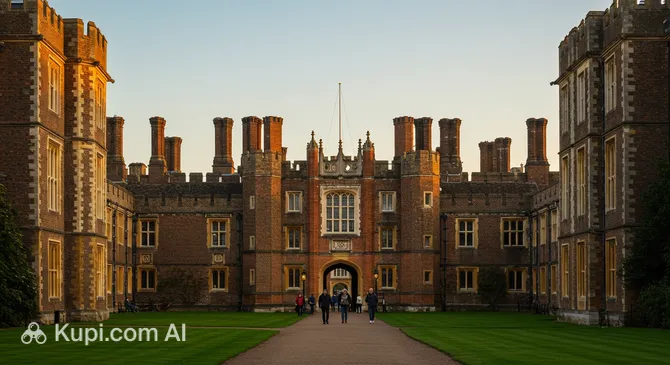
Hampton Court Palace. Illustration.
Source: Kupi.com AI

Traveler photos:

A visit to Hampton Court is not just a tour of a historical building, but a true journey through time. It is a place where you can spend an entire day enjoying architecture, art from the Royal Collection, magnificent gardens, and the unique atmosphere of one of the world's greatest royal residences.

Contacts

To plan your visit, check current opening hours, or get additional information, you can use the palace's official contact details. The latest information is always available on the attraction's official website.

How to contactContact
AddressHampton Ct Way, Molesey, East Molesey KT8 9AU, UK
Phone number+44 20 3166 6000
Websitewww.hrp.org.uk

What to Do

A visit to Hampton Court offers guests full immersion into history and court life. Once inside, you can explore the opulent halls and chambers, including the Great Hall, where royal feasts were held, and Henry VIII's apartments. The massive Tudor kitchens are of particular interest, where the 16th-century atmosphere has been recreated: here you can see how food was prepared for hundreds of courtiers and even watch cooking demonstrations using ancient recipes. To make the experience even more vivid, actors in historical costumes often stroll through the palace halls and courtyards, recreating scenes from the past.

A walk through the famous gardens of Hampton Court will bring no less pleasure. Here you can spend hours enjoying the beauty of formal parks, vibrant flower beds, and fountains. The main outdoor attractions are the world-famous hedge maze—one of the oldest in the world, which is fun to get lost in for both adults and children—and the "Magic Garden" playground, which is perfect for younger visitors. Additionally, the grounds house a historic tennis court where people played as far back as the days of Henry VIII.

Hampton Court is not just a museum but a living cultural venue. Throughout the year, it hosts numerous events, including themed tours, seasonal festivals, and exhibitions. In summer, the palace hosts two major events: the Hampton Court Palace Festival music event in June and the grand Flower Show in July, which attracts gardeners from all over the world. Art lovers will also appreciate the Cumberland Art Gallery, where masterpieces from the Royal Collection are displayed. It's worth checking the events calendar before your visit to make your trip even more fulfilling.

Getting There

Getting to Hampton Court Palace from central London is quite simple, and the most convenient way is by train. Direct South Western Railway trains depart from London's Waterloo station and go to Hampton Court station. The entire journey takes approximately 35-40 minutes, making it fast and comfortable. Trains run regularly, usually every half hour.

From Hampton Court station to the palace itself, it's a short and pleasant walk of no more than 5–10 minutes. The path crosses a scenic bridge over the Thames, offering beautiful views. Besides trains, Hampton Court can be reached by bus—several routes, such as the R68 from Richmond or the 111, 216, 411, and 461 from Kingston, stop nearby. During the summer season, another especially scenic option is available—a river boat along the Thames, which turns the trip into a small journey of its own.

If you prefer to travel by car, parking is provided on the palace grounds. This is a convenient option for those coming from London's suburbs or planning to visit several places in one day. It's worth noting that parking is paid, and on peak days or during events like the Flower Show, spaces may be limited, so it's better to arrive early or use alternative car parks.

Nearest city: London

History & Facts

The history of Hampton Court is inextricably linked with the ambitions and dramatic fates of its owners. Construction of the palace began in 1514 at the initiative of Cardinal Thomas Wolsey, the powerful favorite of King Henry VIII. Wolsey intended to create a residence whose luxury would surpass all others and brought in the best craftsmen, including those from Italy, giving the architecture Renaissance features. However, as the story goes, the King once directly asked the Cardinal why a subject needed such a magnificent palace. The cunning Wolsey replied, "To show what a beautiful palace a subject can offer his sovereign." Soon after, losing royal favor, Wolsey was forced to hand his creation over to Henry VIII in 1529.

Once in possession, Henry VIII enthusiastically set about rebuilding and expanding the palace, which became one of his most beloved residences. It was during this period that iconic structures such as the majestic Great Hall with its famous carved ceiling, the historic Royal Tennis Court (considered the oldest in the world), and the unique astronomical clock on the gatehouse were built. The palace witnessed crucial events in the monarch's life: his long-awaited heir, the future King Edward VI, was born here in 1537, and his mother and the King's third wife, Jane Seymour, died here just two weeks after giving birth.

For the next century and a half, Hampton Court served as the primary country residence for many English monarchs. Later, in the late 17th century, by order of William III and Mary II, architect Christopher Wren began a massive reconstruction of part of the palace in the then-fashionable Baroque style, aiming to create an "English Versailles." However, the work was scaled back, and as a result, Hampton Court today is a unique blend of two contrasting architectural styles—austere Tudor Gothic and elegant Baroque. The last monarch to live here was George II, and in the 19th century, Queen Victoria opened the palace to the general public, turning it into a national treasure.

Time Needed

When planning a visit to Hampton Court, be prepared to dedicate a significant part of the day to it. For a complete experience of the palace and gardens, it is recommended to set aside at least 4–5 hours. This time is usually enough to see the main royal apartments, including Henry VIII's halls and William III's quarters, look into the famous Tudor kitchens, and take a leisurely stroll through the main parts of the park, including a visit to the legendary maze.

However, if you are a big fan of history and architecture or simply want to explore every corner without rushing, feel free to allocate a full day to Hampton Court. The palace complex is enormous, and beyond the main halls, there are numerous temporary exhibitions, an art gallery, and extensive gardens that deserve attention in their own right. A full day will allow you not only to see all the sights but also to fully enjoy the atmosphere, perhaps catch one of the costumed performances, and relax in one of the local cafes, completely immersing yourself in the grandeur of this former royal residence.

Working Hours

Hampton Court Palace is generally open to visitors daily from 10:00 to 17:30. It is important to note that last entry is one hour before closing, at 16:30. These hours may change depending on the season and special events. For example, during the winter season (from late October to late March), the palace may close earlier, at 16:00, and may be closed on Mondays and Tuesdays. It is highly recommended to check the current schedule on the official palace website before your visit.

Hampton Court is open year-round, except for a few days such as December 24-26. To guarantee entry and avoid long queues, especially during the peak tourist season or popular festivals, it is recommended to book tickets online in advance. Also, keep in mind that some parts of the palace or gardens may be temporarily closed for events or restoration work.

DayOpening hours
MondayClosed
TuesdayClosed
Wednesday10:00 – 17:30
Thursday10:00 – 17:30
Friday10:00 – 17:30
Saturday10:00 – 17:30
Sunday10:00 – 17:30

Nearby

Visiting Hampton Court is an adventure in itself, but the southwest outskirts of London, where the palace is located, offer travelers just as much to see. Exploring nearby attractions will allow you to dive deeper into the region's atmosphere and add variety to your trip. Just a few miles from the royal residence, you can find both picturesque natural spots and modern entertainment centers.

To make your journey even more fulfilling, we have selected several interesting places located near the palace. This is a great opportunity to combine a historical excursion with other leisure activities, whether it's a canal walk, an active day at a water park, or some shopping.

NameDistance
Thorpe Lakes Aqua Park12.7 km
Ansell Garden Centre Aquarium13.3 km
Natural History Museum15.2 km
Victoria and Albert Museum15.4 km
Royal Albert Hall15.5 km
Liquid Leisure Wake Park17.1 km
Surrey Hills17.3 km

Have you reached the end of the page?

So the route has been studied inside and out