Support

The National Gallery

About

The National Gallery in London is one of the world's most significant art museums, located in the very heart of London on Trafalgar Square. It is a true treasure trove for art connoisseurs and a must-see on any traveler's itinerary in the capital of the United Kingdom. The gallery is a majestic building with a classical facade designed by architect William Wilkins, which is an architectural masterpiece in its own right.
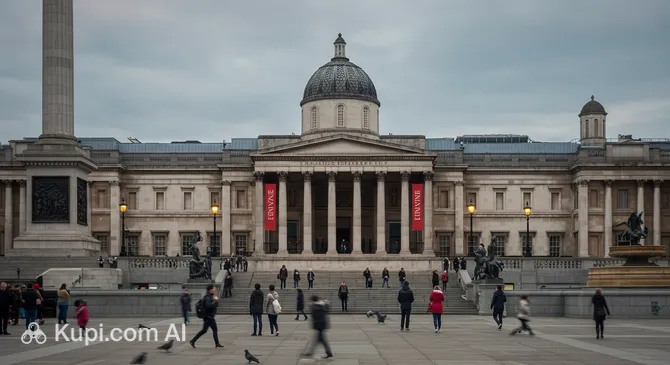
The National Gallery. Illustration.
Source: Kupi.com AI

Traveler photos:

The museum's collection is staggering in its scope: it houses more than 2,000 works of Western European painting dating from the 13th to the early 20th century. The uniqueness of the display lies in its chronological order—visitors can literally walk through seven centuries of art history, witnessing its evolution from early religious panels to Impressionist masterpieces.

The National Gallery was originally established with a noble goal: to provide everyone, regardless of social status, the opportunity to see and be inspired by great works of art. This mission is still felt today, as the gallery remains a place where young artists and curious visitors alike draw inspiration by studying the works of the great masters of the past.

Contacts

To plan your visit and clarify any details, you can contact the National Gallery representatives. We recommend checking the official website for all up-to-date information, including opening hours and announcements for temporary exhibitions.

How to contactContact
AddressTrafalgar Square, London WC2N 5DN, UK
Phone number+44 20 7747 2885
Websitewww.nationalgallery.org.uk

What to Do

A visit to the National Gallery is a unique opportunity to journey through the history of Western European painting. The main feature of the exhibition is that all paintings are arranged in chronological order, allowing you to clearly trace the development of art over the centuries. You can enjoy masterpieces created by such great masters as Claude Lorrain, Titian, Rubens, Rembrandt, and many others. Must-see canvases include Vincent van Gogh's famous "Sunflowers," Jan van Eyck's "The Arnolfini Portrait," and Diego Velázquez's "The Rokeby Venus."

Among the treasures of the collection, you will find many world-famous works. Be sure to look for Sebastiano del Piombo's monumental canvas "The Raising of Lazarus," Titian's sensual "Venus and Adonis," and the dramatic "The Rape of the Sabine Women" by Rubens. Also, don't miss William Hogarth's famous satirical series "Marriage A-la-Mode," Joshua Reynolds' portrait of Lord Heathfield, and David Wilkie's picturesque "The Village Holiday." Each work tells its own story, and experiencing them leaves an unforgettable impression.

The National Gallery offers more than just independent viewing. For those who want to dive deeper into the world of art, there are regular educational programs, lectures, and themed guided tours. Participating in such events makes a visit not just an aesthetic pleasure, but a truly educational experience suitable for all categories of visitors. Additionally, you can relax in the gallery's cafe or stop by the souvenir shops to purchase books and reproductions of your favorite paintings.

Getting There

The National Gallery boasts one of the most advantageous locations in London — situated right on Trafalgar Square, in the very heart of the city. This makes it incredibly easy to reach the museum from anywhere in the capital of the United Kingdom using various modes of public transport.

The London Underground is considered the fastest and most convenient way to get there. The nearest station to the gallery is Charing Cross, served by the Bakerloo and Northern lines. Also within walking distance are Leicester Square (Northern and Piccadilly lines) and Embankment (Bakerloo, Circle, District, and Northern lines), giving tourists great flexibility in planning their route.

In addition to the Tube, Trafalgar Square is easily accessible via numerous bus routes. Stops are located on surrounding streets, including the Strand, Whitehall, and Charing Cross Road. A ride on a famous double-decker bus can be a small adventure in itself.

For those who prefer maximum comfort, taxi services are always available. Trafalgar Square is a well-known landmark for all drivers. However, it is worth noting that when traveling into the city center on weekdays, a Congestion Charge applies, which may affect the total cost of the trip.

Nearest city: London

History & Facts

The history of the National Gallery began in May 1824, when the British government made a far-sighted decision. A collection of 38 paintings was purchased from the heirs of the banker John Julius Angerstein, laying the foundation for what would become a world-renowned museum. Initially, this modest but valuable collection was housed in Angerstein's former townhouse on Pall Mall.

The collection grew at an impressive rate thanks to generous donations. In 1828, Sir George Beaumont bequeathed his collection to the gallery, and in 1830, Reverend Holwell Carr donated another 55 canvases. By 1831, the collection numbered 114 masterpieces, and it became clear that a new, more spacious home was required. Ultimately, the decision was made to build a dedicated facility on the famous Trafalgar Square.

The project for the gallery's new home was designed by architect William Wilkins. Materials from the demolished Royal Mews, which previously stood on the site, were used in the construction. A notable detail is the eight majestic columns salvaged from the old building and integrated into the new facade. The gallery officially opened in its current building on April 9, 1839, in the presence of Queen Victoria. Interestingly, the National Gallery initially occupied only the west wing, while the eastern part was allocated for other purposes.

Time Needed

When planning a visit to the National Gallery, it's worth considering the sheer scale of its collection. To properly familiarize yourself with the main exhibits, it is recommended to set aside 2 to 4 hours. This will be enough time to leisurely walk through the halls, appreciate the evolution of painting, and see the most famous canvases. Given that the gallery houses over 2,000 works of art, this time frame will allow you to get a comprehensive impression without feeling rushed.

If your time is limited, you can focus on the key masterpieces. Such an express tour will take about 1.5–2 hours. During this time, you will have enough time to see world-famous works like Van Gogh's "Sunflowers" or van Eyck's "The Arnolfini Portrait." However, true art lovers wishing to deeply immerse themselves in art history and study the collection in detail should plan for a full day or even several visits.

Working Hours

The National Gallery in London is open to visitors year-round, making it accessible almost any time. Standard opening hours are daily from 10:00 to 18:00, and on Fridays, the gallery stays open later, until 21:00. This allows tourists to plan their visit for either daytime or evening. The gallery is closed only a few days a year: January 1st and December 24th through 26th.

Entry to the National Gallery to view the permanent collection is free for everyone, and advance booking is usually not required. However, a paid ticket may be needed for temporary exhibitions. To avoid queues during peak hours, it is recommended to book a free timed entry ticket online via the official website. This guarantees quick entry and provides you with the most up-to-date information for your visit. For a more in-depth experience, you can use a guided tour service or purchase an audio guide.

DayOpening hours
Monday10:00 – 18:00
Tuesday10:00 – 18:00
Wednesday10:00 – 18:00
Thursday10:00 – 18:00
Friday10:00 – 21:00
Saturday10:00 – 18:00
Sunday10:00 – 18:00

Nearby

A visit to the National Gallery is just one part of an exciting journey through central London. Thanks to its location on Trafalgar Square, the museum is surrounded by many other iconic sites that are easily reachable on foot. Exploring the surrounding area will allow you to dive deeper into the city's atmosphere and make your visit even more rewarding and memorable.

Just a few steps from the gallery, a vibrant district begins, full of historical monuments, cultural centers, theaters, and cozy establishments. A stroll through these places is a great way to complement the impressions of the great works of art seen in the museum and to feel the true rhythm of London life.

NameDistance
Trafalgar Square0.1 km
Covent Garden0.5 km
Salsa Temple1 km
The British Museum1.2 km
The Wallace Collection1.9 km
Imperial War Museum2 km
Mercato Metropolitano2.4 km

Have you reached the end of the page?

So the route has been studied inside and out