Support

Trafalgar Square

About

Trafalgar Square is one of the most famous and bustling attractions in not only London but the entire United Kingdom. It is the true heart of the city, located in the historic district of Westminster, where three major streets intersect: the Strand, Whitehall, and the Mall. The square serves not only as a meeting place and a magnet for tourists but also as an important stage for city-wide events and celebrations. It is considered the geographical center of London, from which all distances are measured.
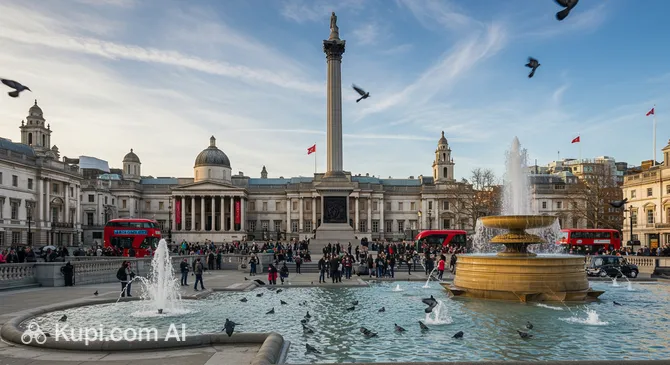
Trafalgar Square. Illustration.
Source: Kupi.com AI

Traveler photos:

The centerpiece of the square is the majestic Nelson's Column, erected in 1843 to commemorate the victory at the Battle of Trafalgar. It is surrounded by the famous fountains and bronze lions that have become symbols of this location. The square's spacious area, which is impressively large, allows guests to comfortably enjoy the architectural ensemble and unique atmosphere.

Besides its cultural and historical significance, Trafalgar Square is an important transport hub. It is easily accessible via Charing Cross tube station, making it an ideal starting point for exploring central London. The National Gallery and other iconic landmarks are in the immediate vicinity, so a visit to the square can easily be integrated into any tourist itinerary.

Contacts

Trafalgar Square is a public space and is open to visitors 24/7, so it does not have a single contact center for tourists. For all the latest information on events and temporary changes in access, it is best to check the official tourism website of London. Reaching the square is very easy: the nearest tube station is Charing Cross, with exits leading directly to the attraction. Many bus routes also serve the area.

How to contactContact
AddressTrafalgar Sq, London WC2N 5DS, UK
Phone number+44 20 7983 4750
Websitewww.london.gov.uk

What to Do

A visit to Trafalgar Square is an opportunity to touch the history and culture of London. The main thing that catches the eye is, of course, Nelson's Column, rising in the very center. It is guarded by four majestic bronze lion statues, which were installed about two decades after the column itself. This is a favorite spot for photos: many tourists try to capture themselves next to one of these famous guardians.

In addition to the central monument, you can see other interesting statues in the square. In the northeastern part, there is an equestrian statue of King George IV, and at the corners of the square are statues of generals Sir Charles James Napier and Sir Henry Havelock. A special atmosphere is created by two large fountains located on either side of Nelson's Column. In the evening, they are beautifully illuminated, turning the square into a truly magical place.

Trafalgar Square is not just a collection of monuments but a vibrant public space where life is always in full swing. You can often find street musicians and artists here, while tourists and locals relax on the steps leading up to the National Gallery. The square traditionally serves as the main stage for city celebrations, festivals, and various events, just as architect John Nash intended. For example, the country's main Christmas tree is set up here, and Chinese New Year is celebrated.

Getting There

Getting to Trafalgar Square is exceptionally easy thanks to its location in the heart of London, in historic Westminster. The square is a major transport hub where three famous streets—the Strand, Whitehall, and the Mall—converge. This central position makes it easily accessible from anywhere in the city and a convenient starting point for walks to other iconic sites like Buckingham Palace, Big Ben, or Covent Garden.

The fastest and most convenient way to reach the square is by using the London Underground (the Tube). The nearest station, Charing Cross, serves the Bakerloo and Northern lines, and one of its exits leads directly onto the square. This eliminates the need for a long search for the right direction after leaving the station. Other stations are also within a few minutes' walk: Leicester Square and Piccadilly Circus, providing travelers with additional flexibility when planning their route.

In addition to the tube, many of London's famous red double-decker buses serve Trafalgar Square. Dozens of routes, including Nos. 9, 11, 15, 24, 29, 87, and others, stop directly at or in the immediate vicinity of the square. A bus ride is a great opportunity not only to get to your destination but also to enjoy the views of central London. Charing Cross railway station is also located nearby, with trains departing to the southeastern regions of England.

Nearest city: London

History & Facts

The history of Trafalgar Square dates back to the 13th century, when King Edward I ordered a cross to be erected on this site in memory of his wife, Eleanor of Castile. However, in those days, the place had a darker reputation: public punishments and even executions were held here, and a whipping post stood nearby for lawbreakers. This contrast between royal memorial and harsh justice makes the square's early history particularly intriguing.

The square began to take on its modern appearance in the early 19th century. Previously, the Royal Mews were located here, and after their demolition, the area became a vacant lot. In 1820, King George IV commissioned the famous architect John Nash to transform the area. Interestingly, the funds for this large-scale construction were raised by public subscription among the citizens themselves, making the project a truly "people's" endeavor. The square was originally intended to be named after King William IV, but it eventually received its current name—Trafalgar—in honor of Britain's famous naval victory at the Battle of Trafalgar in 1805.

The completion of the ambitious project after Nash's death fell to architect Charles Barry. It was under his leadership that the central monument, Nelson's Column, was erected in 1843, becoming an integral part of the ensemble. Later, in 1910, at the request of King Edward VII, the architectural look of the square was complemented by a magnificent building that semi-circled one of its sides, lending it even more grandeur.

Time Needed

For a brief introduction to Trafalgar Square, 30 minutes to one hour is usually enough. This time will allow you to stroll leisurely across the whole area, take classic photos with the bronze lions at the base of Nelson's Column, admire the fountains, and feel the dynamic atmosphere of this iconic location. Since the square is an open public space, you can spend as much time here as you like, simply relaxing on the steps or watching street performers.

However, the duration of your visit may increase significantly depending on your plans. Trafalgar Square is not just a single landmark, but a cultural hub surrounded by important sites. The most significant is the National Gallery, located at the northern end of the square. A quick look at its masterpieces will take at least 1–2 hours, while a deeper dive into art will require half a day or more. Also nearby is the church of St Martin-in-the-Fields, a visit to which will also add time to your walk.

Therefore, when planning your visit, you should base it on your interests. If you just want to check an iconic London spot off your list, a short stop is enough. But if you plan to visit at least one of the nearby museums or simply enjoy the atmosphere without rushing, it is better to set aside at least 2–3 hours or even a whole half-day for Trafalgar Square and its surroundings.

Working Hours

Trafalgar Square is a public space, so it is open 24 hours a day, year-round. You can come here at any time of the day or night to enjoy its atmosphere. Entry to the square itself is completely free, and no prior booking or registration is required to visit.

Although the square itself is always accessible, please note that various events, festivals, and public gatherings are held here regularly. During such events, access to certain parts of the square may be temporarily restricted. Therefore, if you are planning a visit, it is recommended to check the official London tourism portal in advance for any possible changes.

Nearby

Trafalgar Square's location in the heart of London makes it an ideal starting point for exploring the city. After seeing Nelson's Column and the famous lions, don't be in a rush to leave—many other iconic sites are within walking distance, and visiting them will enrich your experience of the UK capital. A walk around the neighborhood will allow you to dive deeper into the city's history and culture, discovering both world-famous museums and bustling shopping streets.

Many key attractions are located so close that you can easily reach them on foot. This is a great opportunity to see more than just tourist facades and feel the real rhythm of London life. Below is a list of interesting places located very close to the square.

NameDistance
The National Gallery0.1 km
Covent Garden0.6 km
Salsa Temple1 km
The British Museum1.3 km
Imperial War Museum1.9 km
The Wallace Collection2 km
Mercato Metropolitano2.3 km

Have you reached the end of the page?

So the route has been studied inside and out