Support

Washington Monument

About

The Washington Monument is a majestic white obelisk rising in the heart of Washington, D.C., on the National Mall, between the Capitol and the White House. This monument, officially named the "Washington National Monument," was erected to honor George Washington, the first president of the USA. As the tallest structure in the city and the world's tallest obelisk, it reaches a height of 169 meters and is visible from almost any point in the capital.

The monument is a giant hollow column built of granite and faced with Maryland marble, with a total weight of about 91,000 tons. Locals sometimes affectionately call it "the pencil" because of its distinctive shape. If you look closely, you can see a slight difference in the shade of the marble at approximately the 46-meter mark—this is the point where construction was halted for several decades due to a lack of funds and the Civil War. At the top of the obelisk sits a small aluminum pyramid, on the east side of which the Latin phrase "Laus Deo" is inscribed, meaning "Praise be to God."
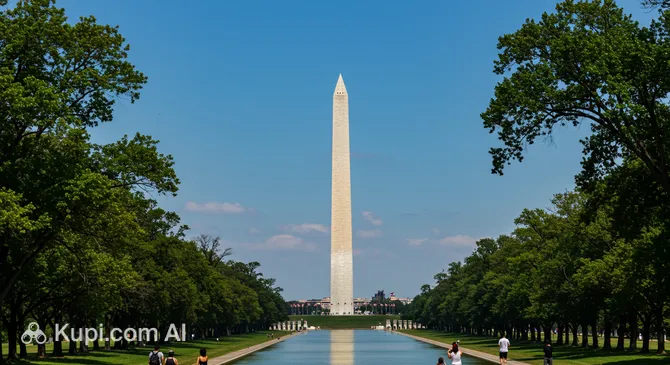
Washington Monument. Illustration.
Source: Kupi.com AI

Traveller photos:

One of the most attractive features of the monument is the opportunity to climb to its top. Inside is an elevator that takes visitors to the observation deck, as well as a staircase of 896 steps. From the top, a breathtaking panoramic view of the city opens up, including iconic landmarks like the Lincoln Memorial, the White House, and the Capitol building.

Contacts

For the most up-to-date information regarding operating hours, special events, and visitor policies for the Washington Monument, it is best to consult official sources. The monument is managed by the U.S. National Park Service. Below are the primary contact details.

How to contactContact
Address2 15th St NW, Washington, DC 20024, USA
Phone+1 202-426-6841
Websitewww.nps.gov

What to Do

The main reason to visit the Washington Monument is, of course, the chance to ascend to the top. A modern elevator takes visitors to the observation deck, and the ride itself is a bit of an adventure, featuring a video about the landmark. Energetic tourists can also choose to climb the stairs, which consist of 896 steps. From a bird's-eye view, you'll see one of the best panoramas of Washington, allowing you to see the city's layout and its key landmarks, including the Capitol and the White House, in great detail.

The journey up is more than just an ascent. Inside the monument, the walls are adorned with commemorative stones that were donated by various states, cities, individuals, and organizations during the construction period. Thus, as you ride the elevator, you can get acquainted with a unique internal exhibition telling the story of the creation of this grand structure and the people who contributed to its construction.

The area around the monument, which is part of the National Mall, also serves as a hub of activity. Various city festivals, concerts, and public events are often held here, especially during the warmer months. You can combine a visit to the monument with a stroll through the park or participation in one of these events, making your visit even more fulfilling and memorable.

Getting There

Getting to the Washington Monument is quite simple thanks to its location in the heart of Washington, D.C.. The monument is situated on the National Mall, within walking distance of many other key landmarks in the USA capital, making it a convenient stop on any tourist itinerary.

The most convenient way to reach the monument is by using public transportation. The metro is the preferred option. The closest stations to the attraction are Smithsonian and Federal Triangle, served by the Blue, Orange, and Silver lines. From either of these stations, you can walk to the base of the obelisk in about 10–15 minutes. Additionally, numerous city buses stop near the National Mall, including the DC Circulator routes, which are also a great alternative.

If you prefer a more comfortable mode of transport, you can use taxis or popular rideshare services, which are widely available throughout the city. Driving is also possible; however, keep in mind that finding parking in the immediate vicinity of the monument can be difficult, especially during the peak tourist season.

Nearest city: Washington, D.C.

History & Facts

The history of the Washington Monument is a story of national respect for the first president of the USA. The idea of creating a memorial to George Washington emerged shortly after his death, but actual construction didn't begin for decades. In 1836, a design competition was held, and architect Robert Mills was chosen as the winner. Construction, funded largely by donations from ordinary citizens, began with a grand ceremony on July 4, 1848, Independence Day. This day was full of symbolism: the cornerstone of the obelisk was laid with the same trowel George Washington himself used when laying the foundation of the Capitol.

The construction of the monument stretched over 36 years and was not completed until 1884. The process was interrupted for two decades due to a lack of funds and the effects of the Civil War. This break is still visible today: if you look closely, you can see that the marble facing above the 46-meter mark has a slightly different shade. This happened because when work resumed, the stone had to be sourced from a different quarry. At the cornerstone ceremony, Speaker of the House Robert Winthrop called on Americans to build a monument that would "express the gratitude of the entire American people," and despite all the difficulties, that call was answered.

The Washington Monument holds many curious facts. For example, until the completion of the Eiffel Tower in 1889, it held the title of the tallest structure on Earth, standing at 169 meters. On the aluminum capstone at the peak of the obelisk, the Latin phrase "Laus Deo" is engraved, which translates to "Praise be to God." Despite its immense historical and cultural significance for Washington, D.C. and the entire country, the monument has not been included in the UNESCO World Heritage list, which surprises many visitors.

Time Needed

For a complete visit to the Washington Monument, including the ascent to the observation deck, you should plan for about 1 to 2 hours. This timeframe accounts for several stages: passing through security, potentially waiting in line for the elevator, the ascent and descent itself, and time spent at the top. During peak tourist season or on weekends, waiting can take up a significant portion of your time, so it is recommended to arrive slightly before the time indicated on your ticket.

The main part of the visit takes place at the observation deck at a height of approximately 152 meters. From here, breathtaking panoramic views of Washington, D.C. open up, and you will have enough time to enjoy them and take photos. Additionally, during the elevator descent, you will be able to see some of the commemorative stones set into the interior walls of the obelisk. If you are short on time, you can simply view the monument from the outside and walk along the adjacent National Mall, which will take no more than 30–40 minutes.

Working Hours

The Washington Monument is open to visitors year-round, except for certain holidays and maintenance days, such as December 25 and July 4. Standard operating hours are from 9:00 AM to 5:00 PM daily. During the summer season, from June to August, hours may be extended until 10:00 PM, but it is recommended to check this information on the official website as schedules can change. It is also worth noting that the monument closes for scheduled maintenance one day per month.

Visiting the monument's observation deck is free, but a ticket is required for entry. It is highly recommended to book tickets in advance online through the official portal (recreation.gov), as quantities are limited and they sell out quickly, especially during the tourist season. A small service fee is charged for online bookings. There is also an option to obtain free same-day tickets at the Washington Monument Lodge box office, which opens at 8:45 AM, but in this case, you should be prepared for long lines that begin forming early in the morning.

9:00 – 17:00

Nearby

Visiting the Washington Monument is just one part of the experience this area has to offer. The monument is located right in the center of the National Mall, making it an ideal starting point for exploring other iconic landmarks in the USA capital. A walk around the neighborhood will allow you to dive deeper into the country's history and culture, as many world-famous museums and memorials are literally just steps away.

Due to its central location, the monument is surrounded by a constellation of attractions. By planning a short walking route, you can see the key symbols of Washington, D.C. in a single day. Below is a list of interesting places located in the immediate vicinity of the obelisk.

NameDistance
National Mall0.2 km
National Museum of African American History and Culture0.3 km
United States Holocaust Memorial Museum0.4 km
World War II Memorial0.5 km
Smithsonian National Museum of American History0.5 km
National Museum of Natural History0.8 km
Thomas Jefferson Memorial0.9 km

Reached the bottom of the page?

Looks like you know this route inside out