Support

Hanoi Opera House

About

The Hanoi Opera House is not just a theater, but a true architectural gem and one of the primary cultural symbols of Hanoi. Located in the heart of Vietnam's capital, this majestic building is a striking example of French colonial heritage. Its construction in the early 20th century was a significant event, giving the city one of the most luxurious structures in all of Indochina.
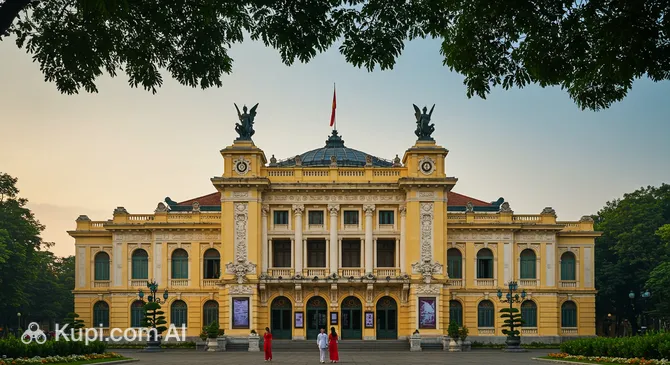
Hanoi Opera House. Illustration.
Source: Kupi.com AI

Traveler photos:

The theater's architecture was inspired by the famous Palais Garnier in Paris, which is evident in its neoclassical features and elegant facade. The interior decoration is stunning: visitors are greeted by a monumental marble staircase, while the halls are adorned with huge mirrors and sparkling crystal chandeliers. Every detail of the interior, from the gilded elements to the velvet seats, creates an atmosphere of solemnity and sophistication.

Today, the Hanoi Opera House is not only a historical monument but also a lively cultural center. Its stage hosts not only opera and ballet productions but also classical and contemporary music concerts, national shows, and important city events. A visit to the theater offers a unique opportunity not only to enjoy the arts but also to touch history and feel the spirit of old Hanoi.

Contacts

If you are planning to attend a performance, wish to find the current schedule, or have any other questions, you can contact the Hanoi Opera House administration. All necessary contact information is provided below.

How to contactContact
Address1 Tràng Tiền, Phan Chu Trinh, Hoàn Kiếm, Hà Nội, Vietnam
Phone number+84 24 3933 0113
Websitehanoioperahouse.org.vn

What to Do

A visit to the Hanoi Opera House offers guests of Hanoi several engaging leisure options. The primary activity is, of course, watching performances. The theater's repertoire is extremely diverse: here you can enjoy productions of classical music, opera, and ballet, as well as modern theatrical shows. Symphony orchestras regularly perform on its stage, and national and international arts festivals are also held here, providing a unique chance to get acquainted with the cultural life of Vietnam and see performances by top local and foreign artists.

For those more interested in history and architecture, the Hanoi Opera House offers tours of the building. During such a tour, you can examine the luxurious interior decoration in detail: the famous marble staircase, richly decorated halls with stucco molding, antique mirrors, and crystal chandeliers. This is a wonderful opportunity not only to take impressive photographs but also to immerse yourself in the atmosphere of the early 20th century while learning more about the history of this magnificent structure's creation. A visit to the theater, whether for a performance or a tour, will be one of the most memorable cultural experiences in the capital.

Getting There

Getting to the Hanoi Opera House is easy, as it is conveniently located in the very heart of Hanoi. The theater is situated on August Revolution Square, just a few minutes' walk from iconic landmarks such as Hoan Kiem Lake (Lake of the Returned Sword) and the Old Quarter. If you are staying in this area, the best way to reach the theater is on foot, allowing you to soak in the city's atmosphere. For travel from further away, you can use a taxi or popular ride-hailing services in Vietnam, such as Grab.

For those who prefer public transport, there are several bus stops near the opera house, making it accessible from various parts of the city. Numerous bus routes pass through this area, including Nos. 02, 49, and 86. You can also use the tourist hop-on-hop-off double-decker bus, which stops right by the theater. The building itself is hard to miss thanks to its majestic French colonial-style facade and its location at the intersection of major streets.

Nearest city: Hanoi

History & Facts

The history of the Hanoi Opera House is a fascinating tale of cultural fusion and engineering. Built by the French colonial administration from 1901 to 1911, architects Broyer, V. Harley, and Francois Lagisquet modeled the project after the famous Palais Garnier in Paris, adapting its design to local conditions. One of the most remarkable facts is related to the construction site: the building was erected on the site of a former pond. To stabilize the soft ground, builders had to carry out extensive drainage work and install approximately 30,000 bamboo piles for the foundation.

The theater's grand opening took place on December 9, 1911, and it immediately became the center of Hanoi's cultural and social life. During the colonial period, its stage primarily hosted French and Italian performers, with a repertoire catering to a European audience. The building was more than just a venue for performances; it was a symbol of French influence in Indochina, striking contemporaries with its luxury and scale. For early 20th-century Hanoi, it was a truly grand structure.

After 1945, the theater's role changed: it became a venue for important state and political events, and works by Vietnamese authors began to be staged there. The building was even equipped with a siren to warn of air raids. To preserve this unique architectural monument, a large-scale restoration was carried out between 1995 and 1997. Today, the Hanoi Opera House shines once again in all its glory, serving not only as a leading stage for academic arts but also as one of the most attractive tourist sites in Hanoi.

Time Needed

When planning a visit to the Hanoi Opera House, it is worth noting that the time required depends directly on your goals. If you only want to see the architecture and take some beautiful photos, you will need about 1–2 hours to explore the building. This is enough time to appreciate the grandeur of the facade and admire the luxurious interiors. For a deeper immersion, there are organized guided tours that usually last about an hour and a half, allowing you to learn more about the theater's history and decor.

If your goal is to enjoy a cultural event, be prepared to dedicate more time to the opera. Attending a play, concert, or ballet will take from 2 to 3 hours, depending on the duration of the performance itself. It is recommended to arrive early to find your seats without rushing, enjoy a cup of coffee, and soak in the formal atmosphere. In this case, it is best to set aside at least three hours for your visit to ensure the evening is as comfortable as possible and leaves only pleasant impressions.

Working Hours

The Hanoi Opera House does not have standard daily opening hours like a museum, as its schedule depends entirely on the events being held. The building is open to visitors year-round, but indoor access is tied to specific occasions. Generally, tours of the theater's magnificent halls are conducted during the day, while the evening is the time for performances—opera, ballet, concerts, and national shows. Regular guided tours for visitors are often organized on Mondays and Fridays in the morning, approximately from 10:30 AM to 12:00 PM.

Since opening hours can change, it is highly recommended to check the current schedule on the official website of the Hanoi Opera House in advance or confirm the information by phone. This is especially important if you plan to attend a specific performance, as tickets for popular productions are best booked well in advance. Planning your visit ahead of time will help you not only choose an interesting event but also guarantee yourself a seat in one of the most beautiful theaters in Vietnam, located in the heart of Hanoi.

7:00 – 17:00

Nearby

A visit to the Hanoi Opera House is a vibrant cultural event, but a discovery of the Vietnamese capital would be incomplete without exploring its surroundings. Thanks to the theater's central location, you can easily reach many other iconic sites within walking distance. A stroll through the nearby streets will allow you to immerse yourself deeper into the city's unique atmosphere.

Starting from the opera house, you will find yourself at the epicenter of Hanoi's cultural and historical life. Both ancient landmarks and modern entertainment venues are just a few minutes' walk away. Below is a list of interesting places nearby that are worth including in your itinerary.

NameDistance
Hidden Gem Cafe1.1 km
Pizza 4P’s Bao Khanh1.1 km
MẸT Vietnamese Restaurant & Vegetarian Food1.1 km
Hoa Lo Prison1.2 km
Hanoi Old Quarter1.3 km
Acoustic Hotel & Spa Bar1.4 km
Hanoi Train Street1.6 km

Have you reached the end of the page?

So the route has been studied inside and out